The De Minimis Rule for claiming GST credit on exempt supplies allows businesses to recover input tax credits even when they make both taxable and exempt supplies.
Under this rule, GST credits on inputs related to exempt supplies can still be claimed if the value of exempt supplies remains below a specified threshold compared to total taxable and exempt supplies. This approach simplifies tax compliance by reducing the need for detailed apportionment when exempt activity is relatively small.
In practice, the rule generally applies when exempt supplies do not exceed a defined limit, such as an average monthly value of around USD 40,000 and not more than 5% of total combined taxable and exempt supplies during the relevant period.
If the exempt supplies stay within this de minimis threshold, businesses can claim full GST credits on related inputs. However, if the threshold is exceeded, GST input credits must be adjusted or apportioned accordingly to reflect the proportion of exempt usage.
What You Will Learn From This Blog
After reading this blog, you will understand:
- What the GST De Minimis Rule is and why it matters.
- How businesses can claim GST credits on exempt supplies.
- The eligibility conditions for satisfying the De Minimis Rule.
- What happens when the De Minimis provision is not satisfied.
- How to calculate allowable residual input tax.
- The importance of maintaining proper GST records.
- Benefits of the De Minimis Rule for businesses.
- The impact of the rule on business growth and profitability.
- Common mistakes businesses should avoid when claiming GST credits.
- How professional accounting support can simplify GST compliance.
When Could You Satisfy De Minimis Rule?
Claim Full Input Tax
Businesses that satisfy the De Minimis Rule can claim all input tax incurred, except for disallowed input tax under Regulations 26 and 27 of the GST (General) Regulations. This allows eligible businesses to recover more GST on business expenses.
Make Claims at the End of the Accounting Period
Claims are generally made at the end of each prescribed accounting period after confirming that the required conditions have been met. This helps ensure the claimed amount is accurate and complies with the applicable regulations.
Perform Long-Term Adjustments
Businesses must carry out long-term adjustments by applying the De Minimis tests over the required adjustment period. These reviews help ensure that previously claimed input tax remains accurate.
Benefit for Small Businesses
The De Minimis Rule is especially beneficial for small businesses with low-value exempt supplies. It reduces the need for complex input tax apportionment and improves GST recovery.
Conduct Regular Compliance Reviews
Businesses should regularly review their transactions and supplies throughout the accounting period. Ongoing monitoring helps ensure they continue to meet the required conditions for making claims.
Adjust Claims When Business Circumstances Change
If there are significant changes in taxable or exempt supplies, businesses must revise their input tax claims accordingly. Timely adjustments help maintain compliance with GST requirements.
Reduce the Risk of Errors and Penalties
Regular monitoring ensures businesses claim the correct amount of GST and avoid over-claims. It also helps reduce the risk of penalties, audits, and compliance issues.
Maintain Proper Records
Businesses should keep complete and accurate records of transactions, invoices, and supporting documents. Well-maintained records make the review and verification process much easier.
Check Eligibility Regularly
Eligibility should be reviewed for every prescribed accounting period rather than assumed from previous periods. Regular assessments help ensure that claims continue to meet the required conditions.
When Could You Not Satisfy De Minimis Rule?
In case we find the De Minimis rule not satisfactory, then one could not directly make claims for input type of taxation. They attribute it directly to creating exempt supplies.
Regarding input tax, we do not consider it as attributed directly to exempt or taxable supplies. We can compute the amount to claim using this formula. Total allowable residual input tax would be equivalent to residual input tax multiplied by the value of the supplies taxable, divided by the value appropriating to the total supplies.
To compute the allowable input tax in this scenario, businesses must use an apportionment formula. The total allowable residual input tax is calculated by multiplying the residual input tax by the ratio of taxable supplies to total supplies.
This method ensures that only the appropriate portion of input tax is claimed based on the taxable activity, ensuring compliance with GST regulations. Adjustments must be made if the business’s taxable or exempt supplies change during the accounting period to ensure the claim remains accurate.
The Importance of the De Minimis Rule for Businesses
Simplifies GST Credit Claims
The De Minimis Rule allows businesses to claim GST credits for inputs related to exempt supplies if they fall below a set threshold, simplifying the claim process.
Reduces Administrative Burden
It lowers the need to track each input tax claim separately for taxable and exempt supplies, easing the overall administrative workload.
Improves Cash Flow
By reclaiming GST on inputs, businesses can reduce costs, improving cash flow and providing more funds for other operations.
Minimizes Errors in Tax Calculation
The rule reduces errors by offering a straightforward method for claiming credits, lowering the risk of tax disputes or penalties.
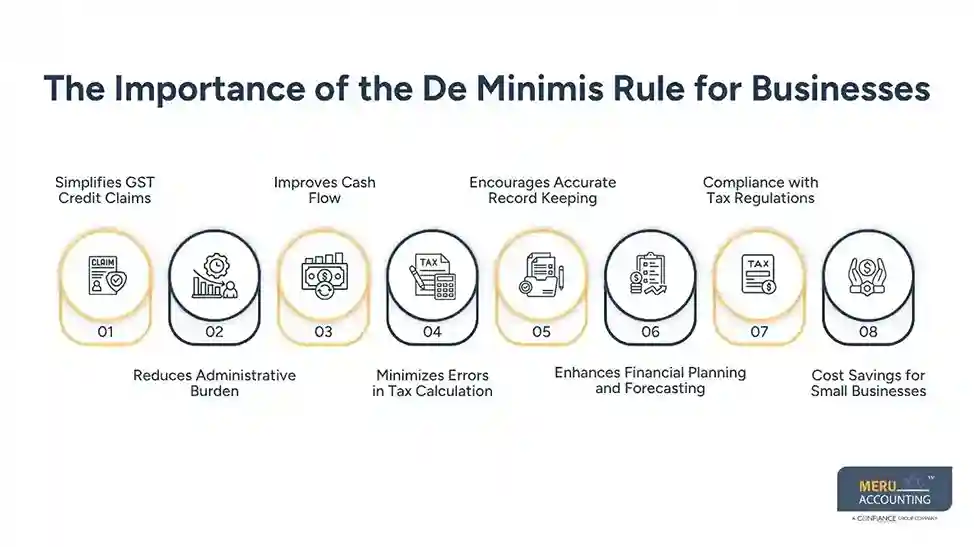
Encourages Accurate Record Keeping
Businesses need to track exempt and taxable supplies accurately, promoting better financial management and clearer bookkeeping.
Enhances Financial Planning and Forecasting
The predictability of GST-related costs helps businesses plan and allocate resources more effectively for future growth.
Compliance with Tax Regulations
The De Minimis Rule ensures businesses stay compliant with tax laws, avoiding audits and penalties while simplifying the claiming process.
Cost Savings for Small Businesses
Small businesses benefit by saving on administrative costs associated with complex tax calculations, especially in sectors with frequent exempt supplies.
Impacts of the De Minimis Rule on Business Growth
Lower Operational Costs
By simplifying GST input tax credit claims, the De Minimis Rule reduces administrative costs, allowing businesses to allocate resources toward growth initiatives.
Improved Cash Flow
The ability to reclaim GST on exempt supplies helps free up cash, providing more funds for reinvestment in expansion, marketing, or product development.
Better Resource Allocation
With reduced complexity in tax compliance, businesses can focus on core operations, simplifying decision-making and improving efficiency across departments.
Increased Profitability
Reducing the tax burden on exempt supplies directly contributes to improved profitability, as businesses can keep more of their revenue for reinvestment.
Enhanced Competitiveness
By lowering costs and improving efficiency, the De Minimis Rule helps businesses offer more competitive pricing and gain an edge in the market.
Support for Innovation
Freed-up resources and improved cash flow can be directed toward research and development, fostering innovation and the introduction of new products or services.
Attractiveness to Investors
Businesses benefiting from streamlined tax compliance and higher profitability are more likely to attract potential investors and partnerships, aiding in long-term growth.
Encouragement for SME Growth
The De Minimis Rule provides smaller businesses with the flexibility to manage their finances better, enabling them to scale up and compete with larger organizations effectively.
Simplified Compliance Processes
By reducing the complexities involved in GST reporting and credit claims, the De Minimis threshold minimizes errors and administrative burdens, ensuring smooth operations and allowing businesses to focus on strategic goals.
How Meru Accounting Helps Businesses Claim GST Credit Under the De Minimis Rule
Understanding GST regulations and correctly applying the De Minimis Rule can be challenging, especially for businesses that make both taxable and exempt supplies. Even small calculation errors may result in incorrect GST claims, compliance issues, or missed tax-saving opportunities.
At Meru Accounting, we help businesses simplify GST compliance through accurate bookkeeping, GST return preparation, and input tax credit management. Our accounting professionals review taxable and exempt supplies, determine eligibility under the De Minimis provision, calculate allowable input tax credits, and ensure that all claims comply with applicable GST regulations.
Our services include:
- GST registration and compliance support
- Input tax credit calculation and review
- GST return preparation and filing
- Tax apportionment for mixed supplies
- Financial record maintenance for GST audits
- Regular GST health checks and compliance reviews
- Assistance with long-term input tax adjustments
- Professional guidance on GST planning and reporting
With Meru Accounting, businesses can reduce compliance risks, maximize eligible GST credits, and maintain accurate financial records while focusing on business growth.
optional anymore
on running the business
Our Expert Perspective
The De Minimis Rule can help businesses maximize eligible GST input tax credits while simplifying compliance, but only when the qualifying thresholds are carefully monitored. Maintaining accurate records, reviewing GST positions regularly, and applying the correct apportionment method are essential for avoiding errors. Professional accounting support ensures businesses remain compliant while optimizing their GST input tax credit claims.
Key Takeaways
- The De Minimis Rule allows eligible businesses to claim GST credits even when they make exempt supplies.
- Businesses must satisfy specific thresholds before claiming full GST input tax.
- Input tax directly related to exempt supplies cannot be fully claimed if the De Minimis provision is not met.
- Residual input tax should be apportioned based on the ratio of taxable supplies to total supplies.
- Regular accounting period reviews help ensure continued compliance.
- Proper bookkeeping and GST documentation are essential for successful GST claims.
- The rule reduces administrative complexity and improves business cash flow.
- Small businesses often benefit significantly from simplified GST credit recovery.
- Accurate GST calculations help avoid penalties and tax disputes.
- Professional accounting support improves GST compliance and maximizes eligible tax credits.
FAQs
The De Minimis Rule allows eligible businesses to claim GST input tax credits even when they make exempt supplies, provided their exempt supplies remain below the prescribed threshold.
Businesses that make both taxable and exempt supplies can benefit if their exempt supplies remain within the qualifying limits during the prescribed accounting period.
Businesses cannot claim full GST credits on exempt-related inputs. Instead, they must apportion residual input tax according to GST regulations.
Businesses must assess their eligibility at the end of each prescribed accounting period and perform any required long-term adjustments.
No. Disallowed input taxes under applicable GST regulations cannot be claimed even if the business satisfies the De Minimis Rule.