
In 2026, global companies are changing how they manage financial work. Many firms now prefer a dedicated accountant instead of building large in-house finance teams. This shift is driven by cost pressure, skill shortages, and the need for more steady financial control.
A professional handling accounting from offshore locations brings structured reporting, regular updates, and better financial clarity. This approach is not only about reducing cost but also about improving accuracy and lowering internal workload. Many firms also combine this model with dedicated staff support to manage daily accounting tasks in a more organized way.
In this blog, we will understand why this change is happening, what benefits it brings, and how businesses are using offshore accounting support in 2026.
What You Will Learn From This Blog
- Why is offshore accounting demand rising in 2026
- How a dedicated accountant differs from in-house hiring
- Benefits of using offshore dedicated accountant services
- Role of dedicated staff in accounting work
- Industries using offshore accounting services
- Common challenges in offshore accounting teams
- How Meru Accounting supports global clients
- Key insights for better financial decision-making
Offshore Accounting Trends In 2026
Growing Demand For Remote Finance Models
Businesses are shifting to remote financial systems where a dedicated accountant manages books from offshore locations. This reduces hiring delays and improves workflow speed.
Rise Of Specialized Accounting Roles
General accounting roles are no longer the preferred choice in many companies. Professionals or dedicated staff are now assigned to specific functions such as payroll, reporting, or tax work, which brings more accuracy and focused output.
Use of Cloud-Based Accounting Tools
Cloud platforms allow real-time access to financial data across teams. Accuracy improves as manual errors are reduced and financial information stays updated without delays.
Cost Optimization Strategies
Fixed costs are being reduced through offshore staffing models instead of in-house teams. Salary expenses, office overheads, and training costs become easier to manage, while monthly budgeting gains better control.
Global Talent Access Expansion
Companies are now hiring accounting professionals from different regions to access skilled talent at flexible pricing. Expertise that may not be available locally becomes easier to source through global hiring models.
Why Businesses Prefer A Dedicated Accountant Over In-House Hiring
Focused Financial Attention
A professional working on assigned financial tasks brings stronger focus and clarity to accounting work. Errors reduce when attention is not divided across multiple responsibilities in internal teams. Regular tracking of financial records ensures timely updates across all accounting activities.
Lower Hiring And Training Costs
Companies avoid high recruitment costs by choosing a dedicated accountant supported by dedicated staff instead of building full-time departments. Elimination of long onboarding cycles reduces both time and training expenses for finance teams.
Faster Reporting Cycles
Financial reports are prepared on time, helping management make quicker decisions. Timely reporting improves financial planning and allows faster response to business changes.
Better Resource Allocation
Routine financial tasks can be assigned to support teams while core accounting work is handled separately. Clear division of responsibilities increases productivity across accounting operations.
Reduced Compliance Risks
Structured processes lower the chances of missed filings and penalties. Regulatory deadlines are tracked systematically to maintain full compliance accuracy.
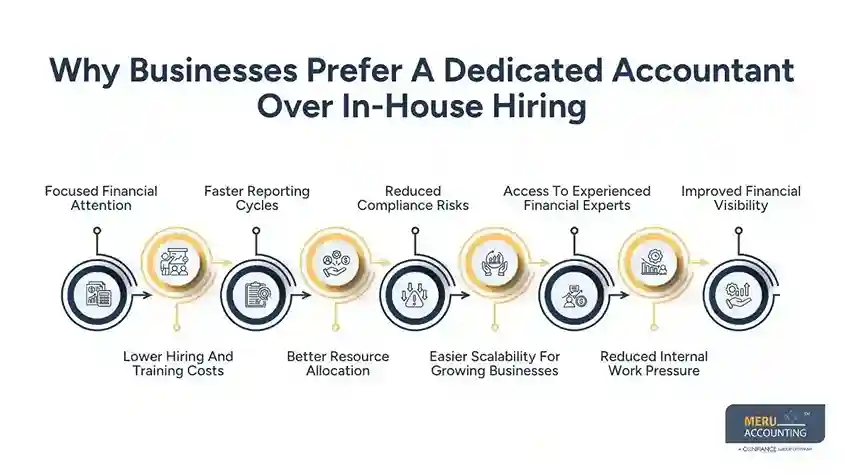
Easier Scalability For Growing Businesses
Accounting workloads can be expanded or reduced without hiring large internal teams. Business changes are managed smoothly without restructuring finance departments.
Access To Experienced Financial Experts
Professionals with exposure to multiple industries bring stronger financial knowledge. This experience improves reporting quality and supports better decision-making.
Reduced Internal Work Pressure
Finance-related responsibilities are handled externally, allowing internal teams to focus on core business activities. This balance creates smoother day-to-day operations.
Improved Financial Visibility
Financial data is organized in a clear structure for easier review. Better clarity in records helps management understand cash flow and expense patterns more effectively.
Role of Dedicated Staff In Modern Accounting Operations
Support in Daily Bookkeeping
Invoice entry, expense tracking, and bank reconciliation are managed by support teams, allowing accounting work to stay organized and accurate. Regular updates ensure financial records remain current without delays.
Data Preparation and Sorting
Financial data is cleaned and arranged before report creation begins. Proper structuring of records reduces correction time during reporting cycles and improves overall accuracy.
Coordination With Clients
Dedicated staff often act as support units, ensuring smooth communication between clients and the dedicated accountant. Clear communication flow helps avoid misunderstandings in financial instructions and updates.
Managing Accounting Software
Accounting tools like QuickBooks and Xero are maintained to ensure updated financial information is always available for review. Proper handling of software systems allows real-time access to entries and records with better accuracy.
Error Checking And Basic Review
Basic errors are identified early through structured review processes before final financial reporting. Early detection of mistakes reduces the chances of reporting issues at later stages.
Key Benefits of Hiring a Dedicated Accountant For Offshore Work
Cost Efficiency In Operations
Reduced overhead costs come from eliminating office space and local hiring expenses. Lower operational spending allows businesses to allocate more budget toward growth activities.
Improved Financial Accuracy
Focused work leads to more accurate financial statements. Regular review of entries reduces the chances of errors in reporting cycles.
Time Zone Advantage
Offshore teams working in different time zones allow continuous accounting updates. Round-the-clock progress helps businesses receive faster financial updates.
Scalability For Businesses
Companies can expand accounting capacity by adding professionals without restructuring internal teams. Flexible scaling supports seasonal workload changes without operational disruption.
Access to Skilled Professionals
A dedicated accountant often brings experience from multiple industries, improving financial insight. Diverse exposure improves decision quality across complex accounting situations.
Industries Benefiting From Dedicated Accountant Services
E-Commerce Businesses
Online stores use a dedicated accountant to manage high transaction volumes and sales tracking. Daily sales reconciliation becomes easier with structured accounting support.
Real Estate Companies
Property firms rely on accounting support for rent tracking, asset management, and compliance. Regular reporting helps maintain clear visibility of property income and expenses.
Healthcare Sector
Hospitals and clinics use dedicated staff for billing and insurance claims processing. Accurate billing systems reduce delays in reimbursement processes.
IT And SaaS Companies
Tech firms depend on accounting professionals for subscription revenue tracking and reporting. Recurring revenue models become easier to manage with structured financial input.
Hospitality Industry
Hotels and restaurants use accounting support for expense control and revenue planning. Seasonal revenue tracking helps maintain stable financial planning across the year.
Challenges in Managing Offshore Dedicated Accountant Teams
Communication Gaps
Working across different time zones may create small delays in communication. Clear reporting schedules help reduce misunderstandings in task execution.
Data Security Concerns
Strong access control systems are required to protect sensitive financial data when working with offshore teams. Companies must ensure secure login systems and controlled access to accounting information.
Quality Control Issues
Without proper systems, output from a dedicated accountant may vary in quality. Regular review processes help maintain consistent reporting standards.
Cultural And Process Differences
Different working styles may affect coordination between teams working on accounting tasks. Standard operating procedures help align expectations and improve task consistency across groups.
Dependency On Technology
Accounting work handled by dedicated staff relies heavily on software systems, so system downtime can affect workflow. Backup systems and cloud-based tools reduce disruption during technical issues.
Offshore Dedicated Accountant Services by Meru Accounting
Structured Accounting Process
Meru Accounting provides trained professionals who follow a structured financial system for global clients. Standardized workflows ensure consistency across all accounting tasks and reporting activities.
Skilled Offshore Teams
We offer support teams who assist with bookkeeping, payroll, and reporting tasks with accuracy. Team coordination improves speed and reduces manual workload pressure.
Multi Software Expertise
Accounting professionals at Meru Accounting work on tools like QuickBooks, Xero, and Zoho Books. Software flexibility allows smooth adaptation to different client systems and requirements.
Industry-Based Solutions
Assignments are made based on industry needs such as real estate, IT, or healthcare. Sector-focused experience helps in handling specific accounting challenges more effectively.
Secure Data Handling
Strong systems are used to protect data shared with each dedicated accountant and dedicated staff team. Encryption and controlled access reduce risks in financial data sharing.
Our Expert Perspective
From our offshore accounting engagements across multiple industries, a clear pattern is observed where businesses move to dedicated accountant models to maintain continuous financial control without expanding in-house teams. A skilled accountant managing offshore work ensures structured daily updates, which directly reduce errors during month-end closing.
When dedicated staff is combined with offshore accountants, accounting workflows become more structured, as routine data entry is separated from financial review. This operating model consistently results in improved reporting clarity and fewer last-minute adjustments in financial statements.
Key Takeaways
- Offshore accounting demand is growing in 2026
- A dedicated accountant provides focused and structured financial work
- Dedicated staff support daily bookkeeping and data preparation
- Businesses reduce costs and improve accuracy with offshore models
- Industries like IT, healthcare, and real estate benefit most
- Proper systems are needed to manage offshore teams well
- Meru Accounting offers structured offshore accounting services
FAQs
Businesses prefer offshore accounting support in 2026 to reduce costs, improve accuracy, and access skilled professionals without expanding in-house finance teams.
A dedicated accountant manages bookkeeping, payroll, reporting, and compliance tasks with full focus on assigned financial work.
Hiring a dedicated accountant is often preferred because it reduces fixed costs and provides more focused financial control compared to in-house hiring.
Support teams handle data entry, bookkeeping tasks, and financial preparation so reporting becomes smoother and more organized.
Small businesses, e-commerce companies, IT firms, and real estate businesses commonly use offshore accounting services due to cost savings and efficiency.