
A dedicated bookkeeper is becoming a preferred choice for companies that want clear and timely accounting without building large internal teams. Many growing firms are now shifting away from in-house hiring because maintaining daily financial records requires consistent dedicated staff, skill, and time.
At the same time, organizations often compare outsourcing with internal accounting teams or structured staffing models. While internal teams work well in some cases, businesses are increasingly finding that a dedicated bookkeeper provides better accuracy and stability in reporting.
This blog explains the reasons behind this shift toward a dedicated bookkeeper, how it affects financial control, and what companies should evaluate before choosing their accounting setup.
What You Will Learn From This Blog
- Why companies are shifting from in-house accounting to external support
- How outsourcing with a dedicated bookkeeper improves financial reporting quality
- Difference between internal accounting teams and outsourced financial support
- How cash flow becomes easier to manage with structured bookkeeping
- What skills matter in a bookkeeping professional
- How financial clarity improves decision-making
Why Businesses are Moving Toward a Dedicated Bookkeeper Model
Lower Cost Structure
This is especially true when working with a dedicated bookkeeper who manages ongoing financial records without requiring full-time employment costs.
This helps companies manage finances with more predictability and avoids long-term hiring commitments associated with full-time employees or dedicated staff.
Access to Experienced Professionals
Dedicated staff often work across multiple diverse industries and sectors. This broader exposure helps significantly improve accuracy and reduces initial learning delays commonly seen in internal accounting teams.
Reduced Pressure on Internal Teams
When financial recording is handled externally, internal teams can focus on operations and growth activities instead of daily transaction management. Workload stress during peak business periods decreases, allowing better focus on core responsibilities.
More Consistent Financial Records
Outsourced professionals follow structured routines for entries and reconciliation, which reduces missing or delayed records that sometimes occur in internal setups. Consistent processes also lead to cleaner books, making monthly reporting and audits easier to manage.
Easier Scaling
As transaction volume grows, outsourced support can adjust more quickly than hiring and training new internal employees. Flexible capacity allows businesses to manage seasonal demand or rapid growth without disruption in accounting workflows.
Why Businesses are Choosing a Dedicated Bookkeeper Over In-House Hiring
Faster Setup and Execution
External financial professionals can begin work immediately using existing systems, while internal hiring requires recruitment and onboarding time. Business operations continue without delays since onboarding cycles are already completed before engagement starts.
Lower Risk of Skill Gaps
Hiring internal employees may result in varying skill levels. Outsourced professionals usually bring tested experience from similar business environments. Prior exposure to multiple client setups reduces the chances of errors in routine accounting work.
Flexible Working Models
Businesses can choose part-time, full-time, or project-based support through dedicated staff depending on their workload, which is harder to manage internally. Workload adjustments can be made without changing employment structure or long HR processes.
Strong Software Knowledge
Most outsourced professionals are already trained in tools like Xero, QuickBooks, and Zoho Books, reducing training requirements. Familiarity with multiple accounting platforms allows smoother integration with existing business systems.
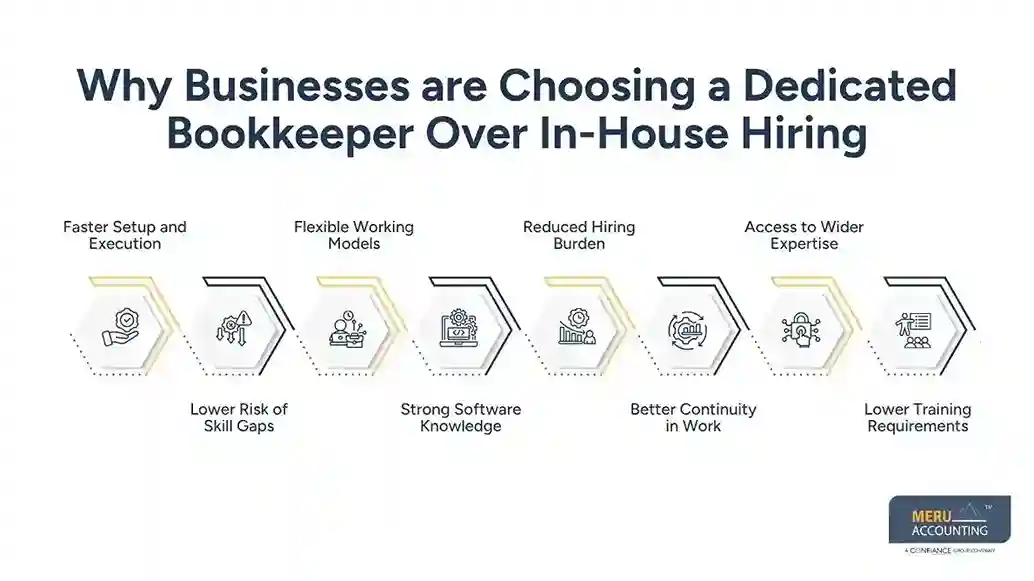
Reduced Hiring Burden
Recruitment, interviews, and background checks take significant time when building internal teams. Outsourcing removes this entire cycle. Management teams can focus more on operations instead of spending effort on hiring processes.
Better Continuity in Work
A dedicated bookkeeper ensures continuity in financial operations even when internal staffing changes occur. Internal setups may face disruption during such events. Consistent workflow reduces delays in monthly reporting and reconciliation tasks.
Access to Wider Expertise
Outsourced professionals often bring exposure from multiple industries and business sizes. Broader experience helps in handling unusual transactions or complex accounting situations more effectively.
Lower Training Requirements
Internal employees require regular training updates to stay aligned with accounting tools and standards. Outsourced professionals already maintain updated knowledge, reducing training costs and time.
How Better Financial Reporting Supports Smarter Business Decisions
Clear Cash Visibility
With a dedicated bookkeeper, these updates remain consistent and reliable, improving financial visibility for decision-makers. Better visibility into cash position reduces the chance of unexpected shortfalls during operational planning.
Timely Reports
Financial statements are prepared on schedule, helping management make faster decisions. Quick access to reports supports faster response to changes in sales, costs, or market conditions.
Better Expense Tracking
Spending patterns become easier to understand when records are updated consistently. Clear tracking of expenses helps identify unnecessary costs and areas where spending can be controlled.
Accurate Profit Analysis
Clean records ensure profit calculations reflect actual performance instead of delayed entries. Reliable profit data allows leadership to evaluate business performance with greater confidence.
Easier Audit Preparation
Well-maintained records reduce last-minute corrections during audits. Organized documentation shortens audit time and reduces stress during compliance checks.
What to Look for When Hiring a Dedicated Bookkeeper
Strong Accounting Knowledge
A dedicated bookkeeper should have strong knowledge of accounting principles and accurate transaction classification skills. Sound knowledge of debit and credit rules ensures correct recording of every financial entry.
Software Expertise
Experience with accounting platforms among dedicated staff ensures smooth processing and fewer manual errors. The ability to work across multiple tools helps maintain flexibility in different business setups.
Accuracy And Detail Focus
Small mistakes in records can affect financial decisions, so attention to detail is essential. Careful review of entries reduces the risk of mismatched balances or reporting errors.
Clear Communication
Financial reports should be explained in simple terms for better understanding. Simple explanations help business owners make decisions without confusion or misinterpretation.
Compliance Awareness
Understanding tax and reporting rules helps avoid penalties and reporting issues. Awareness of regulatory timelines ensures filings and records stay aligned with legal requirements.
Financial Consistency and Reliability
A dedicated bookkeeper ensures financial records are updated consistently without gaps or delays. This reliability helps businesses trust their reports for accurate decision-making and audits.
How Dedicated Bookkeeping Improves Cash Flow Management
Real-Time Tracking
With a dedicated bookkeeper, regular updates provide a clear view of income and expenses without delay. Continuous recording of transactions helps avoid blind spots in daily cash movement.
Better Payment Planning
Businesses can schedule payments based on available cash instead of assumptions, especially when managed by dedicated staff. Planned outflows reduce pressure during low revenue periods and improve financial balance.
Faster Invoice Recording
Invoices are processed quickly, reducing delays in financial tracking. Quick entry of billing data ensures receivables are always visible and up to date.
Early Identification of Gaps
Cash shortages or mismatches are identified early, preventing financial stress. Early alerts allow businesses to take corrective action before issues grow larger.
Better Vendor Coordination
With a dedicated bookkeeper, payments to suppliers are tracked properly, improving trust and stability. Clear payment schedules help maintain strong and reliable vendor relationships.
Why Choose Meru Accounting For Financial Support
Meru Accounting provides structured bookkeeping and accounting support for businesses that want accurate financial records without managing full in-house teams. At our firm, we focus on maintaining clear, timely, and well-organized financial data so companies can make better decisions without dealing with daily accounting pressure.
Our services are handled by dedicated bookkeepers and financial professionals who bring strong accounting experience and work with consistency and accuracy.
At our end, a technology-based workflow supported by dedicated staff ensures real-time updates and reduces manual errors, while industry exposure across multiple sectors improves the quality and reliability of reporting.
We offer flexible engagement options where a dedicated bookkeeper can be assigned based on workload and size, making our services suitable for both small and growing companies. Every process we follow is aligned with recognized accounting standards, including IFAC guidelines, ensuring compliance and dependable financial management.
Our Expert Perspective
In our experience, most financial inefficiencies do not arise from a lack of capability but from accounting responsibilities being divided across multiple internal roles without a unified system. This often results in delayed entries, inconsistent categorization, and reduced visibility of financial performance when there is no dedicated bookkeeper managing a consistent workflow.
When accounting is handled by a dedicated external professional or structured team, the entire process becomes more streamlined and standardized. Transactions are recorded consistently, reports become easier to analyze, and financial data gains a higher level of accuracy and reliability.
Ultimately, the real value is not just operational efficiency, but the ability to maintain clear, continuous, and decision-ready financial information over time.
Key Takeaways
- Outsourcing reduces fixed financial management costs
- A dedicated bookkeeper brings stronger consistency in reporting and long-term financial clarity
- Financial clarity improves decision-making speed, especially when supported by dedicated staff managing records consistently
- Cash flow becomes easier to track with structured systems
- Internal teams benefit from reduced workload pressure
FAQs
Businesses outsource bookkeeping to reduce hiring costs, improve accuracy, and avoid long-term employee management responsibilities.
Outsourcing is often more cost-effective for small and mid-sized businesses as it provides expert support without full-time salary and overhead costs.
It ensures timely recording of income and expenses, giving business owners a clear and updated view of cash flow.
Choose a service based on experience, software knowledge, reporting accuracy, and ability to maintain compliance with accounting standards.
You can review weekly or monthly reports shared by your dedicated bookkeeper. Many businesses also use shared dashboards for real-time tracking of financial data.