
Construction companies handle many projects at the same time, each with its own cost, team, and timeline. This makes financial control more complex than in many other industries. Finance accounting services play a key role in helping construction firms track project costs, manage budgets, and maintain financial clarity across multiple job sites. Without proper systems, even small errors can grow into large financial gaps.
In this blog, you will learn how structured financial support improves job costing, contractor payments, and overall project control. You will also understand how finance accounting services support better decision-making in construction businesses and how financial bookkeeping helps maintain accurate records for every project stage.
What You Will Learn From This Blog
- How construction firms manage project-based accounting using structured financial systems
- Why are finance accounting services important for cost control and reporting
- How finance bookkeeping supports job cost tracking and payment accuracy
- Common challenges in construction accounting and how to solve them
- Benefits of outsourcing financial functions for construction companies
- Real use cases of financial tracking in multi-project environments
Understanding The Role Of Finance Accounting Services In Construction Businesses
Project-Based Cost Structure
Construction work is based on individual projects, each with a separate budget. Finance accounting services help divide expenses like labor, materials, and equipment per project. This gives clear visibility into profit or loss for each job.
Real-Time Financial Tracking
Construction firms need updated financial data to monitor project spending accurately.
Structured financial systems help managers track costs as they occur and reduce budget overruns.
Cash Flow Management
Cash flow timing is very important in construction projects due to stage-based client payments.
Proper financial systems help balance incoming and outgoing payments to avoid shortages.
Compliance And Reporting
Construction companies must follow tax rules and maintain proper financial records.
Accurate systems ensure all transactions are recorded correctly and reduce compliance risks.
Project Profit Analysis
At the end of each project, firms need a clear view of the actual profit earned.
Financial reporting tools help present accurate project results and improve future planning.
Why Construction Companies Need Specialized Finance Accounting Services
Industry-Specific Cost Tracking
Construction costs vary widely based on project type, size, and location. Detailed financial systems help record and monitor these variations with better accuracy.
Multiple Contractor Management
Many contractors work on a single construction project at the same time. Proper financial systems help manage contracts, payments, and work records in an organized way.
Material Cost Fluctuations
Material prices change frequently due to market demand and supply conditions. Strong financial tracking helps construction firms adjust budgets and control real project costs.
Time-Based Billing Systems
Some construction projects use billing based on hours or project milestones. These systems need structured tracking to ensure accurate billing and smooth client invoicing.
Risk Reduction In Budget Errors
Without proper systems, construction budgets can easily go off track during execution. Finance accounting services help reduce financial errors and improve overall budget control.
Challenges Of Project-Based Accounting In The Construction Industry
Difficulty In Tracking Individual Project Costs
Many firms mix expenses across projects, which creates confusion in financial records. Finance bookkeeping helps separate each cost clearly and assign it to the correct job.
Delayed Financial Updates
Manual systems often cause delays in reporting and project financial reviews. This affects decision-making and creates gaps in monitoring overall project progress.
Inconsistent Record Keeping
Without proper finance bookkeeping, records may become incomplete or inaccurate over time. Missing financial details can create confusion during reporting and payment reviews.
Complex Payroll Structures
Construction teams often include full-time workers, contractors, and subcontractors. Managing different payment terms and work schedules becomes difficult across projects.
Budget Overruns
Many projects exceed planned budgets due to weak tracking systems and poor cost control. Unexpected expenses can affect project profitability and future financial planning.
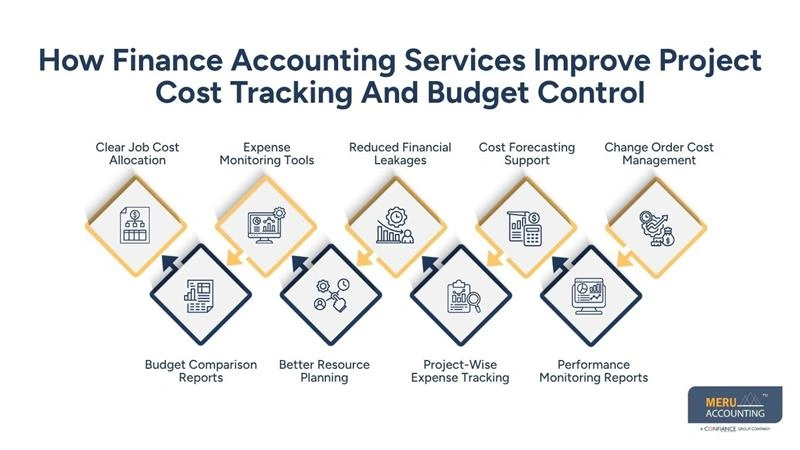
How Finance Accounting Services Improve Project Cost Tracking And Budget Control
Clear Job Cost Allocation
Finance accounting services assign every expense to the correct project and cost category. This helps avoid confusion between jobs and improves financial visibility.
Budget Comparison Reports
Managers can compare planned and actual spending through structured reporting systems. This allows businesses to identify cost differences and take timely action.
Expense Monitoring Tools
Real-time tracking tools help identify overspending during project execution stages. Early cost monitoring supports better spending control and financial management.
Better Resource Planning
Financial data helps allocate labor, materials, and equipment across projects properly. This improves resource use and supports smoother project operations.
Reduced Financial Leakages
Accurate systems prevent unnecessary, duplicate, or unrecorded project expenses. Strong financial controls help improve cost efficiency and reduce revenue loss.
Project-Wise Expense Tracking
Separate expense tracking keeps project costs organized and easier to review. Proper finance bookkeeping helps maintain accurate records across all active projects.
Cost Forecasting Support
Historical financial data helps estimate future project costs more accurately. Better forecasting supports planning and reduces the risk of budget gaps.
Performance Monitoring Reports
Financial reports help measure project performance against planned targets. This allows firms to make informed decisions and improve project outcomes.
Change Order Cost Management
Construction projects often face changes in project scope and requirements. Structured tracking helps record additional costs and maintain budget accuracy.
Role Of Finance Bookkeeping In Managing Job Costs And Contractor Payments
Accurate Daily Records
Daily expenses should be recorded correctly for every active construction project. Structured bookkeeping systems for job costing help maintain clear visibility of all cost movements and reduce financial confusion across multiple sites.
Contractor Payment Tracking
Payments to contractors must be timely and accurate to avoid workflow issues. Bookkeeping support for construction projects ensures payment schedules are properly recorded, reducing delays and mismatches in contractor settlements.
Invoice Management
All supplier invoices should be recorded and matched with related project costs. Project-level bookkeeping accuracy helps maintain consistency between invoices, purchase orders, and job cost records.
Expense Categorization
Project expenses are grouped into materials, labor, equipment, and overhead costs. Strong finance bookkeeping practices in construction projects help teams analyze spending patterns and improve cost allocation decisions.
Audit Preparation Support
Well-maintained records make audits smooth and easier to manage during reviews. Reliable bookkeeping systems for job costing ensure all financial documentation is properly organized and easy to retrieve when required.
Improving Financial Accuracy With Finance Bookkeeping In Multi-Project Environments
Separation Of Project Accounts
Each project has its own financial record using financial bookkeeping, preventing overlap. Strong project-level bookkeeping accuracy ensures each construction job maintains clear financial boundaries and avoids cross-project errors.
Error Detection In Early Stages
Mistakes are identified early through regular checks and financial reviews. Structured bookkeeping systems for job costing help detect inconsistencies before they impact reporting or budgeting outcomes.
Consistent Record Updates
Financial data is updated regularly for better control and reporting accuracy. Timely updates through bookkeeping support for construction projects ensure managers always work with current financial information.
Better Cost Forecasting
Past data helps predict future project costs more accurately over time. Strong finance bookkeeping practices improve forecasting accuracy by analyzing historical project spending trends.
Improved Financial Transparency
Owners and managers get a clear view of all financial activity. Project-level bookkeeping accuracy enhances visibility across multiple construction projects and supports better decision-making.
Benefits Of Outsourcing Finance Accounting Services For Construction Firms
- Outsourcing reduces the need for large in-house teams and lowers overall operational expenses.
- External service providers offer specialized finance accounting services backed by industry knowledge and practical experience.
- Construction managers can spend more time on project execution and site operations.
- Outsourced teams use structured reporting tools and systems to improve financial visibility.
- Services can expand easily as project volume increases across multiple construction jobs.
How Construction Businesses Choose Meru Accounting?
Meru Accounting provides structured finance accounting services designed for construction firms handling multiple projects at once. Our team supports job costing, contractor payment tracking, and project-based reporting.
We also provide strong finance bookkeeping support to ensure every expense is recorded correctly and linked to the right project. This helps construction companies reduce cost errors and improve financial clarity.
With over a decade of experience, Meru Accounting helps firms manage complex construction accounts using simple and reliable systems. Our services are designed to improve accuracy, reduce manual errors, and support better financial decisions.
Our Expert Perspective
Working closely with construction clients, we consistently observe that financial challenges are rarely caused by insufficient revenue. Instead, they stem from ineffective cost tracking across projects. When finance accounting services are implemented correctly, project-level visibility becomes more accurate and decision-making improves. Strong finance bookkeeping practices also help construction firms maintain tighter budget control and achieve clearer profit outcomes at project completion.
Key Takeaways
- Construction projects need separate financial tracking for better control
- Finance accounting services improve cost visibility and budgeting
- Finance bookkeeping ensures accurate daily record-keeping
- Outsourcing financial work reduces errors and saves time
- Proper systems help prevent budget overruns and payment delays
- Structured accounting improves long-term project profitability
FAQs
Finance accounting services in construction help track project-wise costs, manage budgets, and maintain accurate financial reporting across multiple job sites
It helps record daily expenses and ensures every cost is linked to the correct project.
They provide real-time tracking and budget comparison to control spending early.
Yes, even small firms benefit from better cost tracking and financial clarity.
Outsourcing saves time, reduces errors, and gives access to skilled financial experts.