
Fees are often frustrating, and in many cases, they are not immediately visible. The financial industry is filled with a wide range of financial fees—some are well-known, while others are hidden and only become noticeable after they have already cost consumers significant money.
While it is true that financial professionals must be compensated for their services, it is equally important that customers fully understand what they are paying for. Before working with a financial advisor or opening any financial account, always ask clearly how they earn their fees. If the explanation is unclear or evasive, it may be better to look elsewhere.
What You Will Learn From This Blog
- How hidden charges reduce savings over time
- Hidden Financial Fees You Should Watch Out For
- When advisory costs are reasonable and when they are not
- How to identify unnecessary charges early
- Practical ways to manage money better
Introduction to Financial Fees
Financial fees refer to service charges applied by banks, funds, or advisors for handling money-related services such as account maintenance, transactions, and investment management. These charges are often built into financial products, which is why many users do not notice them at first.
Institutions apply charges mainly to cover operational costs, but not every charge delivers equal value. This makes it important to review what you are actually paying for, especially when different services have different pricing structures.
In many cases, financial advisor costs are based on assets managed, hourly consultation, or fixed service packages, and these costs should always match the level of advice and support provided.
Over time, even small charges can reduce overall returns. A difference of just 1% in costs can significantly impact long-term savings due to compounding. Understanding how financial advisor fees and other financial fees work helps individuals make more informed decisions and avoid paying for services that do not add real value.
Hidden Financial Fees You Should Avoid Paying
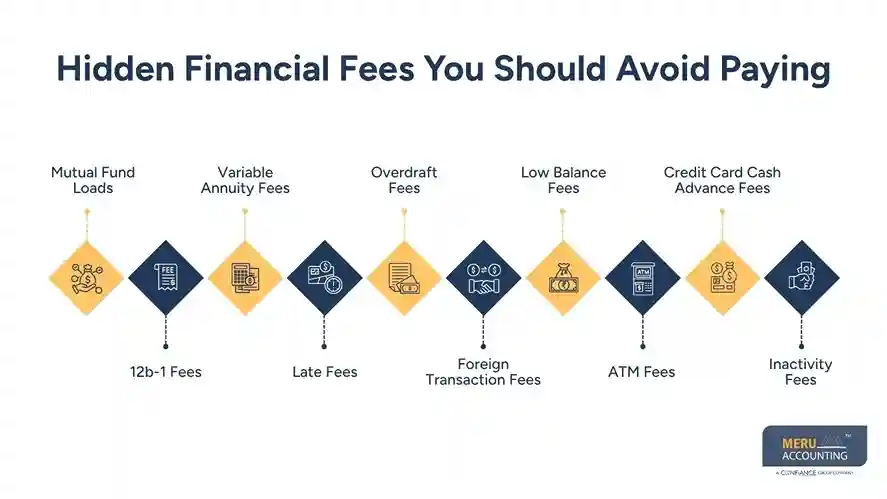
There are several financial charges that consumers commonly encounter across banking and investment products. While some fees are unavoidable, many can be reduced or completely avoided with proper awareness and financial planning. Below are ten common fees that should generally be avoided.
Mutual Fund Loads
Some mutual funds charge load fees. For example, certain share classes include an upfront commission, where a percentage of the investment is deducted at the time of purchase. In addition to this, many mutual funds also charge ongoing management fees, known as expense ratios. When combined, these costs can significantly reduce overall investment returns.
Although load funds are not always a poor choice, no-load alternatives are widely available. Investors are encouraged to compare options carefully before investing.
12b-1 Fees
A 12b-1 fee is an annual marketing or distribution fee charged by some mutual funds in the United States. It is included in the fund’s expense ratio.
These fees are more common in broker-sold actively managed funds. Many no-load and index funds do not include 12b-1 fees, making them a lower-cost option for investors. Investors should review fund disclosures carefully to understand the total cost.
Variable Annuity Fees
Variable annuities often involve complex and high fee structures that may not be fully understood by investors at the time of purchase.
In some cases, investors may believe they are paying minimal fees, while the total annual charges can be significantly higher due to multiple layered costs. Because of their structure, these products should be carefully evaluated before investment.
Late Fees
Late fees are charged when payments are not made by their due dates. These fees are entirely avoidable with proper financial organization.
Maintaining sufficient funds, tracking bill due dates, and using automated payment systems can help ensure timely payments and prevent unnecessary penalties.
Overdraft Fees
Overdraft fees occur when a transaction exceeds the available balance in a bank account. These charges are often avoidable with proper monitoring of account activity.
Maintaining a buffer balance or linking a savings account for automatic transfers can help prevent overdrafts and related fees.
Foreign Transaction Fees
Foreign transaction fees are charged when purchases are made in a foreign currency or outside the country. These fees typically range from a small percentage of the transaction amount.
To avoid these charges, users can opt for financial products that do not include foreign transaction fees or use alternative payment methods when traveling.
Low Balance Fees
Some financial institutions impose financial fees when account balances fall below a minimum required threshold.
To avoid these charges, it is advisable to choose accounts without minimum balance requirements if maintaining higher balances is difficult.
ATM Fees
While different from investment-related charges like financial advisor fees, ATM fees are another example of how small financial costs can accumulate over time. These fees can become expensive relative to small withdrawal amounts.
Using in-network ATMs or choosing institutions that offer surcharge-free withdrawals can help avoid these costs.
Credit Card Cash Advance Fees
Credit card cash advances usually come with high upfront fees and immediate interest charges. This makes them one of the most expensive ways to access cash and should generally be avoided unless absolutely necessary.
Inactivity Fees
Inactivity fees are charged when an account remains unused for an extended period.
To avoid these fees, it is important to conduct occasional transactions or close accounts that are no longer needed.
Why Financial Advisor Fees Matter For Investments
Effect On Net Returns
High financial advisor fees reduce investment returns over long periods, especially in compounding portfolios. Even a small percentage difference can lead to a large gap in total wealth over time.
Service Value Comparison
Not all advisory costs reflect quality. Some investors pay for basic recommendations at premium rates. It is important to check whether the service matches the price being charged.
Lack Of Clear Disclosure
Many clients do not fully understand financial advisor fees before signing agreements. This often happens due to complex fee structures and missing breakdowns of total costs.
Potential Conflicts Of Interest In Non-Fiduciary Models
In some advisory arrangements, especially non-fiduciary models, compensation structures such as commissions or product-based incentives may create potential conflicts of interest related to financial fees.
This can influence recommendations in ways that may not fully align with an investor’s best interest, which is why understanding the advisor’s fee model is essential.
Industry Range Overview
Advisory costs can vary widely depending on service type, making comparison essential before selection. Knowing the market range helps avoid overpaying for similar services.
How to Identify Unnecessary Financial Fees Before Payment
Review Statements Properly
Always check detailed statements to identify hidden or repeated charges. Look for small deductions that appear regularly without a clear explanation.
Compare Providers
Different institutions charge different rates for similar services. A side-by-side comparison often reveals better and lower-cost options.
Request Full Cost Breakdown
Ask for complete disclosure of all applicable charges before agreement. Make sure all financial fees are clearly listed so there are no surprises later.
Check Contract Terms
Small clauses often contain additional charges that appear later. Reading the full agreement helps you avoid unexpected costs in future billing cycles.
Monitor Annual Spending
Review the total yearly cost instead of focusing only on monthly deductions. This gives a clearer picture of how much money is actually going out over time.
How Meru Accounting Supports You In Managing Financial Costs
Detailed Expense Tracking
Meru Accounting records and organizes all financial-related charges so businesses and individuals clearly understand where money is being spent. Clear visibility of each transaction highlights repeated and avoidable costs.
Cost Review And Analysis
Our team examines banking and investment statements to identify unnecessary charges and reduce wastage. Each entry receives careful review to ensure no silent deductions go unnoticed.
Advisory Cost Evaluation
Our experts evaluate financial advisor fees structures to help clients understand whether they are paying fair value. Fee models are compared against industry standards to identify overpricing or imbalance in service costs.
Compliance And Reporting
Proper classification of expenses ensures accurate tax reporting and financial clarity. Accurate records also reduce risk during audits and support better financial decision-making.
Accounting System Support
Structured accounting processes are used to monitor financial outflows in an organized manner. A clear tracking system makes spending patterns easier to analyze and control over time.
Our Expert Perspective
In real financial reviews, we often find that most individuals underestimate the total impact of hidden charges. Small deductions repeated over years create a large loss in savings potential. Similarly, many clients pay financial advisor fees without fully understanding what services are included. A structured annual review of all financial costs can significantly improve money control and reduce avoidable leakage.
Key Takeaways
- Many financial charges reduce savings silently
- Advisory costs must always match service value
- Hidden fees exist in banking, loans, and investments
- Regular review helps control unnecessary costs
- Awareness improves long-term financial decisions
FAQs
You can avoid financial fees by checking your bank statements regularly, comparing service providers, closing unused accounts, and reading all terms before signing any financial agreement.
Hidden financial fees often include ATM withdrawal charges, inactive account fees, currency conversion costs, and automatic renewal charges that are not clearly shown upfront.
Before hiring, check the full fee structure, services included, contract terms, and any additional or hidden costs that may apply later.
Financial advisor fees are usually charged as a percentage of assets managed, hourly consultation fees, or fixed yearly charges. The structure depends on the advisor and the complexity of your financial needs.
Yes, financial fees can reduce returns over time because repeated deductions lower compounding growth and overall investment gains.
optional anymore
on running the business