When businesses plan to improve financial decision-making, many choose to hire remote financial analyst professionals or work with a virtual financial analyst. While both options sound similar, they are not exactly the same. Each comes with its own working style, cost structure, and level of involvement in your business.
If you are planning to hire remote financial analyst services, understanding how they differ from a remote financial analyst is important. This helps you choose the right option based on your business goals, budget, and operational needs.
In this blog, we will clearly explain the differences, roles, benefits, and challenges so you can confidently decide whether to recruit a remote financial analyst or work with a remote financial analyst.
What You Will Learn From This Blog
- Clear understanding of the difference between remote and virtual financial analysts
- Key responsibilities when you hire remote financial analyst
- Benefits and cost comparison of both options
- Skills you should look for before hiring
- Challenges and how to manage them effectively
- Tools commonly used by analysts
- How to choose the right option for your business
Who Is a Virtual Financial Analyst?
A virtual financial analyst is a professional who provides financial services remotely, usually on a contractual or part-time basis. Unlike a full-time employee, they are not deeply integrated into your company’s daily operations.
Instead, they offer support as needed, making them a suitable choice for businesses that require financial expertise without long-term commitment.
In terms of work structure, a remote financial analyst often handles multiple clients at the same time. Their availability is typically limited to specific working hours or project timelines.
They usually focus on clearly defined tasks such as preparing financial reports, managing budgets, or creating forecasts, rather than being involved in continuous business activities.
Communication with a remote financial analyst is generally carried out through emails, video calls, or project management tools. Real-time collaboration may be limited compared to in-house or remote team members.
Due to their flexible engagement model, businesses commonly hire a remote financial analyst for short-term assignments or project-based work, making it a cost-effective and adaptable option.
Hire Remote Financial Analyst vs Virtual Financial Analyst: Key Differences Explained
Aspect | Hire Remote Financial Analyst | Virtual Financial Analyst |
Employment Relationship | When you hire remote financial analyst, they work like an extended team member and integrate with your business operations | A virtual financial analyst works independently and is not fully integrated into the company |
Level Of Involvement | Actively involved in daily financial activities and decision-making when you recruit a remote financial analyst | Focuses only on specific tasks or deliverables |
Working Hours | Usually follows your business hours for better coordination | Works on flexible schedules based on availability |
Communication And Collaboration | Provides regular communication and collaboration with your team | Communication may be limited and less frequent |
Long-Term Vs Short-Term Role | Businesses that hire remote financial analyst often need long-term financial support | Ideal for short-term projects or temporary needs |
Cost Structure | Typically follows a fixed monthly salary or long-term contract | Usually charges hourly or per project |
Scalability | Easier to scale responsibilities as your business grows | Limited scalability based on project scope |
Business Understanding | Gains deeper understanding of your business over time | Works with limited business context due to short-term engagement |
Core Responsibilities To Consider As You Hire Remote Financial Analyst
Financial Planning And Budgeting
When you hire remote financial analyst, they help create budgets and financial plans that align with business goals. They also assist in setting realistic financial targets and monitoring adherence to the plan.
Data Analysis And Reporting
They analyze financial data and prepare reports to support decision-making and improve performance. Their insights help identify trends and uncover opportunities for business growth.
Forecasting Future Trends
A remote analyst predicts future financial trends, helping businesses prepare for upcoming challenges. They also provide scenario analysis to guide strategic planning under uncertainty.
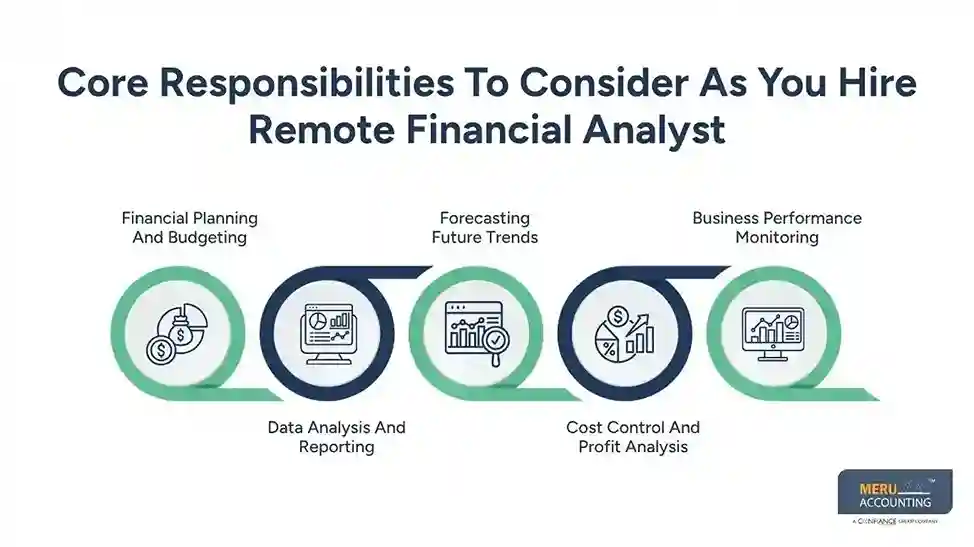
Cost Control And Profit Analysis
They identify areas where costs can be reduced and profits can be improved. They recommend strategies to optimize expenses without affecting business operations.
Business Performance Monitoring
When you hire remote financial analyst, they track performance regularly and suggest improvements. They ensure that key financial metrics are consistently reviewed to support better decision-making.
Benefits Of Hire Remote Financial Analyst For Your Business
Cost Savings Compared To Local Hiring
Businesses can save significantly when they hire remote financial analyst instead of hiring in-house staff. This reduces overhead costs such as office space, equipment, and employee benefits.
Access To Global Talent
You can choose from a wide pool of skilled professionals across different regions. This gives your business access to specialized expertise that may not be available locally.
Better Flexibility And Scalability
Hiring remote analysts allows you to scale services based on your needs. You can easily adjust the level of support depending on business growth or seasonal demands.
Continuous Financial Support
Unlike a virtual financial analyst, remote analysts often provide ongoing support. They stay connected with your team to address financial issues promptly as they arise.
Improved Decision Making
With better financial insights, businesses can make informed and timely decisions. Remote analysts provide actionable recommendations to optimize operations and profits.
Enhanced Compliance And Risk Management
A remote financial analyst helps ensure your business complies with financial regulations. They also identify potential risks and suggest measures to mitigate them effectively.
Cost Comparison: Hire Remote Financial Analyst vs Virtual Financial Analyst
Cost Factor | Hire Remote Financial Analyst | Virtual Financial Analyst |
Hourly Rate Differences | When you hire remote financial analyst, costs are usually calculated as a fixed monthly salary rather than hourly. | A virtual financial analyst generally charges hourly based on project scope. |
Monthly Cost Structure | Fixed monthly payments make budgeting easier when you recruit a remote financial analyst. | A monthly structure is uncommon since most work is project-based for a remote financial analyst. |
Project-Based Pricing | Better suited for long-term or continuous tasks. | Ideal for short-term projects with clearly defined costs. |
Hidden Costs and Savings | May include training or onboarding, but long-term value is higher when you hire remote financial analyst. | Minimal onboarding costs; savings mainly come from short-term engagement with a remote financial analyst. |
Return on Investment (ROI) | Businesses that recruit a remote financial analyst often see higher ROI due to consistent involvement. | ROI depends on project success and the limited involvement of a remote financial analyst. |
Skills To Look For When You Hire Remote Financial Analyst
Strong Analytical Skills
A good analyst should be able to interpret complex financial data clearly. They must also identify trends and patterns that impact business decisions.
Knowledge Of Financial Tools
When you hire remote financial analyst, ensure they are familiar with tools like Excel, Power BI, or accounting software. Proficiency in these tools ensures faster and more accurate financial reporting.
Communication Skills
Clear communication is important for remote collaboration and reporting. They should explain financial insights in simple terms for non-financial teams.
Industry Experience
Experience in your industry helps in a better understanding of financial needs. It allows them to anticipate challenges specific to your business sector.
Problem-Solving Ability
A skilled analyst should provide solutions, not just data. They must offer actionable recommendations to improve financial performance.
Hire Remote Financial Analyst Or Virtual Financial Analyst: Which Is Better For Your Business?
Business Size And Requirements
Small businesses may prefer a virtual financial analyst, while growing companies often hire remote financial analyst. Choosing the right type ensures your financial needs are properly managed without overpaying.
Budget Considerations
If budget is limited, a virtual analyst may be suitable for short-term needs. Remote analysts may cost more upfront but provide long-term value through consistent support.
Long-Term Financial Planning Needs
For continuous financial management, it is better to recruit a remote financial analyst. They can track performance over time and help with strategic decision-making.
Complexity Of Financial Tasks
Complex tasks require dedicated attention, which remote analysts provide. They can handle detailed analysis, reporting, and scenario planning effectively.
Growth And Expansion Goals
Businesses planning to grow should consider hiring remote analysts for consistent support. A remote analyst can adapt to changing business needs as your company scales.
Common Challenges When You Hire Remote Financial Analyst And How To Overcome Them
Communication Gaps
Use regular meetings and clear reporting systems to avoid misunderstandings. Sharing updates in real-time ensures everyone stays on the same page.
Time Zone Differences
Plan overlapping working hours when you hire remote financial analyst from different regions. This helps in scheduling meetings and receiving timely updates.
Data Security Concerns
Ensure secure systems and access controls are in place. Regular audits and encrypted channels protect sensitive financial information.
Performance Tracking
Set clear KPIs and review performance regularly. Tracking progress consistently helps in identifying areas for improvement.
Integration With Team
Encourage collaboration tools to help remote analysts work smoothly with your team. Team-building activities or virtual check-ins strengthen coordination and trust.
Tools And Technologies Used By Remote And Virtual Financial Analysts
Accounting Software
Tools like QuickBooks, Xero, and Zoho Books are commonly used by both remote and remote financial analyst professionals. They ensure accurate record-keeping and easy report generation.
Data Visualization Tools
Power BI and Tableau help present financial data in an easy-to-understand format. Visual insights make it simpler to identify trends and make informed decisions.
Communication Platforms
Zoom, Slack, and Microsoft Teams support smooth communication. They enable instant messaging, calls, and video conferencing for better collaboration.
Project Management Tools
Trello and Asana help manage tasks and deadlines effectively. They allow teams to track progress and ensure timely completion of projects.
Cloud-Based Systems
Cloud platforms allow easy access to financial data from anywhere. They also enable secure collaboration among multiple users in real time.
Why Choose Meru Accounting To Hire Remote Financial Analyst
Experienced Professionals
Meru Accounting provides skilled experts with strong knowledge in various industries when you hire remote financial analyst services. Our team brings practical experience to solve complex financial challenges efficiently.
Customized Financial Solutions
Every business is different. We offer solutions that match your exact financial requirements. We tailor reports and analysis to fit your business goals and decision-making needs.
Cost-Effective Services
Our pricing is designed to help businesses reduce costs without affecting quality. You get high-quality financial support without the overhead of full-time hiring.
Advanced Tools And Systems
We use modern accounting and financial tools to deliver accurate results. These tools ensure faster processing and real-time insights for better decision-making.
Reliable Support And Service
With Meru Accounting, you get consistent and dependable support when you recruit a remote financial analyst services. Our team is always available to answer queries and provide guidance when needed.
Key Takeaways
- Hiring the right financial analyst depends on your business needs
- Remote analysts offer long-term and consistent support
- Virtual analysts are suitable for short-term or project work
- Cost and involvement level are major differences
- Choosing the right option improves financial performance
- Skills and tools play an important role in effective analysis
FAQs
A remote analyst works closely with your team, while a virtual analyst focuses on specific tasks independently. This affects collaboration and long-term involvement.
Small businesses can start with virtual analysts for project-based needs, but growing businesses gain more value when they hire remote financial analyst for continuous support.
Costs vary depending on experience and location, but remote analysts usually have fixed monthly pricing, which makes budgeting simpler.
Virtual analysts can manage long-term tasks, but they are generally more suited for short-term or project-based engagements.
Financial analysts use tools like Excel, QuickBooks, Power BI, and cloud platforms to analyze data and generate reports efficiently.