
The ideal bookkeeping process helps small and medium-sized businesses keep track of money. It shows what you earn and what you spend. This process makes sure your money records are clear and correct. With ideal bookkeeping, you can save time, plan for taxes, and grow your business. Good records help you make smart choices. Bookkeeping is not just about math, but it is about helping your business do well.
Let’s look at what makes a good bookkeeping process for small and medium-sized businesses. We will break it down in a simple and easy way so everyone can understand.
What You Will Learn From This Blog
- What ideal bookkeeping means for small and medium-sized businesses.
- The step-by-step bookkeeping process every business should follow.
- Common bookkeeping mistakes that affect business finances.
- How outsourced ideal bookkeeping improves financial management.
- The importance of accurate financial records and cash flow monitoring.
- How professional bookkeeping supports payroll, tax preparation, and financial reporting.
- Why outsourcing bookkeeping allows business owners to focus on business growth.
What is Ideal Bookkeeping?
Ideal bookkeeping means keeping money records neat, clear, and up to date. It helps small and medium-sized businesses track what they earn and what they spend. With ideal bookkeeping, every sale, bill, and cost is written down.
Good bookkeeping helps stop mistakes and keeps your business strong. It is a smart and simple way to manage money the right way.
Step-by-Step Bookkeeping Process for Small and Medium Businesses
Keep Business and Personal Money Separate
The first step in ideal bookkeeping is to keep your business money and personal money apart. Many small business owners make the mistake of using one bank account for both. This causes confusion and errors. You should:
- Use this account for all business costs and sales.
- Never use business money for personal items.
This makes it easier to track and manage your cash.
Track Every Dollar
Write down every dollar, and good to do this every day. This helps you know:
- How much money is coming in?
- Where is the money going?
- Are you making a profit or a loss?
You can use tools like a notebook, a spreadsheet, or bookkeeping software.
Save All Receipts and Bills
To do ideal bookkeeping, save every receipt, bill, and invoice. These papers prove where your money went. You may need them during tax time or in case of an audit. You can:
- Keep paper files in a folder
- Or take pictures and save them in the cloud
Saving your receipts will help you stay safe and well-prepared.
Use Bookkeeping Software
Doing bookkeeping by hand takes time. A better way is to use bookkeeping software. These programs help you:
- Record sales and costs
- Send invoices to customers
- Get reports and charts
- Stay ready for tax season
Some good options are QuickBooks, Xero, and FreshBooks.
Set a Time Each Week
To keep your books in shape, set a time each week to work on them. It can be 30 minutes on Friday or Sunday night. This helps you:
- Stay updated
- Catch mistakes early
- Be ready if someone asks for your records
Don’t wait until the end of the month or year. A little work each week makes it easy.
Review Your Reports
Your software or bookkeeper can give you reports. Common reports are:
- Income Statement – tells if you are making or losing money
- Balance Sheet – shows what you own and owe
- Cash Flow – shows money going in and out
Reading these reports helps you make smart choices.
Plan for Taxes
Taxes can be hard if you’re not ready. Ideal bookkeeping includes keeping records for taxes. You should:
- Track all income
- Note all business costs
- Save bills and receipts
This way, you won’t get a surprise at tax time.
Hire a Bookkeeper or Pro
If bookkeeping is too much, you can hire someone. A bookkeeper helps with daily records. An accountant can help with reports, tax filing, and money planning.
Always Check for Mistakes
Mistakes can happen. That’s why it’s good to double-check your numbers. Look at your books each month to be sure:
- No payments were missed
- All costs are correct
- Totals match your bank records
Catching small problems early avoids big troubles later.
Make a Budget
With a budget, you can:
- Know how much to spend
- Set goals for saving
- Stop wasting money
Bookkeeping and budgeting go hand in hand.
How Outsourced Ideal Bookkeeping Supports Small and Medium Businesses
Outsourcing ideal bookkeeping helps a small and medium business maintain accurate financial records without handling every bookkeeping task internally. Professional bookkeepers record transactions, reconcile accounts, prepare reports, and keep financial data organized.
As the business grows, bookkeeping becomes more complex. Outsourced bookkeeping manages these responsibilities efficiently, allowing business owners to focus on daily operations and long-term growth.
Accurate Financial Record Management
Accurate financial records form the foundation of every successful business. Every sale, purchase, payment, expense, and receipt should be recorded correctly and categorized under the appropriate account.
Professional bookkeeping teams maintain consistency by recording transactions regularly instead of waiting until the end of the month. This approach reduces errors and keeps financial information up to date.
Well-maintained financial records help businesses:
- Monitor business performance
- Prepare reliable financial statements
- Reduce duplicate or missing entries
- Support audits and tax reporting
- Make informed financial decisions
Accurate records also make it easier to identify unusual transactions before they become larger accounting issues.
Better Cash Flow Monitoring
Cash flow determines whether a business can meet its daily financial commitments. Even profitable businesses may experience difficulties if incoming and outgoing cash is not monitored properly.
Outsourced ideal bookkeeping helps businesses maintain updated cash flow information by recording receipts and payments promptly. Business owners can clearly see available cash balances and upcoming obligations.
Regular cash flow monitoring helps businesses:
- Plan future expenses
- Avoid unnecessary borrowing
- Prepare for seasonal changes
- Identify slow-paying customers
- Manage operating costs effectively
Having current cash flow information allows a small and medium business to make financial decisions with greater confidence.
Timely Bank Reconciliations
Bank reconciliation compares accounting records with bank statements to confirm that every transaction has been recorded accurately.
Regular reconciliations help identify:
- Missing transactions
- Duplicate entries
- Bank errors
- Unauthorized payments
- Recording mistakes
Professional bookkeeping teams perform reconciliations on a scheduled basis, ensuring financial records remain accurate throughout the year.
Timely reconciliations also simplify month-end closing and improve the reliability of financial reports.
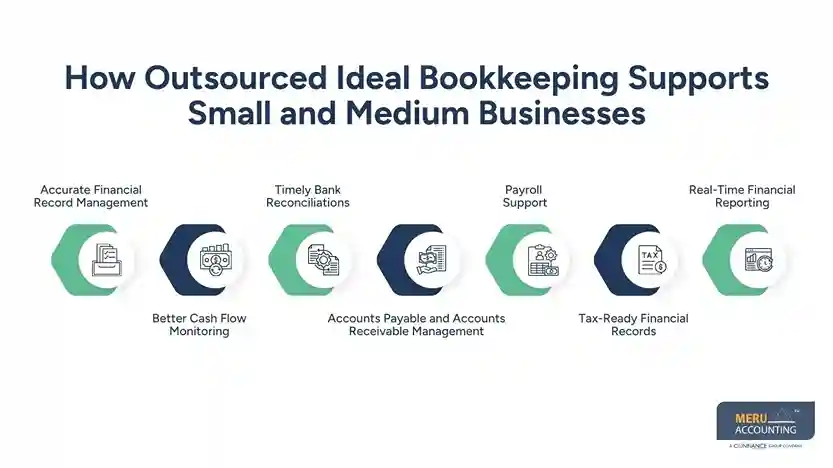
Accounts Payable and Accounts Receivable Management
Managing supplier payments and customer collections is an important part of ideal bookkeeping.
Accounts payable management ensures vendors receive payments on time while helping businesses avoid late fees and maintain strong supplier relationships.
Accounts receivable management focuses on tracking customer invoices, monitoring outstanding balances, and following up on overdue payments.
Effective management of both areas helps businesses:
- Improve cash flow
- Reduce outstanding balances
- Maintain accurate customer records
- Track payment due dates
- Strengthen business relationships
Organized receivable and payable processes contribute to healthier financial operations.
Payroll Support
Payroll involves more than paying employee salaries. Businesses must calculate wages accurately, record payroll expenses, manage deductions, and maintain payroll records.
Outsourced bookkeeping supports payroll by:
- Recording payroll transactions
- Maintaining payroll expense records
- Organizing employee payment information
- Supporting payroll reconciliation
- Preparing payroll-related financial reports
Accurate payroll bookkeeping ensures labor costs are reflected correctly in financial statements while supporting compliance with payroll reporting requirements.
Tax-Ready Financial Records
Tax preparation becomes much easier when bookkeeping remains organized throughout the year.
Professional bookkeeping teams maintain financial records that support tax filing by keeping income, expenses, invoices, receipts, and supporting documents properly organized.
Tax-ready bookkeeping helps businesses:
- Reduce year-end workload
- Minimize missing financial information
- Improve reporting accuracy
- Support tax return preparation
- Respond efficiently to information requests
Instead of searching for documents at tax time, businesses already have complete financial records available.
Real-Time Financial Reporting
Business owners need current financial information to make timely decisions. Waiting until the end of the quarter or year often delays important planning.
Outsourced ideal bookkeeping supports regular reporting by preparing financial statements such as:
- Profit and loss statements
- Balance sheets
- Cash flow reports
- Expense summaries
- Revenue reports
These reports help business owners evaluate profitability, monitor expenses, compare financial performance, and identify trends that require attention.
Real-time financial reporting gives small and medium businesses greater control over their operations and supports better planning for future growth.
Common Bookkeeping Mistakes Small Businesses Make
Mixing Business and Personal Money
Some people still use one account for both. This makes it hard to see what money is for the business and what is not.
Forgetting to Write Things Down
If you don’t track your sales or costs every day, you might forget. This makes your records wrong and not helpful.
Losing Bills and Receipts
If you don’t save your receipts or bills, you may have trouble later. You need them for taxes or to prove what you spent.
Not Using Bookkeeping Tools
Doing everything by hand takes a lot of time. If you don’t use bookkeeping software, you might make more mistakes.
Waiting Too Long to Update Books
If you wait weeks or months to do your books, you may forget things or mix up numbers. Ideal bookkeeping needs regular work.
Not Understanding Reports
Some reports can look hard to read. If you don’t know what they mean, you may not make the best choices for your business.
Missing Tax Deadlines
If your books are not ready, it’s hard for a small and medium business to file taxes on time. This may lead to late fees or stress.
Simplify Your Business Bookkeeping With Meru Accounting
Managing bookkeeping while running a business can become difficult as daily transactions increase. Small and medium-sized businesses often need accurate financial records, timely reporting, and organized bookkeeping without spending valuable time on administrative work.
Meru Accounting provides outsourced ideal bookkeeping services designed to help businesses maintain accurate financial records, monitor cash flow, manage accounts payable and receivable, support payroll bookkeeping, and prepare tax-ready financial reports. Our experienced bookkeeping professionals use reliable accounting processes and cloud-based software to keep your financial records updated throughout the year.
Whether you are a growing startup or an established small business, Meru Accounting helps you maintain organized bookkeeping so you can focus on serving customers, improving operations, and expanding your business with confidence.
Our Expert Perspective
Ideal bookkeeping creates the financial foundation for informed decision-making, accurate reporting, and sustainable growth for every small and medium business. As small and medium-sized businesses expand, managing financial records becomes more complex, making consistent bookkeeping essential for maintaining cash flow, supporting tax compliance, and reducing reporting errors.
At Meru Accounting, we believe outsourced ideal bookkeeping helps businesses maintain accurate, organized, and tax-ready financial records while allowing business owners to focus on daily operations and long-term growth.
Key Takeaways
- Ideal bookkeeping helps small and medium businesses maintain accurate financial records, improve financial visibility, and make informed business decisions.
- Recording transactions regularly, keeping business and personal finances separate, and saving invoices and receipts help reduce errors and keep financial records organized.
- Using bookkeeping software and reviewing financial reports regularly improves efficiency, supports better cash flow management, and simplifies day-to-day bookkeeping.
- Performing regular bank reconciliations and maintaining tax-ready financial records help businesses stay prepared for tax filing and financial reporting requirements.
- Outsourced ideal bookkeeping reduces administrative workload, improves bookkeeping accuracy, and allows business owners to focus on daily operations and long-term business growth.
FAQs
Bookkeeping means tracking all the money your business earns and spends. It helps you know if you are making money and keeps your business safe and legal.
A bookkeeper records daily money activities. An accountant looks at the big picture, helps with taxes, and gives money advice.
No, you can start with simple steps. Many tools make it easy. But you can also hire help if you need it.
Yes. Accurate bookkeeping tracks incoming and outgoing cash, helping businesses manage expenses, customer payments, and financial planning.
Meru Accounting offers expert help for small and medium businesses. We manage your records, handle reports, and make sure everything is correct and ready for tax season.
optional anymore
on running the business