
Outsourced NetSuite-based accounting has become a practical option for companies that manage multiple subsidiaries, regions, or legal entities. Many businesses now rely on NetSuite outsourced accounting to handle complex finance work without increasing internal staff size. This approach allows finance teams to stay small while still managing high reporting volume and multi-entity structures.
In multi-entity operations, Financial data flows across multiple entities, currencies, and tax jurisdictions. When handled internally, this often increases workload and slows reporting cycles. A structured external model built on NetSuite Accounting Solutions helps maintain control, accuracy, and consistency across all entities.
What You Will Learn From This Blog
- How multi-entity businesses manage finance using outsourced NetSuite-based accounting
- Why structured financial systems are needed for scaling operations
- How external accounting teams handle consolidation and reporting
- Real use cases across industries like SaaS, retail, and manufacturing
- Common financial challenges solved through outsourced NetSuite support
- How Meru Accounting manages multi-entity finance operations
Introduction To NetSuite Outsourced Accounting
NetSuite outsourced accounting refers to a system where external finance experts manage accounting tasks inside NetSuite for multiple business entities. This includes bookkeeping, reconciliation, reporting, and consolidation without requiring a large in-house team. It allows companies to handle growing financial work in a more structured way while keeping internal teams focused on core decisions.
Modern financial operations rely on NetSuite Accounting Solutions to connect data across subsidiaries. These tools support structured tracking of transactions and help maintain consistency across reporting periods and business entities.
As a result, financial data stays aligned even when operations are spread across different regions. Businesses often choose external accounting support when internal teams struggle with increasing complexity.
Instead of expanding payroll costs, they work with external professionals who already understand NetSuite systems. This is especially useful for companies with holding structures or global subsidiaries that need unified reporting and consistent accounting logic.
Why Multi-Entity Businesses Need NetSuite Accounting Solutions
Complex Organizational Structures
Multi-entity businesses often operate across regions with different tax laws and reporting formats. NetSuite Accounting Solutions help standardize financial data across all entities.
Cross-Border Financial Reporting Needs
Currency differences and tax rules create reporting challenges. NetSuite outsourced accounting ensures financial statements remain aligned and comparable across different entities and currencies.
Strong Compliance Requirements
Regulatory reporting becomes more complex as businesses expand. External accounting teams help maintain compliance-ready records and audit trails.
Real-Time Financial Tracking
Decision-makers need updated financial visibility. NetSuite systems provide real-time dashboards while outsourced teams ensure data accuracy.
Reduced Internal Work Pressure
Internal finance teams often spend too much time on reconciliation and reporting. Outsourced support reduces this workload significantly.
Scaling Multi-Entity Operations Without Expanding Internal Finance Capacity Using NetSuite Outsourcing
Centralized Financial Management
With NetSuite outsourced accounting, financial data from all entities gets unified inside one system platform. NetSuite’s structured environment reduces duplication and improves overall reporting clarity.
Controlled Cost Expansion
Companies avoid hiring separate teams for each individual business entity. External accounting teams keep finance costs stable during business growth.
Faster Financial Closing Cycles
Month-end closing processes complete faster with structured NetSuite workflows. External teams ensure timely reporting across all business entities.
Reduced Hiring Dependency
Organizations reduce the need to expand internal finance departments significantly. Outsourced accounting teams manage routine tasks with consistent accuracy levels.
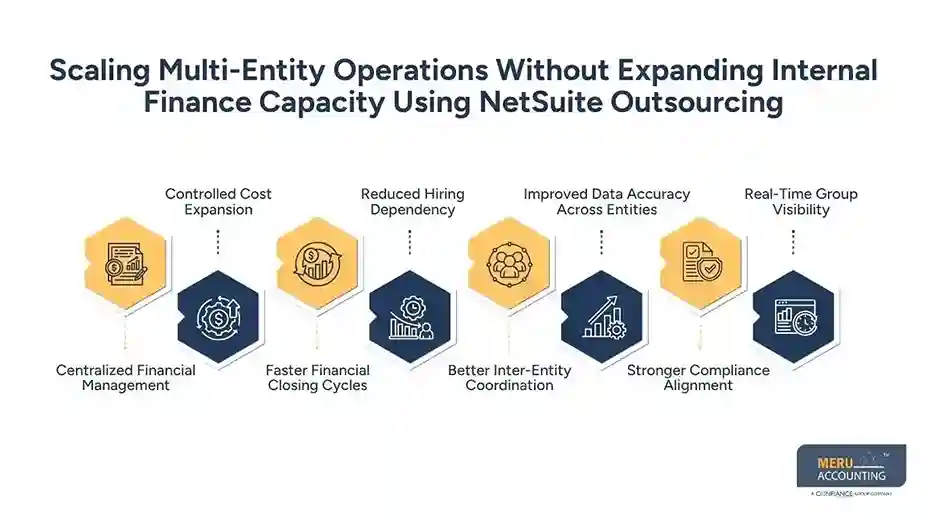
Better Inter-Entity Coordination
Financial records across subsidiaries follow standardized accounting rules consistently. NetSuite systems align reporting structures across multiple business entities.
Improved Data Accuracy Across Entities
Structured NetSuite outsourced accounting processes reduce manual errors in financial data entry tasks. External teams maintain consistent accounting logic across all business units.
Stronger Compliance Alignment
Regulatory requirements are managed using standardized NetSuite reporting frameworks. Audit-ready records are maintained across all company entities continuously.
Real-Time Group Visibility
Financial dashboards show updated performance across all business entities instantly. Leadership teams make faster decisions using accurate consolidated financial data.
How NetSuite Outsourced Accounting Works in Practice
Transaction Recording Process
External teams record daily transactions inside NetSuite. This ensures updated financial data across all entities. Accurate bookkeeping practices strengthen the reliability of financial reporting records.
Bank Reconciliation Handling
In NetSuite outsourced accounting, bank statements are matched with internal records regularly to ensure accuracy and reduce mismatches. Regular reconciliation processes reduce financial discrepancies across multiple accounts.
Monthly Closing Activities
Accounting teams handle month-end adjustments, accruals, and reporting cycles to ensure timely financial closure. Structured closing workflows shorten reporting timelines across all business entities.
Consolidated Reporting Structure
Financial statements from all entities are combined into unified reports for management review. Group-level visibility improves financial analysis across different subsidiaries.
Audit Preparation Support
Structured documentation and audit trails inside NetSuite make audit preparation more efficient and organized. Audit readiness increases through systematically maintained financial records across entities.
Common Use Cases of NetSuite Outsourced Accounting
SaaS And Subscription Businesses
Subscription-based companies use NetSuite outsourced accounting to track recurring revenue and customer billing cycles across regions. Revenue recognition accuracy improves across multiple subscription billing models and contracts.
Manufacturing Companies
Manufacturers manage inventory, production cost, and supply chain finance through centralized NetSuite systems. Cost tracking becomes clearer across raw materials, labor, and production stages.
Retail And E-Commerce Groups
Retail businesses operating multiple stores rely on structured reporting for sales, returns, and inventory tracking. Sales performance analysis becomes easier across online and offline channels.
Holding Companies
Holding structures require consolidated financial statements, which outsourced NetSuite teams prepare efficiently. Inter-company transactions are recorded with consistent accounting rules across entities.
Global Service Providers
Service-based companies with international clients use NetSuite outsourced accounting for multi-currency reporting and compliance alignment. Currency conversion accuracy improves financial reporting across different geographic regions.
Challenges Solved By Outsourced NetSuite Accounting
Inconsistent Financial Data
Different entities often follow separate accounting practices internally, which creates inconsistency. External accounting support helps standardize financial reporting across all entities.
Slow Reporting Cycles
Manual accounting processes slow down month-end closing cycles significantly. External teams improve reporting speed using structured NetSuite workflows.
High Staffing Costs
Expanding internal finance teams increases overall operational overhead costs, which NetSuite outsourced accounting helps reduce. Outsourced accounting reduces the need for large internal finance hiring.
Limited Financial Visibility
Lack of structured systems reduces clarity in financial reporting. NetSuite-based reporting improves visibility across all business entities.
Audit Risk Exposure
Manual accounting processes increase the chances of financial reporting errors. Remote accounting support strengthens audit readiness across all records.
How NetSuite Outsourced Accounting Supports Business Expansion into New Markets
Structured Entry Into New Regions
Expanding into new markets often requires setting up new legal entities, tax structures, and reporting systems.
Outsourced NetSuite accounting provides a ready framework to manage these setups without building separate internal finance teams. This ensures financial data remains aligned from day one.
Faster Setup of New Entities
When businesses enter new countries or regions, accounting setup can slow operations. NetSuite-based external accounting teams configure charts of accounts and reporting structures quickly, allowing faster operational readiness.
Consistent Financial Standards Across Borders
New markets often bring different accounting rules and compliance needs. External accounting support ensures that all entities follow a unified reporting structure, even when local requirements differ.
Reduced Operational Risk During Expansion
Market expansion carries financial risks such as reporting errors or compliance gaps. NetSuite outsourced accounting teams reduce these risks by maintaining accurate records and consistent financial controls across all entities.
Easier Consolidation of Global Performance
As new entities are added, consolidated reporting becomes more complex. NetSuite systems combined with outsourced accounting support make it easier to combine financial results into a single, clear view of global performance.
How Meru Accounting Strengthens Multi-Entity NetSuite Finance Operations
Structured Multi-Entity Finance Handling
Meru Accounting manages multi-entity finance using structured NetSuite workflows. Multi-entity reporting improves accuracy and reduces internal team workload globally.
NetSuite-Based Reporting Discipline
Our team ensures consistent financial reporting across all NetSuite entities through NetSuite outsourced accounting practices. Financial consolidation remains clear across subsidiaries and reporting periods worldwide.
Support For Global Finance Operations
Meru Accounting supports global clients across multiple tax jurisdictions efficiently. NetSuite accounting processes maintain accuracy across varied currencies and regions.
Reduced Internal Finance Load
External accounting teams reduce pressure on internal finance departments significantly. Internal teams gain more time for planning and financial analysis.
Consistency in Closing and Consolidation
Meru Accounting manages closing cycles using standardized accounting processes. Accurate consolidated reports support better management decisions across all entities.
Our Expert Perspective
Multi-entity businesses require a system-led finance approach instead of continuously expanding internal teams. In our experience, NetSuite-based outsourced accounting improves consistency by aligning accounting policies across all subsidiaries and reporting layers.
External finance teams reduce complexity in consolidation cycles while maintaining accuracy across currencies, regions, and entities. Structured NetSuite workflows ensure scalable financial control, enabling leadership to focus on strategic decisions rather than operational bottlenecks.
Key Takeaways
- Outsourced NetSuite accounting helps manage multi-entity finance without expanding internal teams
- NetSuite systems bring structure to cross-entity reporting and consolidation
- External accounting teams reduce workload and improve reporting speed
- Cost control becomes easier during business expansion
- Financial visibility improves across all subsidiaries
- Meru Accounting provides structured multi-entity accounting support
FAQs
External NetSuite accounting teams manage multi-entity bookkeeping and reporting inside one system, reducing the need for additional internal hires.
NetSuite brings all subsidiary financial data into a single structure, enabling faster and more accurate consolidation across entities.
Fast-growing companies use external accounting support to manage rising transaction volumes and multiple entities without expanding internal finance teams.
Structured workflows and external accounting execution inside NetSuite reduce delays in reconciliation, adjustments, and month-end closing cycles.
Reduced hiring, training, and infrastructure costs across multiple entities make external accounting support more cost-efficient for scaling businesses.