
Real estate firms today manage a growing amount of financial work. Property counts are rising, rent activity is more frequent, and reporting needs are more detailed than before. Financial data also needs to stay accurate and ready at all times. Because of this, many firms are changing how they handle accounting. Instead of building large in-house teams, they are moving toward outsourced real estate finance teams for bookkeeping and reporting work.
This shift is not only about lowering costs. It is also about improving speed, reducing errors, and keeping financial records clear and organized. Many firms also find it easier to scale operations when finance work is handled by an external team.
Outsourcing allows real estate companies to stay focused on property growth while trained professionals handle daily accounting tasks in a structured way.
What You Will Learn From This Blog
In this blog, you will learn:
- Why firms are shifting to outsourced real estate finance models
- How outsourcing improves bookkeeping accuracy and speed
- Key reasons behind this change
- Cost and scaling benefits of outsourcing
- Risks of in-house accounting systems
- How outsourcing supports financial planning
This blog explains both the practical and financial side of outsourcing in real estate.
Understanding Outsourced Real Estate Services in Finance and Bookkeeping
Outsourced real estate services mean hiring an external accounting team to manage financial and bookkeeping tasks for property businesses. These teams work remotely but act as a full extension of the finance function.
They typically handle:
- Property bookkeeping
- Rent tracking
- Vendor payments
- Monthly financial reports
- Expense records
- Bank account matching
- Tax-ready books
Instead of hiring full-time staff, firms rely on trained external teams for daily financial work. This model is growing because real estate accounting involves many transactions. Even small errors in rent entry or expense records can affect financial reports.
Outsourced teams help keep data clean, structured, and easier to review. They also improve consistency across different properties and accounts.
This creates a more stable financial system for the business.
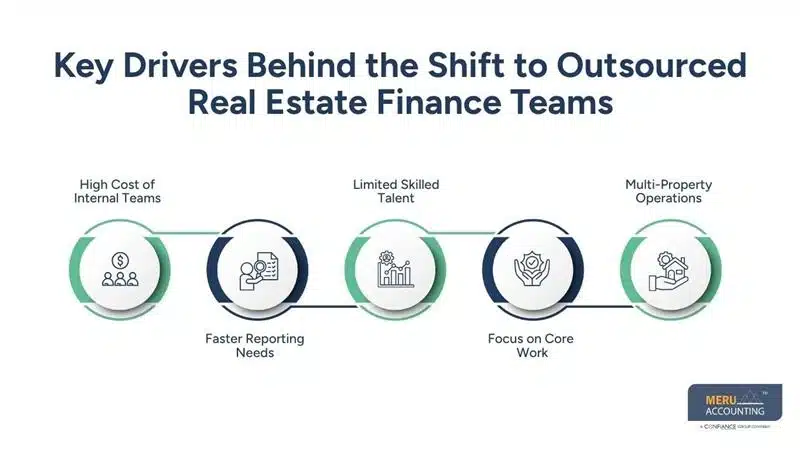
Key Drivers Behind the Shift to Outsourced Real Estate Finance Teams
Several strong reasons are driving firms toward outsourced real estate solutions.
High Cost of Internal Teams
Maintaining in-house accounting staff involves salaries, software, training, and management time. These costs stay fixed even when workload changes. Outsourcing turns this into a flexible cost based on usage.
Faster Reporting Needs
Financial reports are needed more often and with less delay. External teams use cloud systems that help deliver updates faster and in a clearer format.
Limited Skilled Talent
Real estate accounting requires specific knowledge of rent cycles, lease terms, and property expenses. Skilled staff are not always easy to find. Outsourced teams already have this experience.
Focus on Core Work
Firms prefer to spend time on acquisitions, leasing, and property management. They do not want to spend time on daily bookkeeping tasks.
Multi-Property Operations
Many firms manage multiple properties. External teams help keep all financial records organized in one system.
These reasons together make outsourcing a practical and steady choice.
Benefits of Outsourced Real Estate Accounting for Property Firms
The growth of outsourced real estate finance teams comes from clear operational benefits.
Better Accuracy
Specialized teams reduce mistakes in rent tracking, payments, and expense entries. This improves overall financial quality. It also helps keep financial records complete and up to date.
Clear Cash Flow Tracking
Firms can see income and expenses in a structured way. This helps with planning and budgeting. It gives managers a clearer view of how cash moves through the business.
Faster Month-End Close
Standard processes help close books faster each month. This supports timely reporting and decision-making. It also allows leaders to review results without long delays.
Easy Scaling
As the business grows, outsourced teams can handle more work without delay. No hiring process is needed. This makes it easier to support new properties and projects.
Industry Knowledge
Real estate accounting has its own rules. External teams understand these systems and follow them closely. Their experience helps reduce issues that can arise from accounting errors.
Reduced Internal Workload
Internal teams can focus more on business decisions instead of daily accounting work. This gives staff more time to support growth and property operations.
These benefits help improve both speed and control.
Cost Efficiency and Scalability in Outsourced Real Estate Operations
Cost control is a major reason firms use outsourced real estate systems.
In-house accounting usually includes:
- Salaries and benefits
- Accounting tools
- Training costs
- Office setup
- Management time
These are fixed costs that continue every month.
Outsourcing removes most fixed costs. Firms only pay for the services they use. This makes expenses easier to manage.
Scalability is another key benefit. When new properties are added, external teams can quickly take on extra work. There is no delay in hiring or training new staff.
This helps firms stay flexible when business activity changes.
It also supports smoother operations during both growth and slower periods.
Risks of In-House Accounting vs Outsourced Real Estate Finance Models
Some firms still manage accounting internally, but this approach has limits.
Higher Chance of Errors
Small internal teams may miss details in rent or expense records. Even minor mistakes can create issues in financial reports and affect day-to-day decisions.
Limited Tools
In-house teams may not use advanced systems for automation or reporting. This can make routine tasks take longer and increase manual work.
Staff Dependence
If one key employee leaves, work can slow down. It may also take time to transfer knowledge and train a replacement.
Slower Reporting
Manual systems take more time to complete monthly books. Delays in reporting can make it harder to review financial results on time.
Limited Analysis
Internal teams often focus on recording data rather than reviewing trends. As a result, firms may miss useful insights that support planning and growth.
In contrast, outsourced real estate teams use structured systems and backup support. This reduces risk and improves consistency.
It also helps maintain steady financial operations over time.
What is Leverage in Real Estate and Why It Matters for Financial Strategy
To understand financial planning in real estate, it is important to know what is leverage in real estate.
Leverage means using borrowed money to buy property with the goal of increasing returns. It allows firms to control larger assets with less personal capital.
For example, a firm may use a loan to purchase a building and earn rental income from it.
Leverage can support growth, but it also increases financial risk if not managed carefully.
This is why accurate financial tracking is important.
Outsourced real estate teams support better leverage control by:
- Tracking loan payments
- Monitoring total debt levels
- Preparing cash flow reports
- Supporting investment planning
When firms understand what is leverage in real estate, they can make safer financial decisions and manage risk better.
How Outsourced Real Estate Teams Support Better Financial Decisions
Outsourced finance teams play an important role in decision-making. They provide clean and structured financial data.
With this data, firms can:
- Evaluate new property investments
- Review asset performance
- Plan refinancing options
- Control expenses across properties
- Reduce financial risk
Better data leads to better decisions. This is one of the main reasons firms rely on outsourced real estate support.
It allows leadership teams to focus on strategy instead of daily accounting work.
Meru Accounting’s Outsourced Real Estate Accounting Services
Many firms choose external partners for financial support. Meru Accounting offers structured accounting support for real estate businesses.
Our outsourced real estate services focus on clear and organized financial management.
We provide:
- Property bookkeeping
- Rent tracking
- Monthly reporting
- Expense handling
- Cash flow tracking
- Month-end closing support
Our services help firms reduce internal workload and improve financial clarity. It also supports better decision-making and smoother operations.
Key Takeaways
- Outsourced real estate teams improve accuracy and reduce cost
- Outsourcing supports faster reporting and easier scaling
- Real estate accounting requires specific knowledge
- Understanding what is leverage in real estate and how it helps manage financial risk
- Outsourced teams improve cash flow and debt tracking
- Firms get more time for growth and planning
FAQs
It is when external teams handle bookkeeping, reporting, and financial tasks for real estate firms.
They want better accuracy, lower cost, and faster financial reporting.
It means using borrowed funds to buy property and increase returns.
It tracks debt, cash flow, and payments in a clear and structured way.
Yes, it helps reduce costs while providing expert-level financial support.