
A real estate bookkeeper sees a $20,000 commission hit the brokerage account. At first, it looks simple. But the agent is due 70%; a transaction fee must be taken out, and the brokerage keeps the rest. Then the bank shows a payment that is $250 lower than the payout sheet.
Now the question is: where did the $250 go?
This is not just a math issue. It can affect agent pay, brokerage income, bank records, and month-end books. One wrong split, missed fee, or double entry can make a closed deal look wrong in the books.
That is why commission work needs more than a simple payout sheet. A real estate bookkeeper must trace the money from the closing table to the final bank payment and make sure each step has a clear record.
In this blog, we will follow one sample deal to see how that process works and why accurate commission payout tracking matters.
What You Will Learn From This Blog
- How a $20,000 real estate commission can move through a brokerage.
- What a real estate bookkeeper checks before an agent gets paid.
- How real estate commission tracking works from closing to bank payment.
- Why small payout errors can create larger book issues.
- How a bookkeeper for real estate can match deal, payout, and bank data.
- Which records should be kept for each commission.
- How software can make commission work easier without replacing review.
- Which errors are most common in commission accounting.
How A Real Estate Commission Moves From Closing To Agent Payout
The Deal Closes
Suppose a home sells for $500,000 and the brokerage earns a $20,000 commission. The deal is now closed, but the accounting work is not done.
The real estate bookkeeper must first confirm that the commission shown in the books agrees with the closing record.
The Agent Has A 70% Split
The agent’s gross share is $14,000 when the agreed split is 70%. That does not always mean the agent will receive $14,000. Other agreed fees may change the final payout.
A Transaction Fee Is Due
Assume the agent owes a $250 transaction fee. The payout is now $13,750, if no other items apply. This is where real estate commission tracking matters. Each part of the math should be clear and easy to check.
The Brokerage Keeps Its Share
The brokerage’s gross share is $6,000 before any other income or cost entries. The books should show the deal in a way that makes the agent share and brokerage share easy to trace.
The Bank Shows The Final Payment
The agent gets $13,750. The bank then shows the payment. A real estate bookkeeper should be able to link that bank entry back to the same deal, payout sheet, and closing record.
What Does A Real Estate Bookkeeper Check Before Paying An Agent?
The Closing Statement
The closing statement is one of the key source records. It shows the sale details and the commission tied to the deal. The real estate bookkeeper checks that the amount in the accounting record agrees with this source.
The Agent Agreement
An agent’s split may not be the same as another agent’s split. It may also change over time. The current agreement should be checked before the payout is approved.
The Commission Calculation
The gross commission, agent share, fees, and net pay should all be shown. A clear calculation makes it easier to find a wrong number before money is sent.
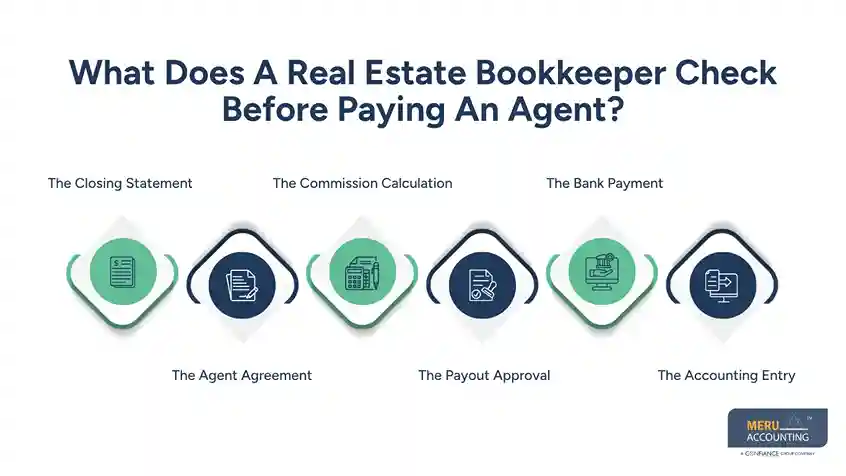
The Payout Approval
The payout should be approved under the brokerage’s own process. A second check can catch a wrong split, missed fee, or duplicate deal before payment.
The Bank Payment
The final payment should match the approved amount. A real estate bookkeeper should not mark a payout as complete just because a bank transaction looks close to the expected amount.
The Accounting Entry
The last check is the book entry itself. The income, agent payout, fees, and bank activity should tell the same story.
optional anymore
on running the business
How A Real Estate Bookkeeper Tracks Commission From Closing To Payout
Step 1: Closing
The process starts when the transaction closes. The brokerage records the commission based on its accounting method and the source records for the deal.
Step 2: Commission Review
The gross amount is checked against the closing statement. This is the first point where real estate commission tracking can catch a wrong amount.
Step 3: Agent Split
The agreed split is applied to the commission. For a $20,000 commission and a 70% split, the agent share is $14,000.
Step 4: Fees And Deductions
Valid fees are then recorded. In our example, a $250 fee leaves a net agent payout of $13,750. A real estate bookkeeper can also verify that approved fees and deductions are reflected correctly before the final payout is recorded.
Step 5: Payment
The approved amount is sent to the agent. The payment record should carry enough detail to show which deal it belongs to.
Step 6: Reconciliation
The bank payment is matched with the payout and accounting record. This final check gives real estate commission tracking a clear end point.
Where Can A Commission Payout Go Wrong?
The Old Split
An agent may move from a 60% split to a 70% split. If an old rate is used, the payout can be wrong even when the calculation itself is correct. A real estate bookkeeper should verify the current commission agreement before applying the split to avoid using an outdated rate.
The Double Entry
One closed deal may be entered twice. This can make commission income look too high and may also create two payout records.
The Missed Fee
A fee may be shown on the agent agreement but left out of the payout sheet. That can cause a gap between the approved amount and the amount sent.
The Wrong Bank Match
A payment may be matched to the wrong deal. This can make one transaction look paid while another remains open. The real estate bookkeeper can match the payment amount, transaction details, and bank entry to the correct deal before marking the commission as paid.
The Late Entry
A commission may be entered well after the deal closed. Late entries can make month-end figures less clear and may leave open balances that need review.
The Missing Source Record
A payout without a closing record or commission sheet is hard to prove later. A real estate bookkeeper should keep a clear trail for each deal.
How Does A Bookkeeper For Real Estate Reconcile Agent Payouts?
Review The Deal
A bookkeeper for real estate starts with the closed deal. The deal number, agent name, closing date, and commission amount are checked first.
Verify The Split
The split on the payout sheet is compared with the current agent agreement. This is key when a brokerage has many agents with different plans.
Check The Fees
Each fee should have a clear reason and amount. A bookkeeper for real estate should check that no fee is added twice or left out.
Payment Confirmation
The approved net amount is compared with the bank payment. If the numbers differ, the payment should stay open for review until the reason is clear.
Reconcile The Books
The final step is to compare the payout with the accounting entry. This ties the deal, cash, and books into one record.
Record The Difference
If there is a real difference, the reason should be noted. A short note can save time when the same deal is reviewed weeks or months later.
Which Records Should Stay With Each Commission?
Closing Records
Keep the closing statement or other source record used to confirm the commission. It gives the real estate bookkeeper a base for the amount recorded.
Agent Split Records
Keep the current agent agreement or approved split record. This shows why a certain share was used for the payout.
Commission Sheets
A commission sheet can show the full math in one place. It may include gross commission, agent share, fees, and net payment.
Bank Records
Bank records show when cash came in or went out. They are key when the bookkeeper for real estate checks the final payment.
Payment Records
Keep the payment date, amount, agent, and deal reference. This makes past payout questions easier to answer.
Reconciliation Notes
If a difference was found and fixed, keep a short note. That creates a better record than changing a number with no explanation.
Can Accounting Software Track Real Estate Commission Payouts?
Deal Tags
Many accounting systems allow classes, jobs, projects, or other tags. A real estate bookkeeper can use these fields to link entries to a deal or agent.
Bank Feeds
Bank feeds can bring payment data into the accounting system. They can save time, but each match still needs a review before it is accepted.
Recurring Rules
Some entries may follow the same pattern each month. Rules can reduce data entry, but unusual commission deals still need a human check.
Reports
Reports can show income, agent costs, open payouts, and bank activity. Good reports give the real estate bookkeeper a way to spot gaps before month-end close.
Approval Controls
Some systems allow review before a payment is marked as final. That extra check can be useful for brokerages with many agents.
Source Documents
Software should not be treated as the only record. Closing statements, agreements, and payout sheets still matter when a deal needs to be checked.
What Happens When Commission Records Do Not Match?
The Agent Questions The Payout
An agent may ask why the amount paid is lower than expected. The answer should come from the deal record, not from guesswork.
The Bank Does Not Match
The bank may show $13,500 while the payout sheet shows $13,750. The real estate bookkeeper must find the reason for the $250 gap.
The Income Looks Wrong
If the gross commission was entered twice, brokerage income may be overstated. A bank and book check can bring the error to light.
The Month-End Close Slows Down
Open commission items can delay the close. A bookkeeper for real estate can keep these items in a review list until each difference is cleared.
An Old Deal Needs Review
Months later, an owner may ask about a past payout. Accurate real estate commission tracking means the answer can be traced to the original deal and its records.
The Error Repeats
If the cause of an error is not found, the same issue may happen again. The better fix is to find the cause and change the check that allowed it.
How Meru Accounting Provides Real Estate Bookkeeping Services
Meru Accounting provides accounting and bookkeeping services for real estate firms that need clear financial records and consistent transaction checks.
Our real estate bookkeeper services can cover transaction entries, account reconciliation, commission records, bank matching, and financial reporting. The work can be set around the brokerage’s deal flow and accounting process.
For firms with many agents or closed deals, a bookkeeper for real estate can review commission records from the closing statement through the final payment. This gives the brokerage a clear record of what was earned, what was due, and what was paid.
Meru Accounting can also provide ongoing bookkeeping work for brokerages that need regular account checks and clean financial records.
Our Expert Perspective
Commission payout work is often treated as simple split math. In practice, the hard part is keeping each number tied to the right deal.
Our view is that a strong process should answer three questions for every payout: What deal caused the payment? How was the amount set? Does the bank payment match the approved amount?
When those answers are clear, the books are easier to check, and past payouts are easier to explain.
Key Takeaways
- A real estate bookkeeper must track more than the final agent payment.
- Every commission should link back to the closed deal and its source records.
- Real estate commission tracking should cover the gross commission, agent split, fees, and final payment.
- A bookkeeper for real estate should compare deal data, payout data, bank data, and accounting entries.
- Old split rates, duplicate entries, missed fees, and wrong bank matches are common sources of errors.
- Accounting software can reduce data entry, but commission records still need review.
- Clear source records make past agent payout questions much easier to answer.
FAQs
Accurate commission payout tracking ensures that each agent is paid the correct amount and that brokerage income, fees, and bank records match the closed deal.
A real estate bookkeeper tracks the closing amount, commission earned, agent split, deductions, approved payout, and final bank payment for each transaction.
A commission payout record should include the deal details, gross commission, agent split, fees or deductions, net payout, payment date, and transaction reference.
To reconcile a commission payout, compare the closing statement, agent agreement, commission calculation, payment record, and bank transaction to make sure the amounts agree.
Common errors include using the wrong agent split, entering a commission twice, missing a fee, paying the wrong amount, and failing to match the payout with the correct deal.
optional anymore
on running the business