
Three deals close on the same Friday. The brokerage receives commission on all three. One agent has a 70/30 split. Another has reached a commission cap. The third deal includes a referral fee paid to another broker. At the same time, the New York branch has paid an expense for the Chicago office, while the finance team is trying to match deposits from four bank accounts. On paper, it looks like a good sales day. For the accounting team, it can be a very busy one. This is where real estate brokerage accounting software becomes more than a place to record income and expenses.
The right accounting software for real estate brokers should show where each commission came from, how much belongs to the agent, what the brokerage keeps, which branch owns the cost, and whether the final payment matches the books.
A small brokerage may manage this with spreadsheets and basic accounting tools. As the number of agents, deals, branches, and commission plans grows, that approach can become harder to review.
This blog looks at real estate brokerage accounting software from the point of view of actual brokerage work. Instead of only listing features, we will look at what happens to the numbers from a closed deal to agent payment, and then compare what changes when the brokerage has several branches.
What You Will Learn From This Blog
- How brokerage accounting differs from standard real estate accounting.
- What happens to commission data after a deal closes.
- Which features matter when comparing real estate brokerage accounting software.
- How agent splits, referral fees, deductions, and payments should be recorded.
- What changes when one brokerage operates several branches.
- How to test accounting software for real estate brokers before choosing a system.
How Brokerage Accounting Differs From General Real Estate Accounting
Agent Commission Records
A brokerage must track money due to agents after a deal closes. This can include split rates, caps, fees, and other agreed terms. Basic property books may not need this level of detail.
Deal-Level Income
Brokerage income is tied to sales and lease deals. Each deal may have its own gross commission, agent share, firm share, referral fee, and other costs. Real estate brokerage accounting software should keep these amounts linked to the right deal.
Agent And Broker Splits
A single commission may be split between an agent and the brokerage. Some firms also use team splits or tiered plans. The system should show how the final amount was set.
Branch-Level Costs
A multi-branch firm may have rent, staff pay, ads, and other costs for each office. These costs need clear branch tags so managers can see branch results.
Client And Trust Funds
Some firms may hold funds that need separate treatment based on local rules. The book setup must match the firm’s legal and tax needs. A CPA or other qualified tax expert should review any area with special rules.
What Should Real Estate Brokerage Accounting Software Include?
Commission Tracking
The system should record gross commission income and the split due to each agent. This is one of the key tests for real estate brokerage accounting software.
Agent Pay Records
Agent pay should link back to the deal that created the payment. A good setup can show gross pay, fees, deductions, and the final amount due.
Bank Reconciliation
Bank feeds and reconciliation tools can cut down on manual entry. Each deposit and payment should still be checked against source records before books are closed.
Branch Reports
For firms with many offices, branch reports are vital. Managers should be able to view income, costs, and profit by branch without losing the full firm view.
User Access
Not every staff member needs full access to financial data. Accounting software for real estate brokers should allow firms to set user roles based on job needs.
System Integrations
The system may need links with CRM tools, transaction tools, payroll systems, payment tools, or tax systems. The goal is to reduce repeat entry while keeping source data clear.
How Does Commission Accounting Work In Real Estate Brokerages?
Recording Commissions From Closed Transactions
When a deal closes, the brokerage records the commission due under the deal terms. The entry should match the closing statement and the amount the brokerage is set to receive.
Splits Between Agents And Brokers
The gross commission is then split based on the agent’s plan. For example, if a brokerage receives $20,000 and the agent share is 70%, the agent’s gross share is $14,000 before any other valid deductions.
Referral Fees And Co-Broker Commissions
Some deals include referral fees or payments to another broker, which accounting software for real estate brokers can track separately from the brokerage’s own commission income. These amounts should be tracked apart from the firm’s net commission so that income and costs are not mixed.
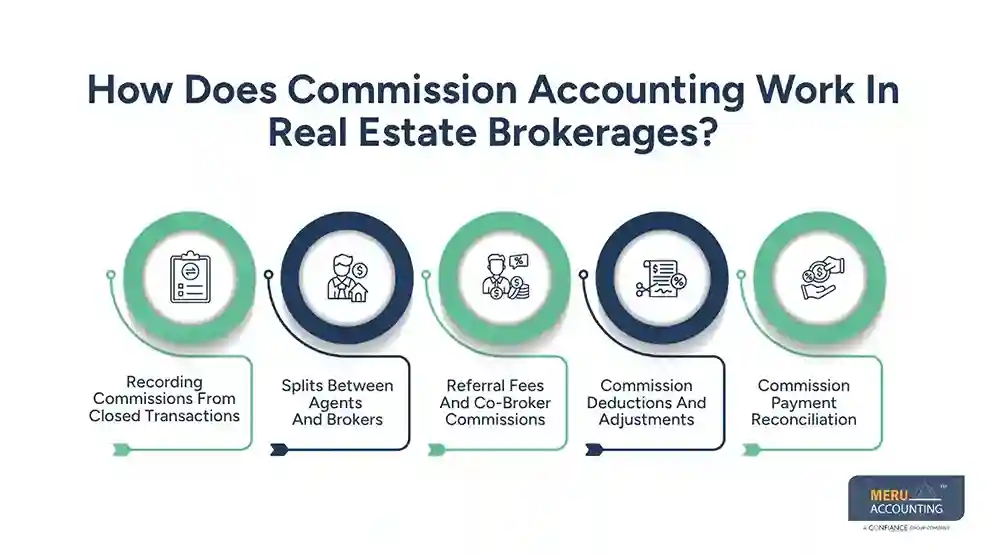
Commission Deductions And Adjustments
Errors, refunds, fees, caps, or later changes can affect agent pay. Real estate brokerage accounting software should keep a clear record of each change and its reason.
Commission Payment Reconciliation
The final agent payment should match the commission record and the bank payment. Regular checks can find unpaid amounts, duplicate entries, or payment differences before month-end close.
optional anymore
on running the business
Best Real Estate Brokerage Accounting Software For Commission Management
Software Comparison Criteria
Start with the firm’s size, deal count, agent count, branch count, and reporting needs. Real estate brokerage accounting software should fit the firm’s process rather than force the firm into a complex setup.
Commission Tracking Capabilities
Check if the system can record agent splits, team splits, fees, caps, referrals, and changes. It should also show the link between a deal and the final commission entry.
Agent Payment Features
Look for clear agent statements and payment records. The finance team should be able to see what was earned, what was taken out, and what was paid.
Reporting And Reconciliation
Reports should cover income, costs, agent pay, unpaid items, and bank activity. Accounting software for real estate brokers is more useful when reports can be checked against the books.
Integration Capabilities
Check if the system can connect with the tools already used by the brokerage. Good links can reduce duplicate entry, but each link should be tested for data accuracy.
Ease Of Review
A finance manager should be able to trace a number from a report back to its source. Clear audit trails, deal IDs, dates, and notes make this review much easier.
How To Compare Real Estate Brokerage Accounting Software For Multi-Branch Operations
Branch-Level Accounting
Each branch should have its own income and cost tags. Real estate brokerage accounting software should let the firm see branch data while keeping the main books in one system.
Centralized Financial Reporting
Head office may need one view of the full firm. Central reports should combine branch results without removing the detail needed for branch review.
Inter-Branch Transactions
Money or costs may move from one branch to another. These entries should be marked as inter-branch items so they are not counted as outside income or cost by mistake.
User Permissions And Access Controls
Branch staff may only need access to their own office. Senior finance staff may need access to all offices. Role-based access can keep data limited to the right users.
Consolidated Reporting
Owners may want one profit report for the full firm and separate reports for each branch. Accounting software for real estate brokers should make both views easy to review.
Branch Performance Review
Branch reports can show sales income, agent pay, rent, staff cost, and other expenses. This gives managers a sound base for monthly review and budget checks.
Common Accounting Challenges For Multi-Branch Real Estate Brokerages
Maintaining Separate Branch Records
When branch records are not tagged in a clear way, costs may be posted to the wrong office. A set chart of accounts and branch codes can keep data in order.
Tracking Agent Commissions
Agent plans may differ by person, team, or deal type. Real estate brokerage accounting software should keep each plan and payment easy to trace.
Reconciling Multiple Bank Accounts
A firm with many branches may have several bank accounts. Each account needs its own bank match and review before the firm’s books are closed.
Consolidating Financial Statements
Branch books must be brought into one firm view. This can be hard when each office uses a different process or chart of accounts.
Managing Inter-Branch Transactions
A payment made by one branch for another branch can create errors in both sets of books. The entry should show which branch paid, which branch received the cost, and why.
Why Choose Meru Accounting For Brokerage Accounting
Meru Accounting provides accounting and bookkeeping services for real estate brokerages that need clear books, commission records, and branch-level financial data. Our work can include account reconciliation, transaction review, financial reporting, and ongoing bookkeeping based on the brokerage’s needs.
For firms that use real estate brokerage accounting software, Meru Accounting can work with the firm’s accounting setup and review the data recorded in the books. This can be useful when a brokerage has many agents, a high deal count, or more than one branch.
Our team works with tools such as QuickBooks, Xero, Zoho Books, NetSuite, and Odoo. Meru Accounting also provides accounting services for US businesses and works with US GAAP and IRS-related accounting needs.
The key is not only to choose accounting software for real estate brokers but also to keep the books set up and reviewed in a consistent way. Software records data; proper accounting processes make that data useful for financial review.
Our Expert Perspective
When comparing real estate brokerage accounting software, do not start with the software demo. Start with your hardest deal.
Take a closed transaction with an unusual commission split, a referral fee, an adjustment, and a bank payment. Then add a branch transfer and ask the system to produce both the agent statement and the company report.
If the numbers remain easy to trace, the system is worth a closer look.
If the finance team still needs several spreadsheets to explain what happened, more software features may not solve the real issue. The accounting process itself may need to be reviewed.
Key Takeaways
- Real estate brokerage accounting software should cover commissions, agent pay, bank records, reports, and branch data.
- Commission records should match closed deals and approved payment terms.
- Agent splits, referral fees, deductions, and adjustments need clear records.
- Multi-branch firms need branch tags, access rules, inter-branch records, and consolidated reports.
- Bank accounts should be reconciled on a regular basis.
- Accounting software for real estate brokers should fit the firm’s size, deal flow, branch setup, and reporting needs.
- A strong accounting process is still needed even when the firm uses good software.
- Meru Accounting provides accounting and bookkeeping services for firms that need structured financial records and regular review.
FAQs
The best accounting software for a real estate brokerage is one that tracks commissions, agent splits, expenses, bank transactions, and branch-level financial data.
Real estate brokerage accounting software should include commission tracking, agent payments, bank reconciliation, financial reports, user access controls, and branch reporting.
Real estate brokerages track agent commissions by recording the closed deal, gross commission, agent split, deductions, fees, and final payment due to the agent.
Accounting software for a multi-branch real estate brokerage should provide branch-level records, centralized reporting, inter-branch entries, user permissions, and consolidated financial statements.
Yes, real estate brokerage accounting software can track commission splits between agents, brokers, teams, referral partners, and the brokerage when the system has commission management features.
optional anymore
on running the business