
Real estate investors today face increasing pressure to make financially sound decisions in changing property markets. Understanding real estate investment pros and cons has become essential for reducing risk, improving returns, and supporting long-term investment growth.
CFO services play a central role in this process by reviewing cash flow patterns, cost behavior, tax effects, and long-term value trends. Each decision is studied through financial reports, risk models, and accounting records. This structured approach reduces emotional bias in investment selection.
The use of real estate investment accounting adds another layer of clarity. It helps in tracking income streams, operating costs, and asset performance in a structured way. Together, the CFO review and accounting data build a strong base for decision-making in property investment.
What You Will Learn From This Blog
- How CFO services study real estate investment pros and cons in detail
- How financial reports guide property decisions
- Role of accounting data in investment clarity
- Key financial metrics used in property evaluation
- How is risk measured in real estate decisions
- Practical insight into CFO led investment review
- Real examples of structured financial decision-making
Role of CFO Services in Real Estate Investment Evaluation
Financial Structure Review
CFO services begin with a full review of income, cost, and asset structure before any investment decision. Each property is checked for revenue strength, expense load, and long-term financial balance.
Cash Flow Monitoring
Cash flow is tracked over time to understand the stability of rental income and recurring costs. This review directly reflects real estate investment pros and cons by showing income strength versus payment pressure.
Capital Allocation Planning
Funds are distributed after comparing multiple property options and their expected financial return. This helps ensure capital is placed in assets that show better risk balance and growth potential.
Financial Reporting Control
Regular reports are prepared to track income, expenses, and overall property performance. These reports are often backed by real estate investment accounting systems for accuracy and clarity.
Investment Feasibility Study
CFOs run feasibility checks to see if a property fits financial goals and return expectations. This process evaluates long-term viability using structured financial data instead of assumptions.
Real Estate Investment Pros And Cons: Financial Analysis Perspective
Income Stability Analysis
Rental income consistency is studied over long periods to understand financial reliability. Stable income patterns reduce uncertainty in property performance and improve planning accuracy.
Cost Pressure Review
Maintenance, tax, and repair costs are reviewed in detail to understand the ongoing financial load. High recurring expenses can reduce net returns and affect overall investment strength.
Asset Value Growth
Property appreciation trends are studied using market data over different time cycles. This analysis of real estate investment pros and cons helps identify long-term value growth versus market correction risk.
Liquidity Constraints
Real estate is less liquid compared to other financial assets and requires more time to convert into cash. This limitation is considered carefully while evaluating exit flexibility and capital recovery timing.
Market Sensitivity
Property values change based on interest rates, demand cycles, and economic conditions. CFOs track these movements closely to understand the possible impact on investment stability.
Financing Impact
Loan dependency affects profit margins due to interest costs and repayment pressure. CFOs study this factor to understand how borrowing influences overall investment returns.
CFO Evaluation of Real Estate Investment Pros and Cons in Decision Making
Structured Decision Models
CFOs use structured models to compare different investment options in a consistent way. These models convert financial and operational data into clear comparison points for better decision-making.
Scenario Testing
Different market conditions are tested to understand how returns may change over time. This process helps assess risk exposure under interest rate shifts, vacancy changes, and cost fluctuations.
Long-Term Value Projection
Future property value is estimated using financial forecasting tools and market data trends. These projections help investors understand potential growth and financial stability over time.
Tax Effect Review
Tax impact is reviewed for each property, including deductions, liabilities, and compliance factors. This step directly influences real estate investment pros and cons by changing net return outcomes after tax planning adjustments.
Portfolio Balance Check
CFOs review how a new property fits within the existing investment portfolio structure. This ensures diversification is maintained and financial exposure is not concentrated in one area.
Exit Strategy Planning
Exit options are planned before final approval to understand liquidity and resale possibilities. This planning helps investors prepare for future market changes and capital recovery needs.
How Real Estate Investment Accounting Supports Decision Making
Income Tracking Systems
Rental income is recorded through structured systems that maintain clear financial records. Accurate income tracking allows CFOs to review cash flow patterns and revenue consistency.
Expense Classification
Operating costs are grouped into categories such as maintenance, tax, insurance, and repairs. Clear classification increases reporting accuracy and makes financial review more organized.
Asset Valuation Records
Property values are updated using both market trends and internal financial records over time. Detailed valuation records strengthen real estate investment accounting by improving accuracy in asset reporting and investment review.
Loan Tracking Accuracy
Loan payments, interest charges, and repayment schedules are recorded in detail for each property. Proper loan tracking gives clearer visibility into debt obligations and financing pressure.
Tax Compliance Data
Tax records are maintained for every asset to ensure reporting remains accurate and complete. Proper compliance tracking allows CFOs to review liabilities, deductions, and filing requirements efficiently. Proper compliance tracking allows CFOs to review liabilities, deductions, and filing requirements efficiently.
Key Financial Metrics Used By CFO Services
Net Operating Income
NOI measures the total income generated after operating expenses are deducted from rental revenue. It gives a clear view of property profitability before financing and tax effects are applied.
Internal Rate Of Return
IRR measures the long-term return expected from a property over its holding period.
CFOs use it to compare investment options based on time-adjusted return performance.
Cash On Cash Return
This metric shows actual cash earned compared to cash invested in the property. It helps investors understand real earnings strength from ongoing rental income.
Debt Service Coverage Ratio
DSCR checks whether rental income is enough to cover loan repayments comfortably. It is used to assess financial safety and borrowing capacity in property investments.
Capitalization Rate
Cap rate measures return based on property value and operating income levels. It plays a key role in understanding real estate investment pros and cons by showing income efficiency versus asset cost.
Expense Ratio
Expense ratio compares total operating costs with the generated income from the property. CFOs use it to identify cost pressure and the overall financial efficiency of investments.
Risk Assessment in Real Estate Investment Pros and Cons Evaluation
Market Risk Review
Market cycles directly impact property demand, pricing, and rental yield over time. CFOs study historical trends and current indicators to understand exposure to price fluctuations.
Tenant Risk Analysis
Tenant stability affects rent continuity, vacancy levels, and cash flow predictability. This becomes central in real estate investment pros and cons evaluation because unstable tenancy can weaken income consistency.
Interest Rate Risk
Loan costs change when interest rates rise or fall, directly impacting repayment burden. CFOs monitor rate movements to estimate future financial pressure on leveraged properties.
Regulatory Risk Check
Changes in property laws, tax rules, or compliance standards can affect net returns. This risk is included to understand how external policy shifts may influence investment outcomes.
Operational Risk Study
Property maintenance issues, vendor delays, and management gaps can increase operating costs. CFOs assess these risks to ensure long-term property performance remains stable and controlled.
How CFO Services Improve Investment Decision Accuracy
Data-Based Decisions
CFOs rely on structured financial data collected from accounting systems and property reports. Structured analysis reduces errors in real estate investment pros and cons decisions by replacing assumptions with verified financial records.
Forecast Accuracy
Financial models combine historical trends, market signals, and cost behavior to project future outcomes. Clear projections help investors understand income stability and long-term property value movement.
Better Cost Control
Detailed tracking of operating expenses highlights unnecessary costs and irregular spending patterns. Stronger control over expenses improves visibility across single and multi-property portfolios.
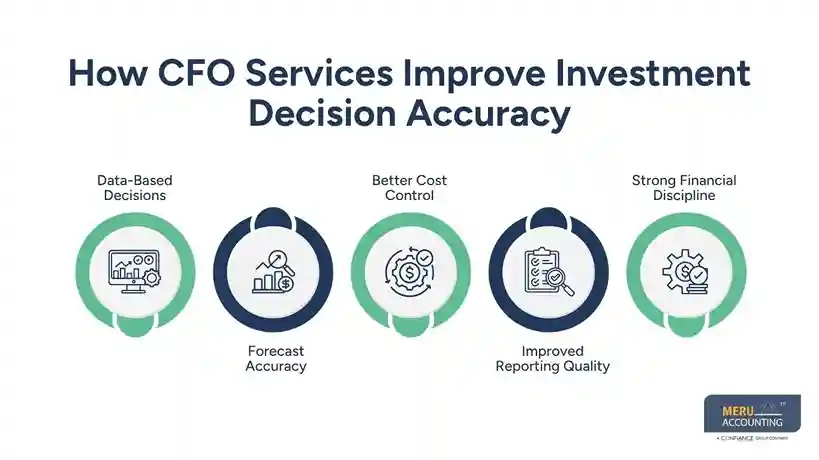
Improved Reporting Quality
Reports present income, expenses, and asset performance in a structured financial format. Investors gain clearer insight into property health and financial progress over time.
Strong Financial Discipline
Regular financial reviews maintain consistent monitoring of investment performance and risk exposure. Decision-making stays aligned with long-term capital goals and portfolio stability.
Why Choose Meru Accounting?
Meru Accounting provides structured financial and advisory support for property investors who need clarity in decision-making. Our team works closely on real estate investment accounting to ensure accurate records of income, costs, and asset values.
We assist investors in understanding real estate investment pros and cons through detailed financial reports, cash flow tracking, and investment analysis. Our CFO level support helps clients reduce confusion in property selection and long-term planning.
By combining accounting systems with financial review methods, Meru Accounting builds clear reporting structures that improve investment decisions. We also help clients align real estate investment accounting with compliance needs across different regions.
Our approach focuses on clean reporting, steady monitoring, and structured review so that real estate investment pros and cons are evaluated with real financial data, not assumptions.
Key Takeaways
- CFO services study real estate investment pros and cons through financial data
- Accounting systems play a key role in property tracking
- Risk and return are measured using clear financial metrics
- Structured review reduces decision errors
- Long-term planning depends on cash flow and cost behavior
- Real estate investment accounting supports accurate reporting
FAQs
CFO services study property income, cost, and risk data. They help investors understand real estate investment pros and cons before making decisions.
Financial analysis shows real profit and risk levels. It helps in reviewing real estate investment pros and cons in a clear way.
Accounting records income and expenses in detail. This supports real estate investment accounting and improves decision clarity.
CFOs use NOI, IRR, DSCR, and cap rate. These metrics guide real estate investment pros and cons.
Yes, CFO services identify financial and market risks early. This improves understanding of real estate investment pros and cons before investing.