
Real estate office management software gives brokers one place to track office costs, agent fees, commissions, bills, and key records. A real estate office may handle many deals at once, so clear records are vital for good cash flow and sound books. The right real estate office management software can link deal data with office costs and brokerage payouts.
The best choice is not just the tool with the most features. It should fit the size of the firm, the way agents are paid, the type of deals handled, and the level of detail needed in reports. IRS guidance also stresses that business records should clearly show income and expenses and should be backed by source records.
What You Will Learn From This Blog
- How real estate office management software can track daily office costs.
- How brokerage firms can record agent commissions and fee splits.
- Which features matter when firms compare real estate office software.
- How to review reports, controls, records, and ease of use.
- How Meru Accounting can provide accounting and bookkeeping services for real estate firms.
Introduction To Real Estate Office Management Software
Real estate office management software brings key office data into one system, including bills, fees, sales data, agent payouts, and other costs. Firms can sort expenses by type, date, agent, office, or vendor, making it easier to track rent, ads, payroll, software fees, travel, and other office costs. This gives managers a clearer record of where office funds are being spent. It also makes it easier to review costs when preparing monthly financial reports.
The software can also keep deal details such as sale value, agent name, fee rate, and payout in one record. Set rules can reduce repeat data entry and lower the risk of missed entries or wrong totals that may occur with manual sheets.
Managers can review each deal without checking several separate files or sheets. A clear deal record also makes it easier to check the amount due to the agent and the brokerage.
Clear records give managers a better view of cash flow by showing money received, expected fees, paid bills, pending agent payouts, and other amounts due. This makes it easier to review office finances and track the results of each deal.
Managers can also compare income with office costs to see the firm’s current cash position. Regular checks can bring attention to unpaid bills, pending commissions, or unusual changes before month-end records are closed.
How Real Estate Office Management Software Handles Office Expenses
Rent And Office Bills
A real estate office may pay rent, power bills, phone costs, and other site costs each month. Real estate office software can sort these bills by cost type and date.
Marketing Costs
Ads, signs, mailers, photo work, and web ads can add up fast. A system can tag each cost by agent, campaign, deal, or office so managers can review spend.
Agent-Related Costs
Some firms pay for desk fees, listing costs, travel, or other agent costs. Real estate office management software can track such costs with the right account and agent record.
Bill Approval
Bills should pass through a clear review step before payment. A good system can show who made the bill, who checked it, and when it was paid.
Expense Reports
Expense reports should show more than a total cost. Real estate office software should show the date, vendor, account, amount, and source record tied to each cost.
The IRS notes that supporting records can include invoices, receipts, account statements, and other proof of business expenses.
Vendor Expense Tracking
Real estate firms often pay many vendors for advertising, repairs, office supplies, software, and other services. The system can keep vendor names, bill dates, amounts, and payment status in one record for easier review.
How Real Estate Office Management Software Manages Brokerage Commissions
Deal-Based Commission Rules
Brokerage firms often use set rules for agent splits and office fees. Real estate office management software can store those rules and apply them to each deal.
Agent Split Tracking
A deal may split income between an agent and the brokerage. The system should show the gross amount, split rate, office share, agent share, and final payout.
Team And Broker Splits
Some firms use team-based splits or different rates for certain agents. Real estate office software should allow each approved plan to be tracked with clear records.
Commission Adjustments
Deals can change after the first payout is set. A strong system should record added fees, refunds, changes, or other adjustments without hiding the first entry.
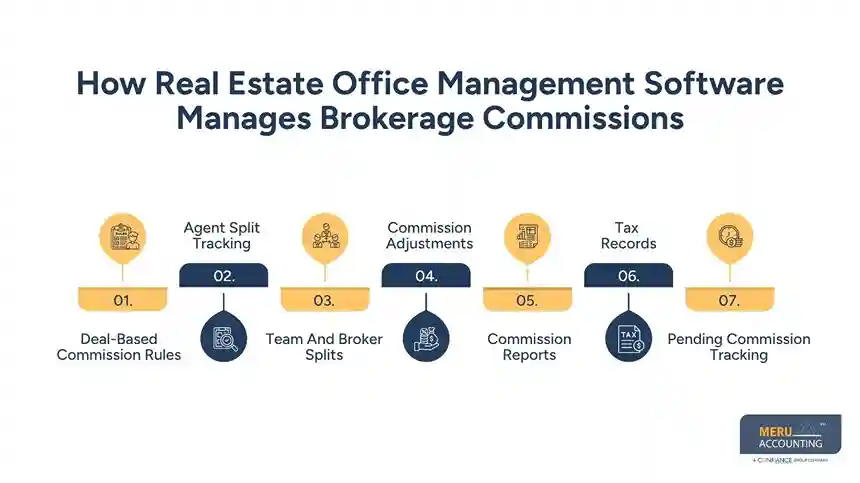
Commission Reports
Managers need reports that show what was earned and what was paid. Reports should also show unpaid commissions and amounts still due to agents.
Tax Records
Commission data can feed into the firm’s books and year-end work. For U.S. businesses, tax reporting rules can apply to certain commission and fee payments, so firms should review current IRS rules with their tax adviser.
Pending Commission Tracking
Some commissions may remain unpaid while a deal is still being processed or funds are waiting to clear. The system can show pending amounts, expected payment dates, and agent payouts so managers can track what is still due.
optional anymore
on running the business
Essential Features For Comparing Real Estate Office Software
Expense Tracking
Expense tools should let staff record bills by account, vendor, date, amount, and office. Real estate office management software should also keep the source file tied to the entry.
Commission Rules
Look for tools that can handle different agent splits and fee plans. A fixed rule can reduce the risk of a wrong payout when many deals close in the same month.
Bank And Book Data
Bank feeds can cut down on manual entry, but each feed still needs review. Real estate office software should make it easy to match bank activity with bills, fees, and deal records.
User Access
Not every staff member needs access to all financial data. User roles should limit who can view, add, edit, approve, or pay certain items.
Audit Trail
A good audit trail shows key changes to financial data. Managers can then see who changed an entry, what changed, and when the change took place.
Reporting
Reports should cover income, costs, agent payouts, unpaid bills, and cash flow. Real estate office management software should let users filter reports by agent, deal, vendor, date, and account.
How To Choose The Best Real Estate Office Management Software
Match The Firm Size
A small brokerage does not need the same setup as a large multi-office firm. Start with the number of agents, deals, users, offices, and monthly transactions.
Check Commission Needs
Review each split type the firm uses before picking a tool. Test a few real deal cases to see if the system can produce the right payout.
Test Expense Workflows
Enter real bills during the review stage. Check whether real estate office software can route bills for review and keep proof with each entry.
Review Data Controls
Financial data needs strong access rules and clear logs. Ask how the tool handles user roles, edits, backups, data export, and record retention.
Check Report Depth
Do not judge reports by looks alone. Test if real estate office management software can show the exact data needed for month-end books, management review, and tax work.
Measure Total Cost
Look beyond the monthly software fee. Include setup, user fees, add-ons, data migration, payment fees, and any outside accounting work.
Managing Real Estate Office Finances With Meru Accounting
Real Estate Bookkeeping
Meru Accounting provides accounting and bookkeeping services for real estate firms. Records can cover income, expenses, bank activity, bills, and other core financial data.
Expense Record Management
Real estate firms need clean records for rent, ads, office costs, vendor bills, and other expenses. Meru Accounting can maintain books with clear account and transaction records.
Commission Bookkeeping
Agent payouts can create many entries across a busy brokerage. Meru Accounting provides accounting and bookkeeping services that record commission income and related payouts in the books.
Monthly Financial Reports
Monthly reports can show income, expenses, assets, liabilities, and cash activity. Such reports give owners and managers a clear view of the firm’s financial position.
Tax Ready Books
Good tax work starts with clean financial records. Meru Accounting maintains accounting records that can be used for tax review and year-end financial work.
Accounting Software Data
Real estate office management software can hold deal and office data, while accounting work keeps the books in order. Meru Accounting can work with accounting data to keep financial records current and well organized.
Our Expert Perspective
The best approach is to choose software that fits the firm’s accounting process and test it with real deal cases, such as sales, commission splits, changes, unpaid bills, and month-end close. Automation can reduce manual entry, but staff should still review unusual costs, commission changes, refunds, and large payments. Firms should also keep invoices, receipts, and other source records that support income and expenses, then review costs, agent payouts, unpaid bills, bank matches, and other key reports each month.
Key Takeaways
- Real estate office management software should track both office costs and brokerage income.
- Expense records should show the vendor, date, amount, account, and source document.
- Commission tools should handle agent splits, fees, adjustments, and payouts.
- Real estate office software should offer clear reports and user access controls.
- Audit trails are useful when staff need to review changes in financial records.
- Real estate office management software should fit the firm’s size and deal flow.
- Real estate office software should work well with the firm’s accounting process.
- Meru Accounting provides accounting and bookkeeping services for real estate firms.
FAQs
The best real estate office management software tracks office expenses, brokerage commissions, agent splits, bills, and financial reports in one system.
Key features include expense tracking, commission management, agent splits, billing, reporting, user access, bank links, and audit records.
Real estate office software tracks the deal value, commission rate, agent split, brokerage share, fees, adjustments, and final payout.
Accounting software for real estate firms records expenses by vendor, date, account, amount, property, agent, or office and keeps related records for review.
Choose software for a real estate office based on expense tracking, commission rules, reporting, user access, accounting links, ease of use, and total cost.
optional anymore
on running the business