There are many types of business structures made by law for different needs. Many people may not know why the type of business matters, but it is a very big deal. LLCs and S Corporations are two common choices for small businesses. An LLC is a legal business structure, while an S Corporation is a federal tax election that eligible businesses can choose. It’s important to look at how they work and which one fits best. For this, we will understand SCorp vs LLC in this blog.
First, you should know when a business needs either of them. An LLC is a kind of business you must create legally with the state. But an SCorp is not formed the same way. It is not a new business type. Instead, it is a special way a business chooses to pay taxes. You can choose to be taxed as an SCorp after forming a business like an LLC or a corporation. This blog will explain SCorp vs LLC in simple words to help you choose the best one.
What You Will Learn From This Blog
After reading this blog, you will understand:
- The key differences between an SCorp and an LLC.
- How each business structure affects taxes, liability, and daily operations.
- The advantages and limitations of choosing an SCorp or an LLC.
- Which business type may be a better fit based on your business size and goals?
- Common factors to consider before deciding between an SCorp and an LLC.
What Is an LLC and an SCorp?
When you start a business, you have to choose what kind of business it will be. Two popular types are LLC and SCorp. People often compare an SCorp vs. an LLC to decide which is better for their needs.
LLC stands for Limited Liability Company. It is a type of business that helps protect the owner’s money. If the business loses money or gets into trouble, the owner’s house, car, and savings are safe. A Limited Liability Company is easy to start and gives you the power to run the business your way. By default, an LLC uses pass-through taxation, so business income is generally reported on the owners’ personal tax returns. An LLC can also choose a different tax treatment if it better suits the business.
SCorp stands for S Corporation. It is not a type of business you form. It is a way to tell the tax office (IRS) how you want your business to be taxed. When an eligible business elects S Corporation tax status, it may reduce self-employment taxes in some cases while meeting IRS requirements. Personal liability protection comes from the LLC or corporation you form under state law, not from the S Corporation tax election itself. But an SCorp has more rules and paperwork.
So, in the talk about S Corporation vs Limited Liability Company, both can help small businesses grow, but they work in different ways.
S Corporation vs Limited Liability Company – A Comparison
Formation Requirements and Costs
To start both an SCorp and a Limited Liability Company, you must fill out forms and pay fees to the state.
- S Corporation: You first form an LLC or a corporation with your state. If eligible, you can then elect S Corporation tax status with the IRS.
- Limited Liability Company: You fill out forms with the state to start the company.
In an S Corporation vs. Limited Liability Company comparison, an LLC is a legal business structure, while an S Corporation is a federal tax election. Both may involve filing fees and ongoing compliance costs.
Personal Liability
Both types protect your own things, like your house or car, if your business loses money.
- S Corporation: Owners are called shareholders and generally are not personally liable for business debts when legal requirements are met.
- Limited Liability Company: Owners are called members, and they’re also safe from business debts.
Administrative Rules
This means the rules you have to follow each year.
- S Corporation: Corporations that elect S Corporation tax status generally must follow corporate formalities such as holding meetings, keeping records, and filing required reports.
- Limited Liability Company: You can skip some of those steps. States often need less from LLCs.
Management Style
This is how you run your business day to day.
- S Corporation: Shareholders vote and pick directors who make big decisions.
- Limited Liability Company: The members (owners) can choose how they want to manage everything.
Business Life (Term)
This tells how long the business can stay open.
- S Corporation: The business keeps going, even if an owner leaves or passes away.
- Limited Liability Company: It can also keep running unless state law says otherwise.
Taxes
Both generally use pass-through taxation by default, so business income is usually reported on the owners’ personal tax returns, although state tax rules may differ.
- S Corporation: Business income generally passes to the owners, who report it on their personal tax returns.
- Limited Liability Company: Business income generally passes to the owners, who report it on their personal tax returns under the default tax treatment.
Double Taxation
This happens when the same money gets taxed twice.
- S Corporation: No double tax.
- Limited Liability Company: Under the default tax treatment, an LLC generally avoids double taxation, although it can elect corporate taxation if desired.
Ownership Transfers
This means how easy it is to give or sell part of your business.
- S Corporation: Shares can generally be owned only by eligible shareholders under IRS rules, such as U.S. citizens or resident aliens.
- Limited Liability Company: You can sell your share, but only if the agreement allows it.
Raising Money
Sometimes businesses need more cash to grow.
- S Corporation: A corporation can raise capital by issuing stock, but S Corporations must follow IRS ownership and stock restrictions.
- Limited Liability Company: You can sell a piece of the business, but you need to follow the rules.
Ease of Operation
This means how simple it is to run your business.
- S Corporation: You need to keep notes, have board meetings, and follow many rules.
- Limited Liability Company: You can run the business in a simple way with fewer rules.
optional anymore
on running the business
How to Choose Between an S Corporation and a Limited Liability Company
Picking between SCorp vs Limited Liability Company is an important step when you start a business. Both are good, but they work in different ways. Here are some easy tips to help you choose the right one.
How Big Is Your Business?
- If your business is small or just starting, a Limited Liability Company is a smart and easy choice. It has fewer rules and is simple to run.
- If your business is growing fast, or you want to hire more people, an SCorp may save you money on taxes.
How Do You Want to Pay Taxes?
- Both S Corporation and Limited Liability Company don’t pay tax as a business. The owner pays tax on the money they earn.
- With an S Corporation, some owners may reduce self-employment taxes because qualifying profit distributions are generally not subject to self-employment tax.
- If you want simpler management and flexible tax options, a Limited Liability Company may be a better choice. If you want to save more when you grow, an SCorp may be better.
What Are the State Rules?
- State rules vary, and some states impose additional taxes, fees, or filing requirements on businesses that elect S Corporation tax status.
- A Limited Liability Company is allowed in every state and often has fewer rules.
- It’s smart to check your state’s website or ask someone who knows the law.
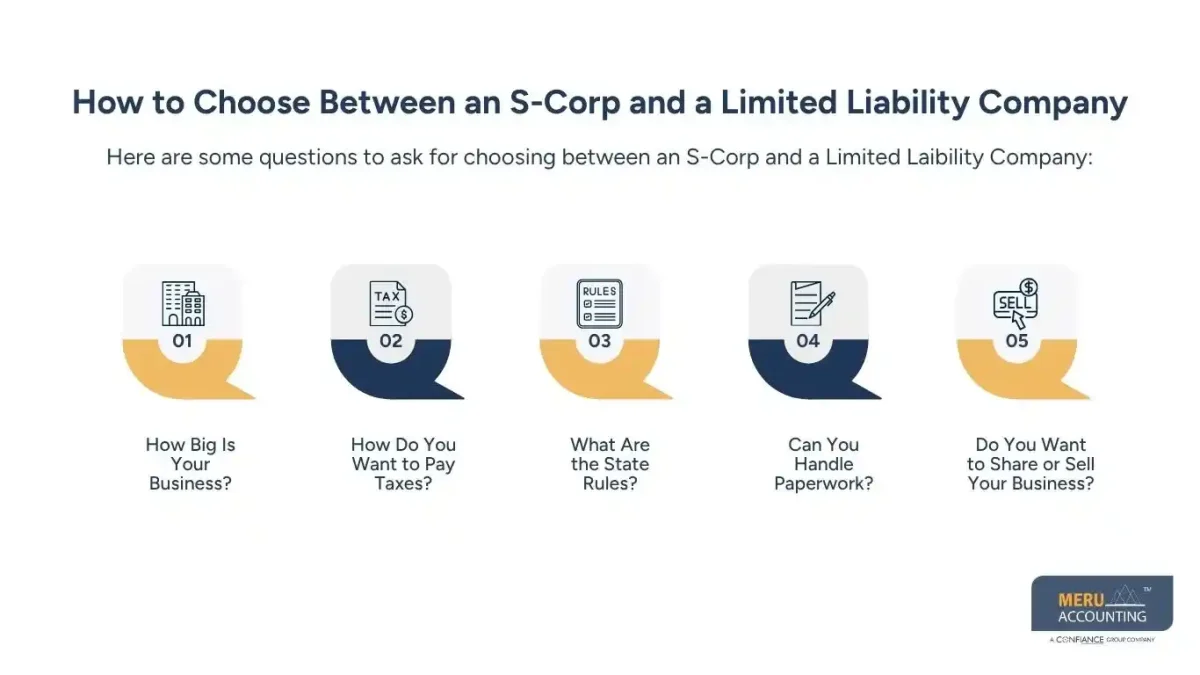
Can You Handle Paperwork?
- Businesses taxed as S Corporations may have additional tax and recordkeeping requirements. Corporations must also follow the formal requirements set by state law.
- A Limited Liability Company is easy. It has fewer forms and no big meetings.
- If you don’t like lots of paperwork, a Limited Liability Company is the best pick.
Do You Want to Share or Sell Your Business?
- SCorp lets you sell stock to raise money. But only some people can buy it.
- A Limited Liability Company lets you sell a part of the business too, but you must follow the rules in your papers.
Both can raise money, but an SCorp may do it faster if allowed.
When choosing between SCorp vs LLC, it depends on what your business needs. Both an LLC and a corporation that elects S Corporation tax status generally provide personal liability protection when properly maintained and commonly use pass-through taxation, although tax treatment can vary based on elections and state law. An LLC is simple and easy to run, which is great for new or small businesses.
S Corporation has more rules, but it may save you money on taxes if your business grows. If you are not sure which one to pick, you can talk to experts like Meru Accounting. We help you choose the best option and keep your business safe and strong.
Our Expert Insight
Choosing between an SCorp and an LLC is about more than taxes. The right structure should match your business goals, expected income, growth plans, and willingness to handle ongoing compliance. Many small businesses begin as an LLC because it is simple to manage, while growing businesses may benefit from electing SCorp tax status when the potential tax savings outweigh the added administrative work. Reviewing your options with experienced accounting professionals helps you make a decision that supports long-term business success.
Key Takeaways
- An LLC is a legal business structure, while an SCorp is a tax election.
- Both structures provide personal liability protection for business owners.
- LLCs offer greater flexibility and fewer compliance requirements.
- SCorps can reduce self-employment taxes for eligible businesses but require more formal administration.
- The best choice depends on your business size, income, growth plans, and state requirements.
FAQs
Yes. You can form an LLC first and later elect SCorp tax status by filing with the IRS if your business qualifies.
An S Corporation may reduce self-employment taxes for some businesses, while a Limited Liability Company offers simpler tax and management rules.
Yes. Both business structures help separate your personal assets from business debts and liabilities.
Yes. A Limited Liability Company has fewer compliance requirements, while an S Corporation requires more records, meetings, and filings.
Yes. Meru Accounting helps businesses compare Limited Liability Company and S Corporation options, handle setup, and manage tax and compliance requirements.