
Managing income from platforms like Airbnb and Vrbo is not only about receiving bookings and payouts. It also involves tracking fees, cleaning charges, taxes, refunds, and seasonal income changes. Many hosts struggle to keep records clear and updated. This is where short term rental accounting services become important.
These services bring structure to daily financial tracking and reduce confusion in record-keeping. They also align rental income reporting with real estate accounting principles, which is essential for tax accuracy and long-term financial planning.
For hosts handling multiple properties or high booking volume, organized financial records are not optional. They directly affect tax filings, profit tracking, and business decisions.
What You Will Learn From This Blog
- How Airbnb and Vrbo bookkeeping becomes complex without structured systems
- Why short term rental accounting services are used by modern hosts
- Common financial mistakes property owners make in rental accounting
- How platform fees, taxes, and payouts can be tracked in a simple way
- How outsourcing improves accuracy and reduces reporting delays
- Why real estate accounting principles matter for short term rentals
- How Meru Accounting supports hosts with financial management
Overview of Rental Accounting Services
Rental accounting services are designed to bring clarity and order to the financial side of short term rental businesses. Hosts on platforms like Airbnb and Vrbo often deal with multiple income streams such as bookings, cleaning charges, service fees, and extra guest payments.
Without a structured system, it becomes easy for these earnings to get mixed up or misreported.
Short term rental accounting services solve this issue by tracking each income source separately, which helps in maintaining a clear picture of total earnings.
Along with income tracking, expense management is handled in a structured way. Costs such as repairs, utilities, platform commissions, and supplies are recorded under proper categories. This approach follows real estate accounting principles, ensuring that every expense is placed in the correct section for accurate financial reporting and tax preparation. When expenses are organized properly, it becomes easier to understand actual profitability across each property.
These services also focus on consistent financial reporting and reconciliation. Instead of waiting until the end of the year, hosts receive monthly financial reports that show income, expenses, and net profit in a clear format.
Every payout from Airbnb or Vrbo is matched with bank deposits to ensure there are no missing or duplicate entries. In addition, all records are maintained in a tax-ready format, which reduces stress during filing season and supports accurate compliance with financial regulations.
Key Bookkeeping Challenges Faced by Airbnb and Vrbo Hosts
Irregular Income Flow
Rental income changes every month based on occupancy. This makes it difficult to maintain stable records without short term rental accounting services.
Platform Fee Confusion
Airbnb and Vrbo deduct service fees before payouts. Many hosts fail to record these correctly under real estate accounting principles, especially when short term rental accounting services are not used, leading to mismatched profit reports.
Multi-Property Management Issues
Handling more than one property increases transaction volume. Without structured systems, financial tracking becomes scattered.
Seasonal Demand Changes
Peak and off-season income variations create inconsistent cash flow patterns. This makes forecasting difficult for hosts.
Tax Reporting Pressure
Incorrect classification of rental income can lead to errors in tax filing. Many hosts struggle with IRS compliance rules for rental income reporting.
How Short Term Rental Accounting Services Simplify Financial Tracking
Automated Income Recording
Every booking is recorded with date, platform source, and payout amount. Short term rental accounting services reduce manual entry errors. Accurate logging of each transaction prevents gaps in revenue tracking.
Real-Time Expense Updates
Expenses are recorded when they occur rather than at the end of the month. This approach ensures accurate cost tracking and improves overall financial clarity. Daily recording also captures even small operational costs without delay, keeping records consistently up to date.
Clean Payout Matching
Each Airbnb or Vrbo payout is matched with booking details. This avoids missing income entries. Reconciliation between platform reports and bank deposits stays consistent and accurate.
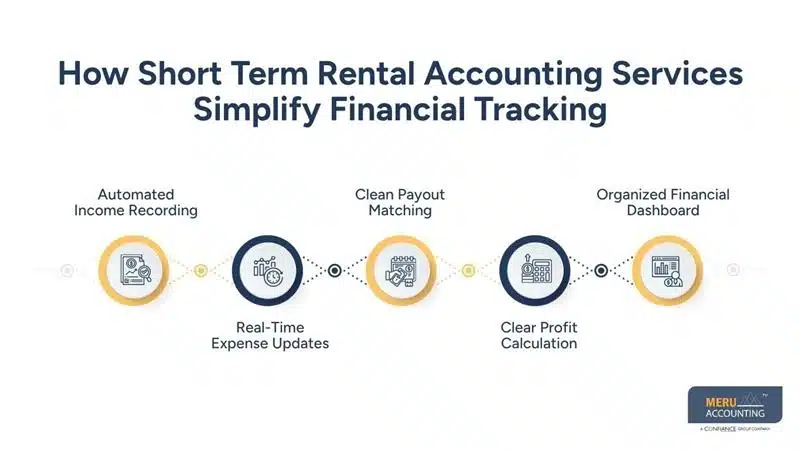
Clear Profit Calculation
Net profit is calculated after deducting fees, taxes, and expenses. Hosts get a clear picture of earnings. Financial clarity makes property performance easier to compare across locations.
Organized Financial Dashboard
All data is placed in structured reports, making it easier to review performance across properties. Structured dashboards allow quick access to income and expense summaries without searching files.
Common Mistakes Hosts Make Without Professional Accounting Support
Mixing Personal And Business Expenses
Many hosts use personal accounts for rental income. This breaks real estate accounting principles and creates tax issues. Clear separation of accounts keeps financial records accurate and easier to review.
Ignoring Platform Fees
Airbnb and Vrbo deduct fees automatically, but many hosts fail to record them properly in short term rental accounting services style tracking. Missing these deductions leads to incorrect profit calculations and weak financial clarity.
Missing Small Expenses
Items like cleaning supplies or minor repairs are often ignored, which affects the final profit calculation. Small costs build up over time and change the actual earnings picture of a property.
Poor Record Keeping
Receipts and invoices are not stored properly, making audits difficult. Organized documentation is important for verifying expenses and supporting tax filings when required.
Incorrect Tax Reporting
Wrong classification of rental income can lead to penalties or adjustments during filing. Accurate reporting aligned with real estate accounting principles reduces compliance risks and filing errors.
How to Manage Platform Fees, Commissions, and Payout Reconciliation Efficiently
Understanding Fee Structure
Airbnb and Vrbo charge service fees, host fees, and sometimes cleaning commissions. Short term rental accounting services separate each fee type clearly. Proper breakdown of fees prevents confusion in final profit reporting.
Recording Gross Vs Net Income
Gross income is the total booking value, while net income is what the host receives. Following real estate accounting principles ensures both are tracked correctly. Clear distinction between the two supports accurate performance analysis.
Monthly Reconciliation Process
All platform payouts are checked against booking records every month to avoid mismatches. Regular reconciliation reduces the chance of missing or duplicated entries in financial books.
Handling Refunds And Adjustments
Cancellations and refunds are recorded separately so they do not distort income data. Proper adjustment tracking keeps monthly revenue figures consistent and reliable.
Building Transparent Reports
Clear reports show exactly how much is earned after all deductions. Structured reporting helps hosts understand true profitability across Airbnb and Vrbo listings.
Why Tax Compliance and Deduction Optimization Matter for Short Term Rentals
Correct Income Reporting
Rental income must be reported correctly under tax rules. Short term rental accounting services ensure accurate classification. Proper reporting reduces errors during annual filing and supports consistent financial records across platforms.
Expense Deduction Tracking
Costs like maintenance, insurance, and utilities are tracked to reduce taxable income legally. Accurate deduction tracking ensures no eligible expense is missed during reporting.
Avoiding Penalties
Incorrect filings can lead to penalties or audits. Structured accounting reduces this risk. Consistent record-keeping also strengthens compliance during financial reviews.
Supporting IRS Guidelines
In the US, rental income is reported under Schedule E rules. These guidelines require clear separation of income and expenses for proper tax treatment.
Year-End Tax Preparation
Clean records reduce stress during tax season and speed up filing. Organized data allows faster review of all transactions without last-minute corrections.
Why Outsourcing Short Term Rental Accounting Services Improves Efficiency and Accuracy
Reduced Manual Workload
Hosts no longer need to manage spreadsheets daily. Short term rental accounting services handle data entry and reporting. Daily financial tasks become more structured and less time-consuming.
Better Financial Accuracy
Professional tracking reduces human errors in income and expense recording. Cleaner records lead to more reliable profit calculations across all properties.
Faster Decision Making
Clear reports allow hosts to decide pricing, investment, and property expansion plans. Quick access to financial data supports timely business choices based on real performance.
Stronger Compliance Support
Following real estate accounting principles becomes easier with the expert handling of records. Proper documentation reduces the risk of reporting errors during tax filing.
Scalability For Multiple Properties
As portfolios grow, outsourcing ensures financial systems remain stable. Consistent processes make it easier to manage multiple Airbnb or Vrbo listings without confusion.
How Meru Accounting Supports Short Term Rental Hosts
Meru Accounting is a global firm providing structured accounting and bookkeeping services for property owners, Airbnb hosts, and Vrbo managers. The firm works with international clients and applies industry-focused financial systems designed for rental income management.
Dedicated Rental Accounting Team
Meru Accounting provides specialists who handle short term rental accounting services for hosts managing one or multiple properties. Focused support ensures accurate tracking of income, expenses, and platform payouts across all listings.
Platform-Based Financial Tracking
Income from Airbnb and Vrbo is tracked separately with full reconciliation support through short term rental accounting services designed for accuracy and consistency. Each transaction is matched with booking records to maintain clear and accurate financial books.
Tax Ready Financial Reports
Reports are prepared in a structured way, making tax filing easier and more accurate. Clear summaries of income and expenses help reduce errors during tax submission.
Software Integration Support
Systems can be integrated with tools like QuickBooks, Xero, and other accounting platforms for real time tracking. Integration reduces manual work and keeps financial data updated across systems.
Focus On Accuracy And Compliance
Our team of certified experts ensures financial records remain clean, structured, and ready for audits or tax review. Regular checks help maintain compliance and reduce risks in financial reporting.
Our Author Insight
Our experience shows that most short term rental owners do not face challenges due to low income, but because of unclear financial records. When short term rental accounting services are implemented with a proper structure, financial visibility improves, and tax preparation becomes much simpler. Consistently following real estate accounting principles also supports better long-term investment decisions and stronger financial planning.
Key Takeaways
- Short term rental income needs structured financial tracking
- Short term rental accounting services reduce errors and improve clarity
- Airbnb and Vrbo fees must be recorded properly for correct profit calculation
- Following real estate accounting principles is essential for tax compliance
- Outsourcing reduces workload and improves financial accuracy
- Meru Accounting provides structured support for rental hosts
FAQs
Professional financial solutions that manage income, expenses, taxes, and reporting for Airbnb and Vrbo hosts in a structured and accurate manner.
Frequent changes in rental income, platform fees, and operating expenses make manual tracking complex, increasing the chances of errors and inefficiencies.
Real estate accounting principles ensure proper classification of rental income, accurate expense tracking, and compliant financial reporting for tax and investment purposes.
Single-property owners and small hosts benefit from organized bookkeeping, clearer financial visibility, and tax-ready financial statements.
Structured outsourcing improves accuracy in financial records and compliance, reducing the likelihood of errors that may lead to penalties or audits.