
A tech startup accountant plays a key role in establishing financial clarity during the early stages of a new business. In early-stage companies, cash flow is limited, records are often messy, and growth decisions depend on clear numbers.
A skilled professional helps founders manage records, track spending, and build strong financial systems from the start. Without a proper financial structure, startups may face errors in reporting, poor cash control, and tax issues that slow growth.
This role goes beyond simply recording numbers. They guide financial decisions, set up systems, and support compliance needs. In this blog, we will explore how a tech startup accountant handles key responsibilities and why this role is important for startup success.
What You Will Learn From This Blog
- Why early-stage startups need structured financial management
- How a tech startup accountant manages daily bookkeeping
- How cash flow and burn rate are controlled
- Role in budgeting and financial planning
- How tax compliance is handled
- Tools used for automation and reporting
- Payroll and expense control methods
- How accounting services for startups support growth decisions
Why Early Stage Startups Need A Tech Startup Accountant
Managing Early-Stage Financial Records
A tech startup accountant ensures that every transaction is recorded properly from day one. Early-stage startups often mix personal and business spending, which creates confusion.
Clear records help avoid errors later in reporting and tax filing, which is a core outcome of accountant services for startups.
Setting a Strong Accounting Base
A proper accounting structure is built using a well-defined chart of accounts and standardized systems. This helps startups track income, costs, and liabilities in a clear format that supports long-term stability.
Helping With Investor Readiness
Investors need clear financial reports before funding any startup. Clean statements, cash flow reports, and projections improve trust and funding chances.
Cost Control in the Early Stage
Startups often spend without structured planning. Expense tracking and monitoring through accountant services for startups help reduce unnecessary costs and support growth-focused spending decisions.
Reducing Financial Errors
Manual mistakes in records can lead to tax or reporting issues. Proper review systems and accounting methods help reduce these risks significantly.
Supporting Decision Making
Founders depend on accurate numbers to make decisions, which is strengthened through accountant services for startups that ensure reliable reporting. Financial reports that reflect real performance help improve planning and business direction.
How Does a Tech Startup Accountant Manage Daily Bookkeeping and Transactions?
Recording Daily Transactions
Every sale, purchase, and payment is recorded on the same day. This keeps financial data updated and reduces confusion during monthly reporting. Proper documentation is also maintained to support each recorded entry.
Bank Reconciliation Process
Bank records are matched with accounting books daily or weekly. Entries are reviewed carefully to ensure accuracy and completeness. This process helps identify missing, duplicate, or incorrect transactions quickly.
Invoice Management System
Invoices are tracked from creation until final payment collection with the help of accountant services for startups, ensuring steady cash flow.
Clients are billed on time to maintain a steady cash inflow. Follow-ups are done regularly to reduce delays in payment collection.
Expense Categorization
All business expenses are classified into proper accounting categories. This helps founders understand spending patterns clearly.
It also supports better financial reporting and tax preparation.
Use of Cloud Accounting Tools
Modern systems like QuickBooks, Xero, and similar tools are used for real-time record keeping. These tools improve data access, accuracy, and financial transparency for founders.
Error Detection in Entries
Regular checks are performed to identify missing or incorrect entries. A tech startup accountant corrects issues early to maintain clean and reliable financial records.
How Do Accounting Services for Startups Help With Cash Flow and Burn Rate Control
Cash Flow Monitoring
Money flowing in and out of the business is tracked on a regular basis. Startups gain clear visibility of available funds at any point. This helps founders avoid sudden cash shortages during operations and maintain financial stability.
Burn Rate Analysis
Monthly spending patterns are reviewed to understand how quickly funds are being used. Founders can estimate how long available capital will last. This supports better planning for survival and future growth decisions.
Payment Scheduling
Bills and vendor payments are organized to prevent cash shortages. Operations continue smoothly without financial stress or delays. It also helps avoid late fees and maintains strong vendor relationships.
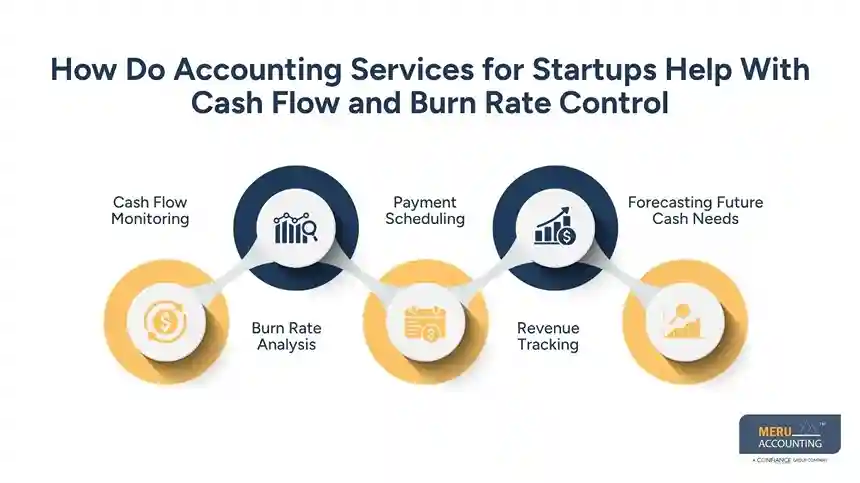
Revenue Tracking
All income sources are recorded and reviewed in detail. Key earning areas become easier to identify and analyze. Accounting services for startups help improve financial visibility and support better business decisions.
Forecasting Future Cash Needs
Future financial requirements are estimated using historical data and trends. Startups become better prepared for funding or expansion needs. It also improves accuracy in long-term financial planning.
What Role Does a Tech Startup Accountant Play in Budgeting And Financial Planning
Budget Creation
Monthly budgets are prepared based on business goals and targets with the support of accountant services for startups that ensure structured financial planning.
This helps founders control spending and avoid early financial pressure. It also ensures resources are used in a planned and structured way.
Financial Forecasting
Future income and expenses are estimated using past financial data trends. This supports better planning for hiring and expansion decisions. It also helps startups prepare for uncertain market conditions.
Cost Allocation Planning
Funds are distributed across departments like marketing, product, and operations. This ensures money is spent in areas that support growth. It also improves balance in overall business spending decisions.
Performance Tracking
Actual financial results are compared with planned budgets regularly. A tech startup accountant identifies gaps and suggests improvements in control. This helps maintain discipline in financial planning and execution.
Investment Planning
Startups preparing for fundraising receive structured financial models for investors. These reports help clearly present business performance and potential. It also improves communication with investors during funding discussions.
Risk Planning
Financial risks are identified at an early stage before they grow. Preventive steps are suggested to reduce the impact on operations. This helps startups maintain stability during uncertain business conditions.
How Do Accounting Services For Startups Support Tax Compliance And Reporting
Tax Filing Support
Accountant services for startups ensure tax returns are prepared on time, reducing penalties and improving compliance accuracy. Penalties are avoided while maintaining proper compliance with tax rules.
Regulatory Compliance
Startups must follow local tax rules in their operating regions. All legal requirements are met through structured accounting processes.
Financial Statement Preparation
Income statements and balance sheets are created for tax reporting. Clear financial reports support accurate filing and legal documentation.
Audit Readiness
Records are maintained in structured form for smooth audit checks. Audit preparation becomes easier with properly organized financial data.
Deduction Management
Eligible expenses are identified to reduce the overall tax burden legally. Startups benefit from lower tax liability through proper expense tracking.
What Tools And Technologies Do Tech Startup Accountants Use For Automation
Cloud Accounting Software
A tech startup accountant uses tools like Xero and QuickBooks daily. Real-time updates improve accuracy and financial tracking efficiency.
Expense Management Apps
Apps are used to scan receipts and track business expenses automatically. Manual entry work is reduced through digital expense recording systems.
Payroll Systems
Payroll tools calculate salaries, taxes, and benefits without manual errors. Employee payments are processed on time with accurate deductions applied.
Dashboard Reporting Tools
Visual dashboards display financial health in simple and clear formats. Founders gain quick insights into performance through summarized reports.
Bank Integration Systems
Bank accounts are directly connected to accounting tools for updates. Transactions are recorded instantly without delays or manual intervention.
Automation Workflows
Repetitive tasks like invoicing and reminders are fully automated under accountant services for startups to improve efficiency. Operational efficiency improves through reduced manual accounting effort.
How Accounting Services For Startups Improve Payroll and Expense Management
Payroll Processing
Accounting services for startups manage salaries, bonuses, and deductions accurately. Employees receive timely payments with the correct calculation of benefits.
Contractor Payments
Payments for freelancers and contractors are tracked and processed properly. Vendor relationships remain smooth through timely payment management.
Expense Tracking System
All business expenses are recorded and categorized in proper accounts. Financial visibility improves through structured expense classification methods.
Reimbursement Handling
Employee reimbursements are verified and processed without unnecessary delays. Employees experience faster settlement of approved business expenses.
Tax Deduction Compliance
Payroll taxes are calculated and deducted according to regulations. Compliance is maintained with accurate tax deduction practices.
Why Startups Choose Meru Accounting?
Meru Accounting provides structured financial support for early-stage companies across the US and global markets. Our team works as a trusted financial partner for founders who need clear reporting and strong financial control. We also provide accounting services for startups that include bookkeeping, payroll management, tax filing, and financial planning.
At Meru Accounting, we focus on setting strong financial systems that help startups avoid errors and improve decision-making. Our experts work with tools like Xero, QuickBooks, and other cloud platforms to ensure real-time accuracy. Whether it is cash flow tracking or investor reporting, our tech startup accountant team ensures every detail is managed with care.
Our Expert Perspective
From our practical experience working with early-stage companies, we have observed that financial clarity is often the first step toward stable growth. Many startups do not fail because of weak ideas, but because financial control is not properly managed in the early phase.
A structured tech startup accountant approach allows founders to clearly understand real numbers and make informed decisions with confidence. When combined with reliable accounting services for startups, businesses are able to build strong planning habits and reduce financial risks from the beginning.
Key Takeaways
- Early startups need structured financial systems, often delivered through accountant services for startups, to avoid errors.
- A tech startup accountant manages bookkeeping, reporting, and planning
- Budgeting helps startups plan growth with less risk
- Tax compliance reduces legal and financial issues
- Automation tools improve accuracy and save time
- Accounting services for startups support payroll and expense management in a structured and accurate way
FAQs
A finance professional manages bookkeeping, cash flow tracking, and financial reporting. Clean records are maintained from the beginning of operations.
Professional financial services help manage taxes, payroll, and expenses effectively. Better planning and fewer errors support smoother business operations.
Income and expenses are tracked on a daily basis. Founders gain clear visibility of available funds at any time.
Yes, accounting services for startups ensure accurate tax filing and compliance with rules. This helps avoid penalties and legal issues.
Tools like QuickBooks, Xero, and payroll software are used to automate accounting tasks and improve accuracy.