If you are asking what is TIC in real estate, the short answer is that TIC means tenancy in common. It is a form of property ownership where two or more people own shares in the same property. Each owner may hold a different share, and the owners can share income, costs, gains, and other rights based on their legal agreement.
Knowing what is TIC in real estate matters before you put money into a shared property deal. A TIC investment can give an investor access to a property without buying the whole asset alone, but the return depends on rent, costs, debt, ownership share, property value, and the terms set between the owners.
What You Will Learn From This Blog
- What is TIC in real estate and how tenancy in common works.
- How TIC ownership differs from other forms of shared property ownership.
- How to work out TIC investment returns and cash flow.
- Which costs and deal terms can change the return on your money.
- How TIC ownership compares with an LLC structure.
- Which key numbers to check before making an investment decision.
What Is TIC in Real Estate?
So, what is TIC in real estate in simple terms? It is a form of shared property ownership where two or more people own an interest in the same property as tenants in common. The ownership does not have to be equal. This flexibility is one of the defining characteristics of tenant in common real estate, because owners can hold different percentages of the same property.
For example, three investors may own 50%, 30%, and 20% of a rental property. Their shares should be clearly stated in the deed and related legal documents.
In a TIC structure, each owner holds an interest in the real property rather than shares in a separate company that owns the property. The ownership share may affect how rental income, expenses, gains, and sale proceeds are divided.
A written TIC agreement can also set rules for repairs, financing, property use, management, distributions, and a future sale.
Understanding what is TIC in real estate also means looking beyond the ownership percentage. TIC owners may not have equal control over management or major decisions, as these rights can depend on the agreement and state law. Before investing, review the deed, TIC agreement, loan terms, financial records, and tax treatment with qualified legal and tax professionals.
What Are the Key Features of a TIC Investment?
Multiple Owners Share One Property
A TIC investment has two or more owners holding interests in the same real property. The property may be residential, commercial, industrial, or another type of real estate.
The owners may split income and costs based on their ownership shares or other agreed terms.
Ownership Shares May Differ
Different capital amounts can lead to different ownership shares. For example, an investor who puts in $200,000 may own a larger share than one who puts in $100,000.
The ownership percentage should be clear before you assess TIC investment returns.
Rental Income Can Be Shared
If the property earns rent, the amount available to each owner can depend on the owner’s share and the deal terms. Gross rent alone does not show the actual cash return.
Vacancy, repairs, taxes, insurance, management fees, and debt costs must also be reviewed.
Costs Can Be Shared
Owners may share property tax, insurance, repairs, management costs, loan costs, and other expenses. The split should be clear in the agreement.
A deal with high rent can still produce weak cash flow if operating and financing costs are high.
Exit Terms Matter
A TIC agreement may contain rules for selling an ownership interest or selling the whole property. The process can be more complex when several owners have different goals.
How to Analyze TIC Investment Returns
Start With Your Total Investment
To understand what is TIC in real estate from an investor’s point of view, start with the amount of cash you put into the deal.
Include the purchase contribution, closing costs, loan fees, reserves, and other upfront costs. This gives you a better base for return analysis.
Review Annual Property Income
Next, review the property’s yearly income. For a rental asset, this may include base rent, parking income, storage income, or other property income.
Do not treat gross rent as profit. The property must pay its operating costs before cash reaches the owners.
Subtract Operating Costs
Operating costs may include property tax, insurance, repairs, utilities, management fees, maintenance, and other normal expenses.
For a sound review of TIC investment returns, use actual past results where available instead of relying only on estimates.
Account For Debt Service
If the property has a mortgage, loan payments can take a large share of property cash flow. Interest and principal also affect the way cash and equity change over time.
A property can show positive operating income but still have low cash flow after debt service.
Measure Cash Return
One simple measure is cash-on-cash return:
Cash-on-Cash Return = Annual Cash Flow ÷ Cash Invested × 100
For example, if your TIC share requires $100,000 and gives you $7,000 in annual cash flow, the cash-on-cash return is 7%.
Include Future Sale Results
TIC investment returns should not be judged only by yearly cash flow. A sale can create a gain or loss that changes the total result.
For a complete review, consider income received, changes in property value, debt paid down, selling costs, and taxes.
How to Calculate Cash Flow From a TIC Investment
Find Gross Property Income
Begin with all income earned by the property during the period. Rent is often the main source, but other income may also exist.
Use actual statements when possible so the cash flow model starts with real data.
Deduct Property Expenses
Subtract costs such as taxes, insurance, repairs, management fees, utilities, and other operating costs.
This gives you a clearer view of property-level cash flow before financing.
Deduct Loan Payments
Next, account for the debt payments tied to the property. The amount that remains after debt service is closer to the cash that may be available to owners.
In tenant in common real estate, the applicable ownership documents and agreement should clarify how this cash flow is allocated among the owners.
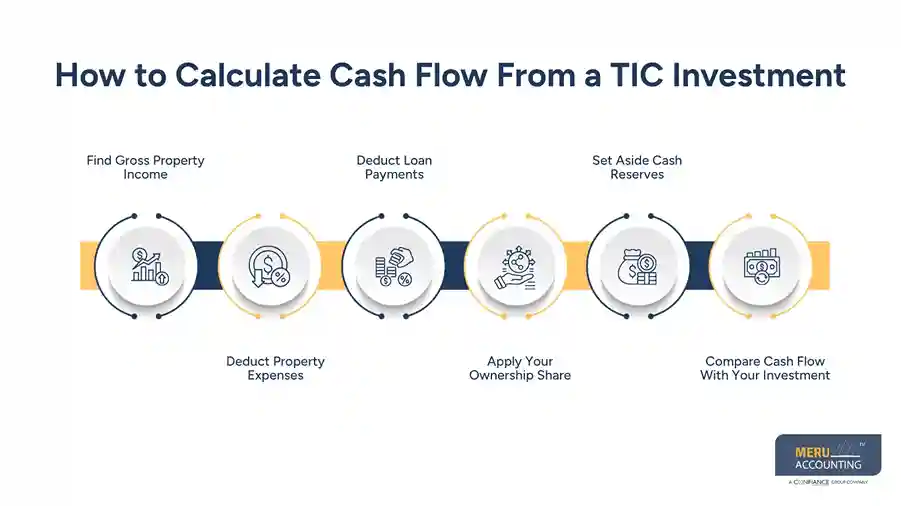
Apply Your Ownership Share
Suppose annual cash flow after debt service is $80,000 and your ownership share is 25%. Your share would be $20,000 before any other investor-level items.
This simple step is central to understanding what is TIC in real estate from a cash-flow view.
Set Aside Cash Reserves
Not all cash should be paid out. A property may need funds for major repairs, vacancy, capital work, or other future costs.
A good cash-flow review checks whether reserves are adequate before treating distributions as fully available income.
Compare Cash Flow With Your Investment
If you invested $200,000 and receive $14,000 in annual cash flow, your simple cash-on-cash return is 7%.
This figure gives one view of TIC investment returns, but it does not capture every tax, financing, or sale factor.
optional anymore
on running the business
What Factors Affect TIC Investment Returns and Cash Flow?
Purchase Price
A high purchase price can reduce the return if rental income does not rise enough to match the cost of the asset.
When asking what is TIC in real estate, investors should also ask whether the price paid for the property fits its income and expected value.
Rental Income
Rent is a key driver of property cash flow. A rise in rent can increase cash flow, while lower rent or vacancy can reduce it.
Lease terms, tenant quality, market rent, and vacancy should all be reviewed.
Operating Expenses
Property tax, insurance, repairs, management fees, and maintenance can change the cash left for owners.
Small changes in recurring costs can have a large effect over many years.
Interest Rates
Debt cost can change TIC investment returns. A higher interest rate can raise loan payments and reduce cash available for distribution.
Review the loan rate, term, amortization, maturity date, and any reset terms.
Property Value
Changes in property value affect the equity held by the owners. A higher value may create a gain at sale, while a lower value can reduce equity.
IRS Publication 544 explains federal rules for gains and losses when property is disposed of.
Ownership And Deal Terms
Your share of income, costs, debt, and sale proceeds may depend on the legal structure and agreement.
That is why what is TIC in real estate cannot be judged from ownership percentage alone.
TIC vs. LLC: Which Ownership Structure Fits the Investment?
Aspect | Direct TIC Ownership | LLC Ownership |
Ownership Structure | Tenant in common real estate involves two or more investors directly owning interests in the same property. | An LLC owns the property, while investors generally own membership interests in the LLC. |
Legal Structure | Understanding what is TIC in real estate requires reviewing the deed, TIC agreement, ownership rights, and applicable state law. | The LLC is the legal property owner, with investor rights generally defined in the operating agreement. |
Liability | Liability depends on state law, insurance, loan terms, and the specific TIC ownership arrangement. | Liability treatment depends on state law, LLC compliance, insurance, guarantees, and the specific structure. |
Tax Reporting | Tax reporting for tenant in common real estate depends on the ownership arrangement and applicable tax rules. | Tax reporting depends on the LLC’s tax classification and applicable federal and state tax rules. |
Financing | Financing depends on the property, TIC ownership structure, loan documents, and lender requirements. | Financing depends on the LLC structure, property, loan documents, and lender requirements. |
Management & Exit | Management, distributions, transfers, and sale terms can depend on the TIC agreement and applicable law. | The LLC operating agreement can establish management, distributions, transfers, and property-sale procedures. |
TIC Investment Analysis: Key Metrics to Review
Cash-On-Cash Return
Understanding what is TIC in real estate is only the first step; investors also need to determine how the ownership interest performs financially.
It is useful for checking current cash income, but it does not show the full return from property value growth or sale proceeds.
Net Operating Income
Net operating income, or NOI, is property income after operating expenses but before debt service and income taxes.
NOI can be used to compare property operations across different financing plans.
Capitalization Rate
If you are researching what is TIC in real estate, cap rate is one of the basic measures to understand when comparing a property’s income with its value.
Cap Rate = NOI ÷ Property Value × 100
It can give a quick view of property income relative to price.
Debt Service Coverage
Debt service coverage compares property income with required debt payments.
A lower coverage level can leave less room for changes in rent, vacancy, or expenses in a tenant in common real estate investment.
Equity Multiple
Equity multiple compares total cash received with the amount invested.
For example, $250,000 of total cash received from a $200,000 investment gives a 1.25x equity multiple before considering the timing of those cash flows.
Internal Rate Of Return
IRR considers the timing of cash invested and cash received. It can include yearly distributions and sale proceeds.
IRR can be useful for TIC investment returns, but the result depends heavily on the assumptions used for future cash flows and sale value.
How Meru Accounting Can Support TIC Financial Reporting
Keep Ownership Records Clear
Meru Accounting provides accounting services that organize property income, costs, owner contributions, distributions, and other deal records.
For investors learning what is TIC in real estate, clear ownership records are important because financial activity may need to be matched with individual ownership percentages and distributions.
Track Property Cash Flow
Meru Accounting provides bookkeeping services that record income and expenses for tenant in common real estate investments.
Review Monthly Reports
Monthly income statements and balance sheets can show changes in revenue, expenses, assets, liabilities, and equity.
These reports can give investors a better basis for checking the numbers used to analyze a tenant in common real estate investment.
Organize Owner Transactions
Capital contributions and distributions should be recorded in a clear way.
Meru Accounting provides accounting work that can organize these entries so they can be reviewed with the ownership records and deal terms.
Prepare Records For Tax Review
Meru Accounting provides bookkeeping and accounting services that keep financial records ready for review by the tax professional handling the property’s tax work.
Tax treatment can vary by structure, so tax conclusions should come from a qualified tax adviser.
Our Expert Perspective
A sound TIC investment review should start with actual rent, vacancy, operating costs, debt service, reserves, and the investor’s cash contribution rather than relying only on projected returns. Ownership terms also need close review, including how income, expenses, distributions, voting rights, and sale proceeds are shared. Sale assumptions should be tested at different values and include selling costs, while tax results should be kept separate from cash received because depreciation, interest, basis, and other tax rules can affect the final outcome. Clear accounting records should also match ownership data, bank activity, loan records, and distributions so that any differences are found before they affect investor reporting.
Key Takeaways
- What is TIC in real estate refers to tenancy in common, where two or more people own interests in the same property.
- TIC owners may have equal or different ownership shares.
- What is TIC in real estate should be understood through the deed, TIC agreement, loan documents, and financial records.
- TIC cash flow starts with property income and then accounts for operating costs, debt service, reserves, and the owner’s share.
- TIC investment returns can include cash income, equity growth, debt paydown, and proceeds from a later sale.
- Cash-on-cash return, NOI, cap rate, debt coverage, equity multiple, and IRR give different views of a deal.
- A TIC structure and an LLC structure have different legal, tax, financing, and management features.
- Financial records should be reviewed with legal and tax documents before making an investment decision.
FAQs
TIC means tenancy in common, a form of ownership where two or more people own shares of the same property.
A TIC investment lets multiple investors own shares of one property and receive income and sale proceeds based on the deal terms.
TIC investment returns can be measured by comparing cash flow, property value gains, debt paydown, and total cash received with the amount invested.
TIC cash flow is calculated by subtracting operating costs, debt payments, and reserves from property income and then applying the investor’s ownership share.
TIC owners directly hold interests in the property, while an LLC owns the property and investors generally hold membership interests in the LLC.
optional anymore
on running the business