
Buying a rental home, apartment, office, or other property takes more than finding a place at a fair price. A financial advisor for real estate investors can review your cash, debt, income, goals, taxes, and risk before you commit funds. This type of real estate advisory can turn a broad plan to “buy property” into a clear property investment plan with set limits, return goals, and cash needs.
Real estate can create rental income, price growth, and tax benefits, but it also has costs and risks. The IRS notes that rental owners must report rental income and may deduct certain rental costs, while depreciation has its own rules. A sound plan should therefore look at both cash flow and tax rules rather than focus only on the expected rise in property value.
What You Will Learn From This Blog
- What a financial advisor for real estate investors does when building a property plan.
- How a financial advisor for real estate investors reviews income, cash, debt, credit, and other financial data before a purchase.
- How property price, rent, debt, tax, and repair costs affect an investment.
- How to set a budget and risk limit for one property or a wider portfolio.
- Which real estate investment strategies may fit different goals and cash needs.
- Which financial metrics can be used to track property results over time.
- How accounting and financial records can give investors a clearer view of property performance.
What Does a Financial Advisor for Real Estate Investors Do?
Reviews Your Main Financial Goals
A financial advisor for real estate investors starts with the reason for the investment. Your goal may be monthly income, long-term growth, retirement income, or a mix of these aims.
The plan should set a time frame and a target return that fits your cash and risk level. FINRA notes that investment choices can vary based on income, assets, goals, risk tolerance, and time horizon.
Check Cash And Debt
Before a purchase, the advisor looks at cash on hand, debt payments, credit needs, and funds set aside for daily life. This shows how much cash may be safe to place into a property.
A large down payment may lower debt, but it can also leave less cash for repairs, vacancies, or other needs. A plan must account for both sides.
Sets A Property Budget
A property budget is more than the listed price. It can include the down payment, closing costs, loan fees, repairs, insurance, taxes, and funds kept in reserve.
A financial advisor for real estate investors can set a purchase limit after these costs are added. This can keep one property from taking up too much of the investor’s available cash.
Review Tax Factors
Tax rules can affect the amount of cash an investor keeps after a property earns income. For US rental property, the IRS lists items such as repairs, insurance, taxes, interest, management fees, and depreciation among rental-related items subject to specific rules.
The advisor may work with a tax professional to model the tax effect. The exact tax result depends on the investor’s facts, property use, ownership form, and current tax law, while real estate advisory can help place these factors within the broader investment plan.
Builds A Review Process
A property plan should not end on the day the purchase closes. Rent, costs, debt, property value, and cash needs can change over time.
A financial advisor for real estate investors can set review dates and key measures so the plan can be checked against the original goal. This also gives the investor a basis for changing the plan when facts change.
How to Assess Your Current Financial Position Before Investing In Real Estate
Calculate Your Available Cash
Start with cash that can be used for the purchase without putting basic needs at risk. Separate purchase funds from an emergency reserve and money needed for near-term bills.
This step gives the investor a real view of how much can be put into the deal. It also shows how much cash may remain after closing, giving real estate advisory discussions a more accurate starting point for evaluating the investment.
Review Your Monthly Income
A financial advisor for real estate investors may review stable income alongside existing obligations to assess how much property-related debt the investor can reasonably carry. Review salary, business income, rent from current properties, and other regular income.
Then compare this income with housing costs, debt payments, living costs, and planned investment costs. The goal is to see the full cash picture before a new loan is added.
List Current Debt
Make a list of each loan, credit balance, interest rate, and monthly payment. A new mortgage adds a long-term payment, so current debt must be part of the plan.
A financial advisor for real estate investors can use this data to set a debt limit and test whether the plan still works if rent is lower than expected.
Set A Cash Reserve
Rental property can face empty units, repairs, legal costs, insurance changes, or delayed rent. A cash reserve gives the investor funds for such events.
The reserve should be based on the property type, loan terms, expected costs, and the investor’s wider financial needs rather than one fixed number for every deal.
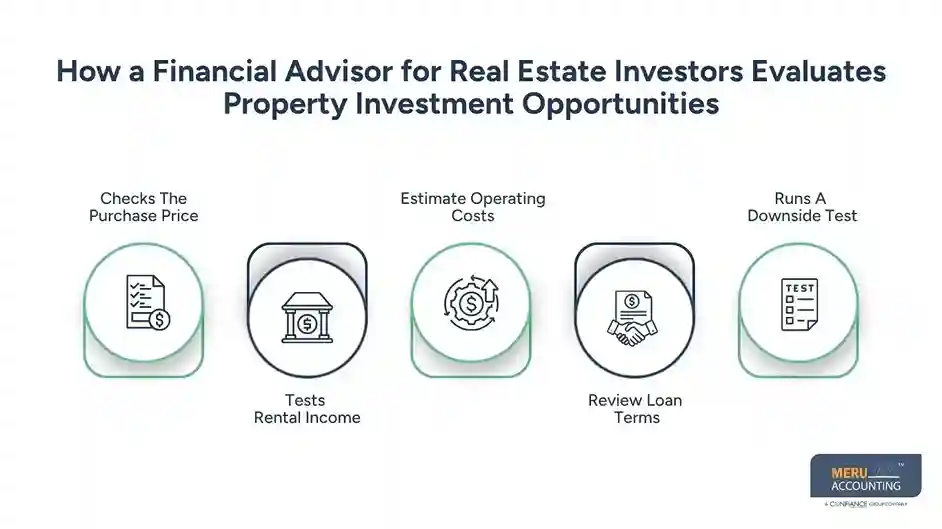
How a Financial Advisor for Real Estate Investors Evaluates Property Investment Opportunities
Checks The Purchase Price
The first review is whether the price fits the property’s income and expected costs. Comparable sales, local rent data, property condition, and expected repairs can all matter.
A financial advisor for real estate investors can place these figures into a cash-flow model as part of real estate advisory, instead of judging the property from price alone.
Tests Rental Income
Expected rent should be checked against the unit type, area, lease terms, vacancy risk, and current market data. Do not treat projected rent as guaranteed income.
A financial advisor for real estate investors can test several rent levels in the model as part of real estate advisory and property cash-flow analysis.
Estimate Operating Costs
Costs may include property tax, insurance, repairs, maintenance, management, utilities, legal fees, and other property costs. The IRS also identifies many of these categories in its rental property guidance.
A deal can look strong before these costs are counted and much weaker after they are included. A full cost model gives a more useful view.
Review Loan Terms
The loan can shape the result as much as the property itself. Review the interest rate, loan term, down payment, monthly payment, fees, and any rate reset risk.
A financial advisor for real estate investors can compare more than one loan case. This makes it easier to see how debt changes cash flow and total investment cost.
Runs A Downside Test
A good property plan should test what happens when rent falls, repairs rise, the property stays empty, or the loan costs more than expected.
The aim is not to predict a bad result. It is to see whether the investor still has enough cash and income to carry the property under less favorable conditions.
optional anymore
on running the business
Building A Property Investment Plan Around Your Budget And Risk Profile
Set A Clear Purchase Range
The purchase range should come from available cash, debt limits, income, reserve needs, and the return target. It should not be based only on the maximum loan a lender is willing to offer.
A financial advisor for real estate investors can set a lower working limit so the investor retains room for property costs and other financial goals.
Match Debt To Cash Flow
Debt can increase the amount of property an investor can buy, but it also creates a fixed payment. If rental income falls, the loan payment may still be due.
The plan should test debt under different rent and cost cases. This gives the investor a clearer view of the cash needed each month.
Keep A Repair Fund
Older buildings, homes with deferred work, and some commercial properties may need large repairs. A repair fund can cover planned work and unexpected bills.
A financial advisor for real estate investors can factor these property-specific conditions into the reserve amount when reviewing the overall investment plan. It should also be kept separate from money needed for daily living.
Set Return Targets
A property plan may use measures such as net operating income, cash flow, cash-on-cash return, cap rate, and total return. Each measure answers a different question.
For example, cash-on-cash return focuses on cash invested, while cap rate looks at property income relative to value. No single measure gives the full result.
Plan For Portfolio Growth
If the goal is to buy more than one property, the first purchase should be viewed as part of a wider plan. The investor should set limits for debt, property type, area, and cash exposure.
Diversification can reduce concentration risk, although it cannot remove investment risk, making portfolio allocation an important consideration in real estate advisory. FINRA notes that spreading assets across different areas can reduce the effect of one investment performing poorly.
Choosing The Right Real Estate Investment Strategy
Long-Term Rental Property
A long-term rental may suit an investor who seeks regular rental income and long-term property ownership. The plan should include rent, vacancy, repairs, taxes, insurance, debt, and management costs.
A financial advisor for real estate investors can compare the expected cash flow with the amount of money tied up in the property.
Fix-And-Flip Projects
A flip depends on the purchase price, repair budget, holding period, financing cost, selling cost, and expected sale price. A small change in any of these numbers can change the result.
The plan should include a time buffer and cost buffer because work can take longer or cost more than first planned.
Commercial Property
Commercial property may include offices, retail sites, warehouses, or mixed-use buildings. Lease terms, tenant quality, vacancy, repairs, and property use can affect income.
A financial advisor for real estate investors can compare projected income with debt and expected operating costs as part of real estate advisory before the investor commits funds.
Real Estate Investment Trusts
REITs give investors a way to gain exposure to real estate without buying and managing a property directly. Publicly traded REITs can also behave differently from direct property ownership.
The right choice depends on the investor’s goal, time frame, liquidity needs, risk level, and wider portfolio.
Mixed Real Estate Holdings
Some investors may use more than one property type or combine direct property with REITs and other assets. This can spread exposure across different real estate segments.
The plan should still track total exposure. Owning several properties in one area or one property type may leave the investor with high concentration risk.
How Meru Accounting Can Support Real Estate Investment Financial Records
Property-Level Bookkeeping
Meru Accounting provides bookkeeping services that can organize income, property costs, vendor payments, and bank activity by property. Clear records can make it easier to see which property earns cash and where costs are rising, giving real estate advisory discussions more reliable financial information.
For a financial advisor for real estate investors, having each property’s income and expenses separated can make portfolio-level financial reviews more meaningful.
Monthly Financial Reports
Meru Accounting provides accounting services with monthly financial reports that can show income, expenses, balances, and other key figures. These reports can give investors a regular view of property results.
A clean monthly close also gives the investor better records to review with a financial advisor for real estate investors or a tax professional.
Bank And Account Reconciliation
Meru Accounting provides bank reconciliation services to match recorded transactions with bank activity. This can flag missing entries, duplicate entries, or items that need review.
Regular reconciliation is useful when property owners have several bank accounts or many recurring vendor payments.
Tax-Ready Records
The IRS requires rental income and expenses to be reported under applicable tax rules, and depreciation has specific rules for rental property.
Meru Accounting can organize accounting records so the investor has a clearer record set for tax work and for discussions with a financial advisor for real estate investors. Tax treatment should still be reviewed by a qualified tax professional based on the investor’s facts.
Our Expert Perspective
Property investment plans work best when the numbers are kept current after the purchase. In our experience, a monthly view of rent, costs, debt, and cash can give investors a clearer base for each review.
Meru Accounting provides accounting and bookkeeping services that can keep these records organized, while the investor and relevant financial or tax professionals can use the data to make investment and tax decisions.
Key Takeaways
- A property investment plan should start with your income, cash, debt, goals, and risk limit.
- A financial advisor for real estate investors can turn these details into a property budget and investment plan.
- Property analysis should include rent, vacancy, repairs, taxes, insurance, debt, and other costs.
- A property should be tested under both expected and less favorable conditions.
- NOI, cash flow, cash-on-cash return, and cap rate can give different views of property results.
- Rental tax rules can affect the final result, so current IRS rules and professional tax advice matter.
- Diversification can reduce concentration risk, but no investment plan can remove risk.
- Precise accounting records help a financial advisor for real estate investors track property income, costs, cash, and results.
- A financial advisor for real estate investors can review the plan as property and personal financial conditions change.
FAQs
A financial advisor for real estate investors reviews your budget, goals, debt, risk, and expected property returns to create an investment plan.
A financial advisor can assess your finances, set a property budget, compare investment options, review risks, and track property performance.
To create a property investment plan, set your goal, review your finances, choose a property type, set a budget, estimate costs and returns, and plan for risk.
Real estate investors should track cash flow, net operating income, cap rate, cash-on-cash return, vacancy, operating costs, and debt payments.
You may consider a financial advisor before buying property when you need help with budgeting, financing, risk review, portfolio planning, or long-term investment goals.
optional anymore
on running the business