
The real estate industry runs on speed, timing, and accuracy. Every deal involves numbers, contracts, payments, taxes, and reporting. Because of this, accounting becomes one of the most critical parts of the entire business. But in real life, most firms struggle with it. There are growing accounting challenges for the Real Estate industry that affect both small firms and large developers. These challenges come from complex transactions, multiple properties, changing tax rules, and heavy reporting needs. When financial data is not clear, business decisions also become weak.
Traditional accounting methods are no longer enough. Manual tracking, spreadsheets, and small in-house teams often fail to handle the scale of modern Real Estate operations. This is why outsourcing has become a practical and widely used solution. Today, more companies are improving their accounting for Real Estate by using outsourcing services that bring structure, accuracy, and cost control.
In this blog, we will break down the real problems, their impact, and how outsourcing solves them practically and simply.
What You Will Learn From This Blog
This blog will help you clearly understand:
- Why real estate accounting is more complex than most industries
- The major accounting challenges for the Real Estate sector
- How financial issues impact growth and decision-making
- Why traditional systems often fail
- How outsourcing fixes real-world accounting problems
- Practical examples from real estate operations
Understanding Modern Accounting for Real Estate Businesses
Modern accounting for Real Estate is not limited to bookkeeping. It is a full financial system that manages cash flow, property performance, investor reporting, tax compliance, and operational costs.
A Real Estate business may handle:
- Multiple residential and commercial properties
- Rental income from different tenants
- Property purchase and sale transactions
- Construction and development costs
- Maintenance and repair expenses
- Loan repayments and interest tracking
- Investor profit sharing and capital distribution
Each of these areas must be recorded correctly and on time. Even a small delay or mistake can affect overall financial reporting. Unlike other industries, real estate accounting is property-based. Each property acts like a separate financial unit. This makes tracking more detailed and more complex.
Even with software tools, companies still face accounting challenges for the Real Estate because tools cannot replace financial expertise and structured processes.
Major Accounting Challenges for the Real Estate Sector
Real estate firms face multiple financial issues every day. These issues increase as the business grows.
Multi-Property Financial Complexity
Managing one property is simple. Managing 20, 50, or 100 properties is not. Each property has its own income, tenants, expenses, and timelines. Keeping everything aligned becomes difficult without proper systems.
Irregular Cash Flow Patterns
Rental income may come late or at different intervals. But expenses like loans, salaries, taxes, and repairs are fixed. This imbalance creates constant cash flow pressure.
High Transaction Volume
Real estate companies handle hundreds or thousands of transactions every month. These include rent payments, deposits, vendor bills, commissions, and transfers.
Without structured accounting, this volume becomes overwhelming.
Compliance and Regulatory Pressure
Tax laws and property regulations change often. Businesses must stay updated or risk penalties. Filing delays or incorrect reports can lead to audits.
Manual Data Entry Errors
Many firms still depend on spreadsheets or basic tools. Manual entry increases the chances of duplication, missing entries, or incorrect calculations.
Lack of Industry Expertise
General accountants may not understand property-based accounting rules. This leads to gaps in accounting for Real Estate operations.
Poor Visibility of Financial Performance
Without dashboards and structured reports, owners cannot see the real-time performance of each property.
These issues are the core accounting challenges for the Real Estate sector that slow down efficiency and growth.
Impact of Poor Financial Management in Real Estate Operations
When accounting is weak, it creates a ripple effect across the entire business.
Incorrect Profit Analysis
If the data is wrong, the profit numbers are also wrong. This affects planning and investment decisions.
Delayed Strategic Decisions
Real estate moves fast. Without updated financial reports, companies miss good opportunities.
Reduced Investor Confidence
Investors want transparency. Poor reporting reduces trust and makes funding harder.
Financial Leakage
Small mistakes in rent tracking, vendor payments, or expense entries can lead to long-term financial loss.
Legal and Tax Risks
Missing compliance deadlines or filing incorrect reports can lead to penalties or legal action.
Internal Confusion
Teams spend more time fixing errors than focusing on growth and operations.
All of these problems come from weak accounting for Real Estate systems.
How Outsourcing Solves Accounting Challenges for the Real Estate Industry
Outsourcing is now one of the most effective solutions in the real estate sector. It directly addresses major accounting challenges for the Real Estate industry in a structured way.
Improved Accuracy and Data Control
Professional accounting teams follow strict processes. This reduces human error and improves data accuracy.
Real Estate-Specific Expertise
Outsourced teams understand property cycles, rental systems, and real estate taxation. This improves the quality of accounting for Real Estate.
Reduced Operational Costs
Hiring in-house accountants, training staff, and maintaining systems is expensive. Outsourcing reduces these costs significantly.
Faster Reporting and Insights
Outsourced teams provide timely reports, helping management make faster decisions.
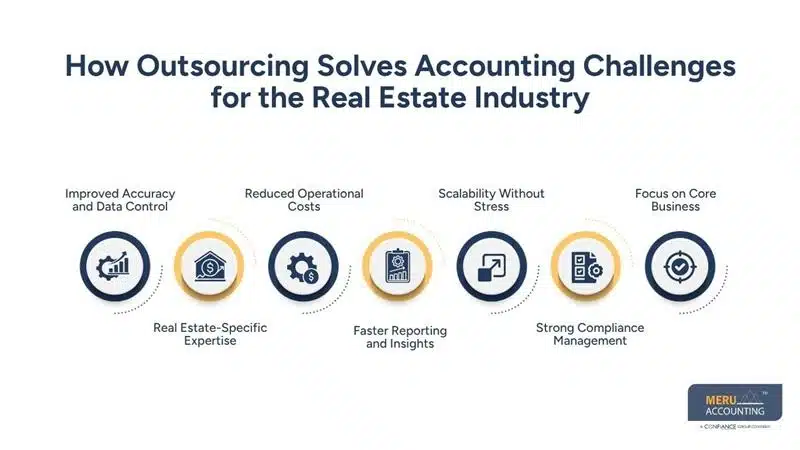
Scalability Without Stress
As the business grows, outsourced services can easily handle increased workload without delays.
Strong Compliance Management
Tax filing, audits, and regulatory reporting are handled on time with fewer risks.
Focus on Core Business
Internal teams can focus on sales, acquisitions, and client relationships instead of accounting work.
This is why outsourcing is a practical solution to accounting challenges for the Real Estate industry.
Practical Use Cases of Outsourced Accounting in Real Estate Operations
Outsourcing is widely used in different real estate business models.
Property Management Companies
They manage multiple tenants and properties. Outsourcing helps track rent collection, maintenance costs, and vendor payments clearly.
Real Estate Developers
Developers handle large projects with complex budgets. Outsourcing supports cost tracking, contractor payments, and project accounting.
Rental Property Owners
Owners with multiple properties need simple, clean reports. Outsourcing helps manage monthly income and expenses easily.
Real Estate Investment Firms
These firms require detailed investor reporting and profit sharing. Outsourcing ensures transparency and accuracy.
Brokerage Firms
They deal with commissions and deals. Outsourcing helps manage commission tracking and payouts.
Each use case shows how outsourcing solves real accounting challenges for the Real Estate industry in a practical way.
Technology’s Role in Modern Accounting for Real Estate
Technology has changed how accounting for Real Estate works today.
Modern outsourcing firms use:
- Cloud accounting platforms
- Automated reconciliation tools
- AI-based transaction tracking
- Real-time dashboards
- Digital document systems
These tools reduce manual work and increase accuracy. But technology alone is not enough.
The real value comes when technology is combined with expert accountants who understand real estate operations. This combination helps eliminate most accounting challenges for the Real Estate sector.
Risk Reduction and Financial Stability
One of the biggest advantages of outsourcing is risk reduction.
It helps in:
- Preventing accounting errors
- Avoiding tax penalties
- Improving audit readiness
- Reducing fraud risks
- Ensuring consistent reporting
This creates a stable financial system for real estate companies and improves long-term planning.
Meru Accounting’s Services for Real Estate Businesses
Real estate companies need reliable financial support that understands both accounting and industry needs. Meru Accounting offers complete outsourcing solutions designed specifically for real estate businesses.
Their services include:
- Full bookkeeping and accounting management
- Property-wise income and expense tracking
- Rent roll management and reconciliation
- Vendor and contractor payment processing
- Monthly and quarterly financial reporting
- Tax preparation and compliance support
- Cash flow and financial analysis
By using these services, businesses can significantly reduce accounting challenges for the Real Estate sector and improve financial clarity.
Meru Accounting helps firms move from manual systems to structured, scalable accounting operations.
Our Expert Insight
In Real Estate, most accounting issues do not start as major problems. They begin with small gaps like missed entries, late updates, or unclear cost tracking. Over time, these small issues grow into serious accounting challenges for the Real Estate industry that affect cash flow, reporting, and planning.
From our experience, the best results come when firms build a clear system for accounting for Real Estate instead of relying only on manual work. Once records are structured and handled with steady processes, accuracy improves, and decision-making becomes much easier. Outsourcing often adds this needed structure and helps firms stay consistent as they grow.
Key Takeaways
- The real estate sector faces growing accounting challenges for the Real Estate due to multi-property tracking, cash flow gaps, and compliance pressure.
- Modern accounting for Real Estate is complex and requires structured systems beyond basic bookkeeping.
- Manual accounting methods often lead to errors, delays, and financial confusion as the business scales.
- Poor financial management can result in incorrect reporting, missed opportunities, and reduced investor trust.
- Outsourcing provides a practical solution by improving accuracy, reducing costs, and ensuring compliance.
- Real estate outsourcing works well across property management firms, developers, investors, and brokerage businesses.
- Technology combined with expert accounting support helps eliminate most operational financial issues.
FAQs
They include multi-property tracking, cash flow imbalance, compliance issues, and high transaction volume.
Because it involves multiple income sources, expenses, loans, taxes, and investor reporting across properties.
It improves accuracy, reduces cost, ensures compliance, and provides expert financial support.
Yes, it reduces workload and gives better financial clarity even for small businesses.
Yes, outsourced accounting services scale easily as the property portfolio expands.