
Financial management in distribution businesses plays a central role, and accounting for distribution companies becomes even more critical when operations expand across multiple storage locations.
As companies grow, they need clear records of stock movement, cost flow, and profit tracking at each warehouse, which is a core focus of effective distribution accounting. Without structured financial tracking, even small gaps in data can lead to incorrect reporting and weak decision-making.
In multi-location operations, every warehouse works like a separate unit while still being part of one business. This creates a need for accurate financial coordination across all sites. Strong systems for recording transactions, tracking inventory value, and monitoring expenses help businesses maintain control as they scale.
This blog explains how accounting for distribution companies and structured financial practices supports multi-warehouse growth, what challenges arise, and how businesses can maintain accuracy and control across locations.
What You Will Learn From This Blog
- How multi-warehouse businesses depend on structured financial records through accounting for distribution companies
- Key challenges in managing finances across multiple storage locations
- Methods to track costs, stock, and profit across warehouses
- How centralized reporting improves business control
- Practical examples of improving operational accuracy
- Real use cases for better financial planning in distribution setups
The Role Of Accounting For Distribution Companies In Business Growth
Financial Clarity Across Locations
Multi-warehouse businesses need clear visibility of performance at each site. Financial tracking systems help separate results by location, making it easier to understand which warehouse is performing well and which needs attention.
Inventory Value Accuracy
Stock value plays a major role in profit calculation. Proper financial recording, supported by accounting for distribution companies, ensures that inventory in every warehouse is valued correctly, reducing the mismatch between physical stock and records.
Cost Segregation By Warehouse
Each warehouse has its own expenses, such as rent, labor, and handling, which distribution accounting helps classify more accurately. Structured financial systems help assign these costs properly so business owners can see the real expense of each location.
Revenue Tracking By Source
Sales may come from different warehouses based on location and delivery routes. Proper tracking ensures revenue is recorded under the correct warehouse, improving financial clarity.
Cash Flow Monitoring
Cash movement becomes complex when multiple warehouses are involved. Structured financial processes help track inflows and outflows at each location, making cash planning more stable.
Key Challenges In Multi-Warehouse Financial Management
Stock Differences Between Warehouses
One common issue in accounting for distribution companies is a mismatch in stock records between locations. This often happens due to delayed updates or manual errors in recording movement.
Hidden Transportation Costs
In distribution accounting, moving goods between warehouses creates additional costs that are sometimes missed in records. These gaps can affect the total profit calculation.
Complex Internal Transfers
When goods move between warehouses, proper documentation is required. Without it, duplication or missing entries can occur in records.
Compliance And Reporting Pressure
Multiple locations increase the complexity of tax and compliance reporting. Incomplete data can lead to errors during audits.
Manual Data Entry Issues
Manual systems often lead to delays and mistakes. Small entry errors can grow into larger financial mismatches over time.
How Accounting For Distribution Companies Improves Multi-Warehouse Efficiency and Control
Real-Time Stock Tracking
Updated stock records in accounting for distribution companies give clear visibility of availability across all warehouses. Businesses can monitor the movement of goods quickly and maintain balanced stock levels.
Standardized Record Keeping
Uniform processes across all warehouses ensure consistency in financial and inventory records. Having the same reporting structure across locations makes comparison and analysis more reliable.
Reduced Human Errors
Structured systems and automated workflows lower the chances of manual mistakes in data entry. Improved accuracy strengthens trust in financial records and daily reporting.
Faster Decision Making
Clear reports generated through accounting for distribution companies allow managers to respond quickly to changes in demand or stock levels. Access to updated information from all warehouses supports quicker operational control.
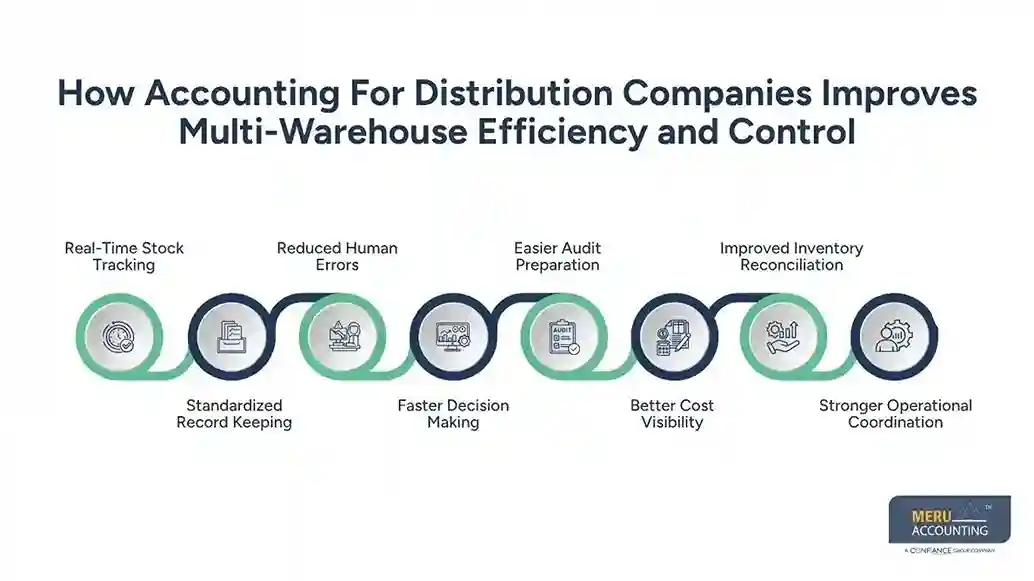
Easier Audit Preparation
Well-maintained records simplify audits by keeping all transactions organized and traceable. In distribution accounting, each entry can be verified easily, reducing confusion during review and compliance checks.
Better Cost Visibility
Warehouse-level cost tracking highlights expenses related to storage, transport, and handling. Clear visibility of cost patterns supports better financial planning and control.
Improved Inventory Reconciliation
Regular comparison between physical stock and recorded data reduces mismatches. Accurate reconciliation across warehouses ensures better stock accuracy and reduces loss risks.
Stronger Operational Coordination
Connected financial and inventory data across warehouses improves coordination between teams. Better alignment helps maintain the smooth flow of goods and reduces delays.
Tracking Costs and Profitability Using Accounting For Distribution Companies
Separation of Direct And Indirect Costs
Businesses can clearly divide costs like storage, transport, and handling. Clear separation helps in understanding the real profit from each activity.
Location-Wise Profit Analysis
In distribution accounting, each warehouse can be evaluated separately for profit performance. This approach helps identify strong and weak performing locations.
Product Level Margin Tracking
With accounting for distribution companies, profitability can be measured for individual products across warehouses. Better margin tracking supports improved pricing and product selection decisions.
Transport and Delivery Cost Allocation
Delivery costs should be allocated accurately to each warehouse. Correct allocation prevents errors in overall profit calculation.
Handling Returns and Damages
Returns and damaged goods are recorded in a structured manner. Proper recording ensures accurate final profit and loss calculation.
The Impact of Distribution Accounting on Supply Chain Efficiency
Better Supplier Coordination
Financial tracking helps maintain clear records of supplier costs and delivery timelines, improving coordination. Clear visibility of supplier data supports timely communication and smoother order management.
Improved Demand Forecasting
Past sales data from accounting for distribution companies helps predict future demand more accurately, reducing stock imbalance. Accurate forecasting supports better planning for seasonal and high-demand periods.
Timely Stock Refill Planning
Businesses can plan restocking based on actual usage patterns, avoiding shortages. Proper refill timing helps maintain stable inventory levels across all warehouses.
Reduced Losses and Waste
Proper tracking in distribution accounting reduces missing stock and helps identify areas of loss early. Early detection of issues minimizes financial leakage and stock wastage.
Consistent Data Across Supply Chain
All locations follow the same data system, improving overall coordination. Uniform data flow ensures better communication between warehouses and management teams.
How Multi-Warehouse Businesses Benefit From Centralized Financial Reporting
Single View of All Warehouses
In accounting for distribution companies, a centralized system allows businesses to see all warehouse data in one place, improving control. Managers can track performance across locations without switching between multiple reports.
Combined Financial Reports
Instead of separate reports, distribution accounting systems merge data for a full view of business performance. Merged reporting gives a clearer understanding of total revenue, cost, and profit.
Improved Compliance Management
Central records make it easier to meet audit and tax requirements. Accurate consolidated data reduces the chances of reporting errors during compliance checks.
Faster Audit Processing
Auditors can review organized data without delays or confusion. Well-structured records reduce time spent on verification and documentation review.
Stronger Business Planning
Leadership teams can make better long-term plans based on complete financial data. Complete visibility across warehouses supports more accurate growth and investment decisions.
How Meru Accounting Supports Multi-Warehouse Growth
Meru Accounting provides structured financial solutions in accounting for distribution companies, helping businesses manage operations across multiple warehouses.
As companies expand, maintaining accurate records across locations becomes more complex, and a strong financial system is required to reduce errors and maintain control.
Proper financial setup ensures smooth coordination between warehouses and improves overall reporting accuracy. We design multi-location financial systems that connect all warehouse records into one clear structure.
Our real-time reporting methods provide updated financial information from each warehouse, helping businesses make better daily decisions. We also focus on cost control by identifying hidden expenses in storage, transport, and handling, which improves cost accuracy and financial clarity.
Our services also include inventory reconciliation to ensure stock records match across all locations and reduce mismatches. We prepare financial data in an organized format to simplify audit work and reduce delays during compliance checks. As businesses grow, our scalable financial systems ensure that expansion across new warehouses does not affect accuracy or control.
Our Expert Perspective
From our experience in accounting for distribution companies, financial misalignment between warehouses is often one of the earliest challenges during expansion.
Delayed entries and inconsistent processes further lead to reporting gaps across locations. We have observed that standardized financial systems significantly improve accuracy, streamline operations, and reduce confusion between multiple warehouses.
Key Takeaways
- Multi-warehouse businesses need structured financial tracking
- Clear systems reduce stock and cost mismatches
- Central reporting improves decision-making and planning
- Proper cost tracking in accounting for distribution companies improves profit clarity across all warehouse operations.
- Standardized records in distribution accounting reduce audit and compliance issues
- Strong systems support long-term business growth
FAQs
Structured financial systems organize stock, cost, and sales data from all warehouses, allowing clear tracking of performance and reducing reporting gaps.
Common issues in accounting for distribution companies include stock mismatch, delayed updates, transfer errors, and incorrect cost allocation between locations, which can affect financial accuracy.
Accurate inventory tracking comes from structured recording methods, regular stock reconciliation, and consistent data entry across all warehouse locations.
Centralized reporting brings all warehouse data into one system, making comparison easier and supporting faster and more informed decision-making.
Warehouse-wise expense tracking separates transport, storage, and handling costs, helping identify true operational costs and improve profit clarity.