As businesses grow, their financial needs change as well. Accounting services become more important when a company starts handling more sales, new team members, vendor payments, and larger day-to-day operations. Systems that once worked for a small business may no longer give the level of support needed for steady growth.
Many business owners focus on single entry vs double entry accounting when thinking about financial systems. While that choice matters, it is only one part of the bigger picture. Growth creates new needs that go beyond recording income and expenses. Companies also need clear reports, tax support, cash flow tracking, and useful financial insight that can help guide business decisions.
As a company moves into the next stage of growth, having the right financial support becomes a key part of long-term success. Modern accounting support is not just about keeping records organized. It also helps businesses improve planning, reduce risk, and build a stronger path for future growth.
In this blog, we will explore why growing companies need accounting services beyond just single entry vs double entry accounting, and how the right financial systems support long-term success.
What You Will Learn From This Blog
In this blog, you will learn:
- The basics of accounting services for growing companies
- The meaning of single entry vs double entry accounting
- Why businesses often start with simple systems
- Signs that a company has moved beyond basic bookkeeping
- How modern accounting support goes beyond transaction records
- How professional accounting services help build long-term growth plans
Understanding the Basics of Accounting Services for Growing Companies
Growing businesses need more than data entry and transaction records. Modern accounting services include many tasks that support the financial health of a company. These services help business owners understand results, control costs, manage taxes, and plan for future growth.
Accounting support can include:
- Bookkeeping and transaction tracking
- Payroll processing
- Financial statement preparation
- Tax planning and filing
- Cash flow tracking
- Budget creation
- Financial forecasting
- Compliance support
- Business reporting and review
As a business grows, financial data becomes a key part of decision-making. Clear numbers help leaders understand where money comes from and where it goes.
What Is Single Entry vs Double Entry Accounting?
The topic of single entry vs double entry accounting focuses on two main ways businesses record financial transactions. Each method serves a different stage of business growth and offers a different level of detail and control.
Single-entry accounting records each transaction only once. It is similar to keeping a basic list of money in and money out. Small businesses with low activity often use this method because it is simple and easy to maintain.
Double-entry accounting records every transaction in two places. Each entry includes a debit and a credit. This system helps keep records balanced and provides a clearer view of assets, liabilities, income, and expenses.
The single entry vs double entry accounting comparison is mainly about simplicity versus accuracy and financial control. Single-entry systems may work for very small operations, while double-entry systems are better suited for growing businesses that need detailed financial reporting.
Single Entry vs Double Entry Accounting – Key Differences
Feature | Single Entry Accounting | Double Entry Accounting |
Recording Method | Each transaction recorded once | Each transaction recorded twice (debit & credit) |
Complexity | Simple and easy to maintain | More structured and detailed |
Financial View | Limited financial insight | Complete financial picture |
Accuracy Level | Higher chance of errors | High accuracy with built-in balance check |
Suitable For | Small or early-stage businesses | Growing and established businesses |
Reporting | Basic income and expense tracking | Full financial statements (P&L, balance sheet) |
Error Detection | Difficult to trace mistakes | Easier to identify and fix errors |
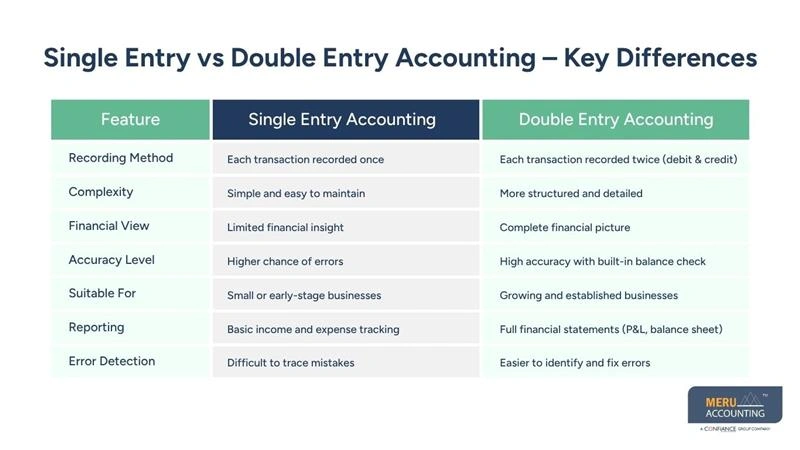
Single-entry systems may work well for businesses with very few transactions and simple operations. However, as a company grows, double-entry systems provide stronger financial clarity, better control, and more reliable reporting for decision-making.
Why Small Businesses Often Start with Basic Record Systems
Many small businesses begin with simple accounting systems because they want to keep costs low and avoid added steps. During the early stage, owners often handle many tasks on their own.
A company with a small customer base and few monthly transactions may not need advanced tools right away. Owners sometimes use spreadsheets or basic software to track income and costs.
Small businesses often choose basic systems because:
- Financial activity is still low
- Budgets are tight
- Report needs are simple
- The owner handles most accounting tasks
- Daily work stays easy to track
For many companies, simple methods work during the first stage. Problems often start when growth creates more financial activity.
Warning Signs That Your Business Has Outgrown Simple Bookkeeping Methods
As companies grow, financial tasks become harder to manage. Business owners may begin to notice issues that affect reports and decision-making.
Some signs show that a company may have moved beyond simple bookkeeping methods.
Reports take too long to create
When teams spend too much time making reports, the process may no longer fit business needs.
Cash flow gets hard to track
Growing companies often deal with more customers, invoices, and payment dates. Missing details can create cash flow issues.
Tax work becomes harder
Business growth can bring more tax rules and filing needs.
Financial errors happen more often
Manual records and basic systems may increase mistakes as transaction levels grow.
Decision-making gets harder
Business leaders need clear data to make smart choices. Missing details can affect growth plans.
These signs often show that companies need stronger accounting services instead of relying only on basic record systems.
The Expanding Role of Accounting Services in Modern Businesses
Many people think accounting only means tracking income and costs. Today’s business needs have changed that view.
Modern accounting services support many parts of company growth. Businesses need accounting systems that give useful data for planning and growth.
Professional accounting teams can help with:
Financial reporting
Reports help leaders understand company results and financial health.
Cash flow management
Strong cash flow support helps businesses manage daily work and future needs.
Compliance and tax support
Companies must follow changing tax and reporting rules.
Budget planning
Budget systems help control spending and support business goals.
Performance tracking
Businesses can measure growth through financial data and key results.
The value of accounting support goes beyond data entry. It creates a stronger accounting system for long-term success.
How Professional Accounting Services Help Build Long-Term Growth Strategies
Business growth needs planning. Companies that make choices without financial insight often face problems that could be avoided.
Professional accounting services help leaders build growth plans based on clear information.
Better financial visibility
Business owners need a clear view of revenue, costs, and profit trends. Better visibility supports stronger choices.
Improved cash flow planning
Cash flow affects every part of a business. Professional support helps companies plan for future needs and avoid cash shortages.
Stronger budget systems
Budgets guide spending and help businesses stay focused on goals.
Data for business choices
Financial reports help leaders decide when to hire staff, grow work areas, or invest in new chances.
Better risk control
Strong accounting systems help find problems before they turn into larger issues.
Support for future growth
Growing businesses often plan for expansion, funding, or new markets. Financial data plays a key role in those choices.
The topic of single entry vs double entry accounting helps companies choose a recording method. Still, long-term growth needs more than transaction records alone.
Meru Accounting's Accounting Services
At Meru Accounting, we understand that growing businesses need more than basic bookkeeping support. As companies expand, financial systems that worked in the early stage often become limited and less effective. Our focus is to help businesses move beyond basic methods and build stronger financial systems that support long-term growth and better decision-making.
What We Offer
Our accounting services are designed to support the key financial needs of growing businesses, including:
- Bookkeeping and transaction tracking
- Payroll processing
- Tax filing and compliance support
- Financial reporting
- Budgeting and planning
- Cash flow tracking
These services help ensure that day-to-day financial work stays accurate, organized, and easy to manage.
How We Help Businesses
We help businesses reduce financial confusion and improve clarity in their numbers. By organizing financial data in a structured way, we make it easier for business owners to understand performance and stay in control of their finances.
Key Takeaways
- Growing businesses often need more than basic transaction recording methods
- Single entry vs double entry accounting is important, but it is only one part of financial management
- Small businesses often start with simple systems because work levels are low
- Growth can create new report, tax, and cash flow issues
- Modern accounting services support planning, compliance, and business results
- Professional accounting support helps companies build long-term growth plans
- Strong financial systems improve decision-making and business strength
FAQs
Growing businesses handle more transactions, staff, taxes, and accounting tasks. Professional accounting services help organize financial data and support better choices.
Single entry vs double entry accounting compares two ways of recording transactions. Single-entry records a transaction one time, while double-entry records both debit and credit entries.
Yes. Small businesses with low financial activity sometimes use single-entry systems during the early stage.
Companies should think about stronger systems when reporting becomes hard, mistakes increase, or financial tracking becomes difficult.
Accounting services support cash flow tracking, financial reporting, budgeting, planning, and business choices that help companies grow with more confidence.