
Backlog accounting services are used when a business has missing or delayed financial records for several months. In many companies, invoices, expenses, and bank entries remain unrecorded due to workload issues or weak internal systems. This creates gaps in financial reporting that affect cash flow clarity and tax readiness.
Missing financial records are rebuilt in a structured way so financial statements reflect real business activity. In practice, this work often includes reviewing bank statements, sorting invoices, and correcting mismatched entries. Many firms also use catch up bookkeeping during this process to bring accounts back to an updated state.
In this blog, you will understand how these services work, why financial delays happen, and how structured recovery of records improves financial control and reporting accuracy.
What You Will Learn From This Blog
- How missing financial records impact business decisions
- Why do backlog situations develop in bookkeeping systems
- How financial data is restored step by step
- Role of catch up bookkeeping in record correction
- Industries where delayed bookkeeping is most common
- How professional accounting teams handle recovery work
Introduction to Backlog Accounting Services and Their Importance
Delayed financial records occur when business transactions are not entered into the accounting system on time. This can include unpaid invoices, missing expense entries, or bank transactions that were never recorded.
Over time, these small gaps build up and create confusion in financial reports, making it difficult to understand the real financial position of the business.
When records remain incomplete, financial reporting becomes unreliable and may show incorrect profit or expense figures. This creates financial risk, especially during tax filing, budgeting, and decision-making.
To address this issue, backlog accounting services are used to organize old records, verify transactions, and rebuild financial statements in a proper and structured order.
These services also play an important role in improving financial control by helping business owners clearly understand income flow, spending patterns, and outstanding liabilities.
In many cases, catch up bookkeeping is used along with financial record recovery processes to ensure all missing months are updated and aligned with current records, bringing consistency back into the accounting system.
What are Backlog Accounting Services in Modern Businesses?
Systematic Record Reconstruction
Backlog accounting services focus on rebuilding financial data step by step using available documents such as invoices, receipts, and bank statements. This process ensures that no financial activity is ignored while restoring past records in the correct order.
Use of Digital Accounting Tools
Software like QuickBooks, Xero, or Zoho Books is used to re-enter and organize financial data in a structured format. These tools make it easier to track corrections and maintain consistency across all accounting entries.
Bank Data Matching Process
Every transaction is matched with bank records to ensure accuracy and identify missing or duplicate entries. This step reduces errors and helps confirm that all financial movements are properly recorded.
Financial Reporting Restoration
Once data is corrected, updated profit and loss statements and balance sheets are prepared for business review. These reports give a clear view of past performance and current financial position.
Integration With Catch Up Bookkeeping
Catch up bookkeeping ensures that all missing months are updated so the accounting system reflects continuous financial activity. It also helps maintain uniform records across all reporting periods for better clarity.
Common Causes of Financial Backlogs in Bookkeeping
High Transaction Load
Businesses with frequent sales or purchases often fail to record entries on time due to workload pressure, a challenge often addressed through backlog accounting services. When daily activity increases, accounting updates often fall behind schedule.
Staff Shortages Or Skill Gaps
Lack of trained accounting staff can result in delayed entry of financial data. This creates gaps in records that slowly build into larger backlog issues.
Software Migration Issues
When companies switch accounting systems, some data may fail to transfer correctly. This leads to missing entries that need manual correction later.
Weak Internal Documentation
Missing invoices or receipts often create gaps that later require financial reconstruction. Without proper records, verifying transactions becomes time-consuming and complex.
Rapid Business Growth
Fast expansion without updated accounting systems leads to backlog situations that require structured cleanup. Financial processes often fail to keep pace with increasing transaction volume.
How Backlog Accounting Services Restore Financial Accuracy
Recovery of Missing Entries
Old bank transactions and invoices are reviewed and entered into accounting systems in the correct order as part of backlog accounting services. This helps rebuild a complete financial timeline without missing activity.
Correction of Accounting Errors
Wrong categorizations, duplicate entries, and mismatched amounts are identified and fixed. Each correction ensures that financial data reflects actual business activity.
Bank Reconciliation Alignment
All financial records are matched with bank statements to ensure consistency and accuracy. This step confirms that recorded transactions match real bank movements.
Preparation of Updated Reports
Corrected data is used to prepare updated financial statements that reflect real performance. These reports help business owners understand true profit and expense levels.
Tax Filing Readiness
Clean records make tax preparation more accurate and reduce risk during audits or reviews. It also reduces the chances of errors during compliance submissions.
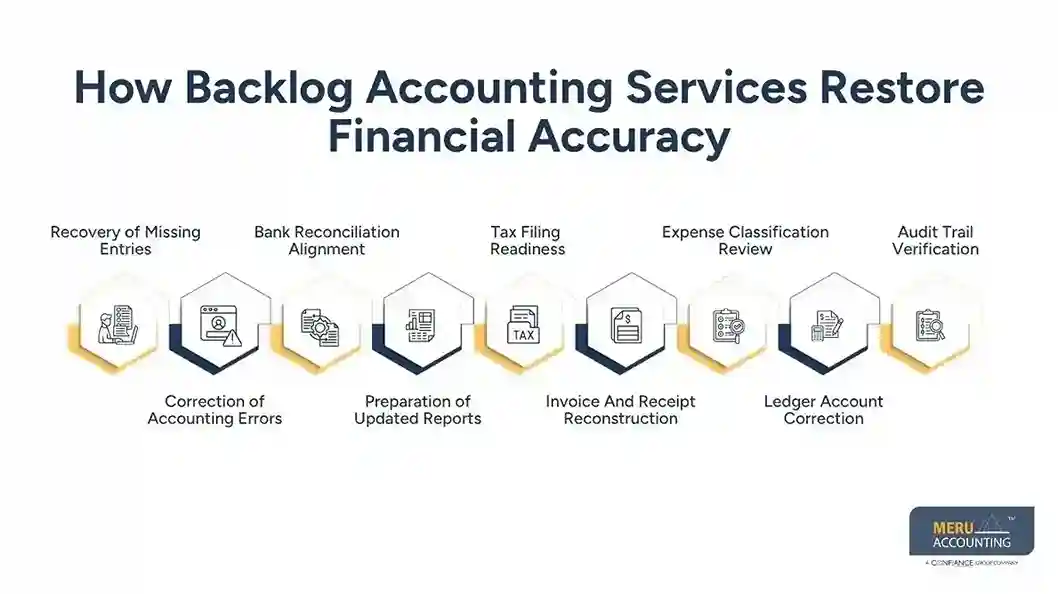
Invoice And Receipt Reconstruction
Missing invoices and receipts are reconstructed using bank data and supporting documents. This ensures no transaction is left unverified during the recovery process.
Expense Classification Review
All expenses are reviewed and placed into the correct categories for accurate reporting. Proper classification helps improve clarity in financial statements.
Ledger Account Correction
Ledger entries are checked and corrected to remove inconsistencies in account balances. Balanced ledgers strengthen the reliability of overall financial records.
Audit Trail Verification
Each transaction is verified to maintain a clear audit trail for future reference. Strong audit trails make financial reviews smoother and more transparent.
Role of Catch Up Bookkeeping in Managing Missed Financial Records
Purpose of Catch Up Bookkeeping
Catch up bookkeeping focuses on updating all missing financial entries so accounts reflect complete activity. It brings older records up to current accounting standards for better clarity and control.
Difference From Backlog Accounting Work
Backlog accounting services focus on correction and recovery, while catch up bookkeeping focuses on updating missing time periods. Both functions address different parts of the same financial cleanup process.
Combined Use in Practice
Most businesses use both processes together to ensure full financial restoration. The combined approach reduces gaps and improves overall record accuracy.
Reducing Reporting Gaps
Catch up bookkeeping ensures no month is left unrecorded in the accounting system. Continuous updating strengthens consistency across all reporting periods.
Improving Audit Preparation
Updated records make it easier for businesses to respond during audits or financial reviews. Well-maintained books reduce delays during compliance checks and reviews.
Industries That Benefit Most From Backlog Accounting Services
E-Commerce Businesses
Online sellers handle high transaction volumes, making delayed entries more common. Frequent daily sales create pressure on bookkeeping teams to maintain updated records.
Real Estate Companies
Multiple deals, commissions, and payments often create delayed bookkeeping situations. Complex transaction structures increase the chance of missing or late entries.
Healthcare Sector
Medical billing delays and insurance claims often lead to missing records. High documentation requirements make timely accounting more challenging.
IT And SaaS Companies
Subscription billing cycles require consistent tracking, which is often delayed. Recurring payments and upgrades often create recording gaps in accounting systems.
Hospitality Industry
Seasonal activity creates irregular financial recording patterns that need later correction. Peak business periods often leave little time for proper bookkeeping updates.
How Meru Accounting Handles Backlog Accounting Services
Structured Recovery Approach
Meru Accounting follows a clear process under backlog accounting services to review, sort, and rebuild missing financial records in proper order. Each stage is carefully planned to maintain accuracy and reduce errors during recovery.
Experienced Accounting Team
Our professionals handle complex financial histories using structured review methods and careful verification. Years of practical exposure in backlog cases ensure stable and reliable outcomes.
Use Of Reliable Accounting Systems
We use tools like QuickBooks, Xero, and Zoho Books to ensure accurate record reconstruction. These platforms allow real-time tracking and better control over restored data.
Industry-Focused Handling
Different industries require different approaches, and our process is adjusted based on business type and transaction flow. Custom handling ensures records match the operational structure of each business.
Focus On Compliance Standards
All restored records are prepared in line with tax and audit requirements to maintain financial accuracy. Strict compliance checks reduce risks during financial assessments and filings.
Our Expert Perspective
In real financial operations, backlog cases are more common than businesses expect and usually become visible only when bank balances do not match or tax filing becomes difficult.
From our experience, a structured recovery process combined with catch up bookkeeping is essential to restore accuracy in financial records.
Once missing transactions are properly identified and recorded, businesses gain clear visibility into their financial performance, including profit trends, expense patterns, and cash flow movements, which ultimately strengthens financial control and reduces reporting issues in the future.
Key Takeaways
- Backlog accounting services rebuild missing financial records in a structured way
- Financial delays often happen due to workload, system issues, or missing documents
- Catch up bookkeeping is used to update missing months of data
- Corrected records improve tax filing accuracy and financial reporting
- Many industries face backlog issues due to high transaction volume
- Professional recovery ensures better financial clarity and control
FAQs
Backlog accounting services rebuild missing financial records by reviewing bank statements, invoices, and past transactions in a structured process.
Unrecorded financial data is recovered by matching bank entries with supporting documents and updating all missing transactions in accounting systems.
Backlog accounting services focus on reconstructing past financial records, while catch up bookkeeping updates all pending months to bring accounts current.
Time depends on the missing data volume, with smaller cases taking a few weeks and larger accounting gaps requiring more time.
Clean and updated financial records from backlog accounting make tax filing accurate and reduce complications during audits and compliance checks.