
E-commerce businesses often face complex financial and inventory challenges as they grow. Multiple sales channels, payment gateways, and stock discrepancies can quickly create confusion, making it difficult to maintain accurate financial records. This is where catch up bookkeeping services become essential.
These services allow sellers to organize past transactions, reconcile payment issues, and ensure their inventory records match actual stock levels. By doing so, e-commerce entrepreneurs can regain control over their finances and make informed decisions.
What You Will Learn From This Blog
- Why catch up bookkeeping services are critical for e-commerce sellers
- Common challenges with payment gateways and inventory management
- How bookkeeping catch up services resolve financial and stock chaos
- Step-by-step process of cleaning up your books
- Tips for choosing the right service and avoiding common mistakes
- How Meru Accounting can simplify your e-commerce bookkeeping
What are Catch Up Bookkeeping Services?
Catch-up bookkeeping services are designed to organize and update delayed or incomplete financial records that have been delayed, overlooked, or mismanaged.
Many e-commerce sellers use bookkeeping catch up services to handle daily transaction entries, payment settlements, refunds, and inventory tracking as their business grows.
These services ensure all financial transactions are accurately recorded and reconciled, providing reliable records for reporting, tax filing, and business planning.
Businesses that manage multiple sales channels often need these services to fix reporting gaps, resolve inventory mismatches, and correct errors. Some use them occasionally, while others schedule them regularly to maintain order.
Beyond compliance, accurate records give sellers a clear view of cash flow, costs, and performance, enabling informed decisions and better planning for future growth.
Common Challenges E-Commerce Sellers Face with Payment Gateways and Inventory
Payment Gateway Confusion
Multiple gateways can lead to mismatched deposits, duplicate charges, or missing payments. This creates difficulties in understanding actual revenue. Different settlement timelines from payment providers can also make tracking daily cash flow more complicated.
Delayed Reconciliation
Without timely bookkeeping, payment settlements may be recorded incorrectly or delayed, causing inaccuracies in cash flow reporting. Over time, these delays can create confusion during tax filing and financial reviews.
Inventory Discrepancies
Errors in stock counts, returns, and shipments often result in incorrect inventory records, affecting order fulfillment and profitability. Inventory mistakes may also lead to overselling or stock shortages that impact customer satisfaction.
Multi-Channel Management
Selling across various platforms can create inconsistencies between online listings, warehouse stock, and accounting records. Managing data from multiple systems often increases the risk of manual entry errors.
Regulatory Compliance Risks
Improper bookkeeping increases the risk of failing to comply with tax regulations, which can lead to fines and legal issues. Inaccurate financial records may also create problems during audits or financial assessments.
How Catch Up Bookkeeping Services Help Resolve Payment Gateway Chaos
Transaction Reconciliation
Professional catch-up bookkeeping services match payments recorded in invoices, payment gateways, and bank deposits to ensure complete accuracy.
This includes reconciling transactions across multiple sales channels and verifying that all settlements from payment processors are correctly recorded. Differences in settlement timelines are also adjusted to reflect the actual cash position of the business.
Error Detection and Correction
Duplicate charges, missing payments, refunds, and incorrect entries are identified and corrected to ensure clean financial records. This process helps eliminate inconsistencies that can distort revenue reporting and improves the reliability of financial data used for analysis.
Bank Statement Matching
Accountants review bank statements alongside sales and gateway reports to make sure no transaction is overlooked. This ensures financial records remain accurate and consistent.
Tax Calculation Accuracy
All sales taxes, transaction fees, and related expenses are properly recorded. This prevents errors during tax filing and ensures compliance with regulations through catch up bookkeeping services.
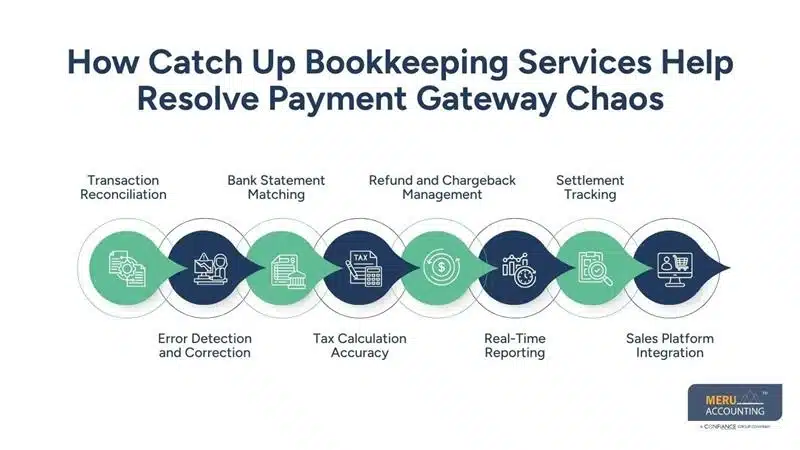
Refund and Chargeback Management
All refunds and chargebacks are tracked carefully, reflecting the actual sales revenue. Monitoring these transactions also highlights recurring issues with customer disputes or returns.
Real-Time Reporting
Reliable financial reports allow sellers to assess performance and forecast revenue more effectively. Accurate reporting simplifies budgeting, cost tracking, and future planning.
Settlement Tracking
Differences in payment gateway settlement schedules are reconciled, keeping cash flow records precise. Timely tracking prevents mismatches between expected and received funds.
Sales Platform Integration
Data from multiple e-commerce platforms is consolidated into a single accounting system. This reduces inconsistencies between sales records, payment reports, and internal books.
Managing Inventory Discrepancies with Catch Up Bookkeeping Services
Accurate Stock Counts
Using bookkeeping catch up services, bookkeepers review historical inventory data and cross-check it with physical stock, ensuring precise records. This process helps prevent errors that could affect order fulfillment and sales reporting.
Correction of Past Errors
Errors like unrecorded returns, misplaced shipments, or duplicate stock entries are corrected during the catch-up process. Correcting these mistakes ensures that future inventory decisions are based on reliable data.
Integration with Accounting Software
Catch up bookkeeping services often update your accounting software to reflect real-time inventory levels, reducing future discrepancies. Integrating inventory data also streamlines reporting and makes reconciliation faster.
Tracking Shrinkage and Loss
Bookkeepers monitor shrinkage, theft, or damaged goods, providing insights into operational inefficiencies. Identifying these issues helps sellers take preventive measures and minimize losses.
Forecasting and Planning
Accurate inventory records enable better demand forecasting, reducing overstocking or stockouts, and improving profitability. Proper planning also allows for more strategic purchasing and inventory management decisions.
Supplier and Purchase Order Reconciliation
Inventory discrepancies often arise from mismatched purchase orders or supplier deliveries. Bookkeepers reconcile supplier invoices and purchase orders with actual stock received, ensuring records accurately reflect inventory inflow.
Step-by-Step Process: How Bookkeeping Catch Up Services Clean Your Books
Initial Assessment
Bookkeepers review financial and inventory records to understand the scope of discrepancies and missed entries. Assessing the backlog helps determine which accounts and systems need the most attention.
Gathering Documentation
Invoices, payment gateway reports, and inventory logs are collected to ensure no transaction is overlooked. Proper documentation allows every entry to be verified during reconciliation.
Transaction Matching
Payments are reconciled with invoices and bank statements, identifying gaps or errors. Bookkeeping catch up services align sales records with actual bank deposits and resolve mismatches in reported revenue.
Correcting Errors
As part of catch up bookkeeping services, incorrect entries, missing payments, or misallocated expenses are corrected in the accounting system. Accurate adjustments make financial statements reliable and reflective of the true business position.
Inventory Reconciliation
Stock levels are compared with physical inventory, and discrepancies are addressed for accurate reporting. Aligning inventory records with accounting data reduces operational mistakes and fulfillment issues.
Final Reporting
A comprehensive financial report is generated after corrections, providing clarity and actionable insights. Clear reporting enables informed decision-making and better business planning.
Choosing the Right Catch Up Bookkeeping Services for Your E-Commerce Store
Experience and Expertise
Select a service provider familiar with e-commerce platforms, payment gateways, and inventory management. Strong industry experience reduces errors during financial cleanup and improves accuracy in reporting.
Software Knowledge
Ensure compatibility with your existing accounting software or recommendation of suitable platforms. Proper system knowledge helps maintain data consistency across sales channels and financial records.
Customized Solutions
A good service tailors processes to your business needs rather than applying a one-size-fits-all approach. Flexible methods ensure that both payment and inventory issues are addressed effectively.
Transparent Pricing
Understand how pricing is structured and whether additional charges apply for backlog management. Clear cost details help avoid unexpected expenses during the cleanup process.
Client Support
Reliable communication and ongoing support from catch up bookkeeping services providers are critical for addressing future issues quickly. Quick response times ensure smoother resolution of queries and reduce operational delays.
Common Mistakes to Avoid When Using Bookkeeping Catch Up Services
Waiting Too Long
Delaying catch-up bookkeeping increases the workload and risk of errors. Larger backlogs often require more time and detailed corrections.
Not Providing Complete Documentation
Missing invoices, bank statements, or gateway reports can lead to incomplete reconciliation. Proper records are essential for accurate adjustments and clean reporting.
Ignoring Inventory Checks
Focusing only on payments without addressing stock discrepancies can create ongoing operational challenges. Unchecked inventory issues may affect order fulfillment and profit accuracy.
Choosing Inexperienced Providers
Choosing an inexperienced provider for catch up bookkeeping services may result in errors or missed issues, leading to inaccurate records. Lack of expertise can result in repeated corrections and delays.
Overlooking Regular Maintenance
Catch-up bookkeeping should be complemented by ongoing record-keeping to prevent future chaos. Regular updates help maintain accuracy and reduce future workload.
How Meru Accounting Can Simplify Your E-Commerce Bookkeeping
At Meru Accounting, comprehensive catch up bookkeeping services are designed to support e-commerce sellers in managing complex financial and inventory records with accuracy and structure. The focus remains on restoring clarity in books so business owners can make informed decisions with confidence.
- Shopify, WooCommerce, Amazon, eBay, and other major platforms are handled with structured accounting processes that reduce reporting gaps and improve record accuracy.
- Every transaction is matched with invoices, settlements, and bank deposits to ensure revenue figures reflect actual cash flow without inconsistencies.
- Stock levels are reconciled with accounting records, while discrepancies such as missing, excess, or unrecorded items are identified and corrected.
- Financial reports are prepared to present clear insights on revenue, expenses, profit margins, and inventory movement for better planning.
- Clients across the US, UK, Canada, and Australia benefit from experience in handling different tax rules, currencies, and e-commerce models.
Partnership with Meru Accounting allows e-commerce sellers to reduce financial confusion, improve record accuracy, and focus more on business growth instead of bookkeeping issues.
Our Expert Perspective
Our team has consistently observed that unresolved payment gateway discrepancies and inventory mismatches can distort financial clarity in e-commerce operations. Catch up bookkeeping services bring structure to historical records by reconciling transactions and aligning inventory data with actual movement, enabling more reliable financial reporting and informed decision-making.
Key Takeaways
- Catch up bookkeeping services restore order in messy financial and inventory records.
- They help reconcile payment gateways, detect errors, and ensure compliance.
- Accurate inventory management prevents stockouts and overstocking.
- Choosing experienced providers ensures efficient and accurate bookkeeping.
- Regular maintenance after catch-up services is essential for long-term financial clarity.
FAQs
Catch up bookkeeping services organize and correct past financial records, including payment gateways, sales entries, and inventory data for online stores.
Transaction matching between payment gateways, invoices, and bank deposits removes mismatches, missing entries, and duplicate records.
Amazon, Shopify, and WooCommerce data are organized through reconciliation of sales, refunds, fees, and settlement reports across platforms.
Accurate inventory reconciliation aligns stock records with physical goods, preventing overselling, stock gaps, and profit miscalculations.
A mismatch between payment records, sales reports, or inventory data signals the need to reconcile and organize financial and inventory records in an e-commerce business.