
A dedicated CPA model is increasingly used by businesses that want reliable accounting support without maintaining a full in-house finance team. It allows companies to assign financial responsibilities such as bookkeeping, reporting, and compliance to trained professionals who work with a consistent focus on assigned tasks.
This structure is especially useful for companies that want cost control along with accurate financial records. In many cases, firms also rely on dedicated staff to manage routine accounting activities under a structured workflow, which reduces operational pressure on internal teams.
The approach is not only about outsourcing work but also about building a stable accounting system where a professional CPA becomes part of the extended finance function.
What You Will Learn From This Blog
- How a dedicated CPA reduces accounting workload and cost pressure
- Why businesses are moving away from full in-house accounting teams
- How dedicated staff contribute to daily financial operations
- How financial accuracy is maintained in external accounting setups
- How Meru Accounting structures its CPA support services
Why Businesses are Choosing a Dedicated CPA Model
Rising Cost Of In-House Hiring
A CPA helps reduce the cost burden of salaries, benefits, and office setup. Many firms find that maintaining an internal CPA team is expensive, while this model offers flexible pricing.
Access To Skilled Professionals
A skilled accountant gives access to trained experts who handle accounting tasks with accuracy. These professionals work as staff, focusing only on assigned clients and tasks.
Better Focus On Core Work
With a dedicated CPA model, businesses do not need to manage hiring, training, or day-to-day coordination of accounting resources.
This significantly reduces operational, administrative, and HR-related workload on internal teams, allowing leadership to focus more on core business activities and growth priorities without distraction.
Reduced Administrative Pressure
A skilled accountant removes the burden of recruitment and HR management. Companies can directly work with staff who are already trained and experienced.
Consistent Financial Output
A skilled CPA ensures that accounting tasks are handled regularly. This leads to stable reporting cycles and fewer delays in financial updates.
Cost Reduction Benefits of Hiring a Dedicated CPA
Lower Fixed Expenses
A dedicated CPA reduces salary commitments and long-term employee costs. This also helps businesses convert fixed payroll burden into a more flexible cost structure.
Reduced Infrastructure Needs
There is no requirement for additional office space or equipment when using an outsourced accounting model. This also removes spending on utilities, hardware setup, and workspace maintenance.
Lower Training Costs
Since professionals are already trained, onboarding expenses are minimal. Businesses avoid repeated training cycles and reduce time spent on skill development.
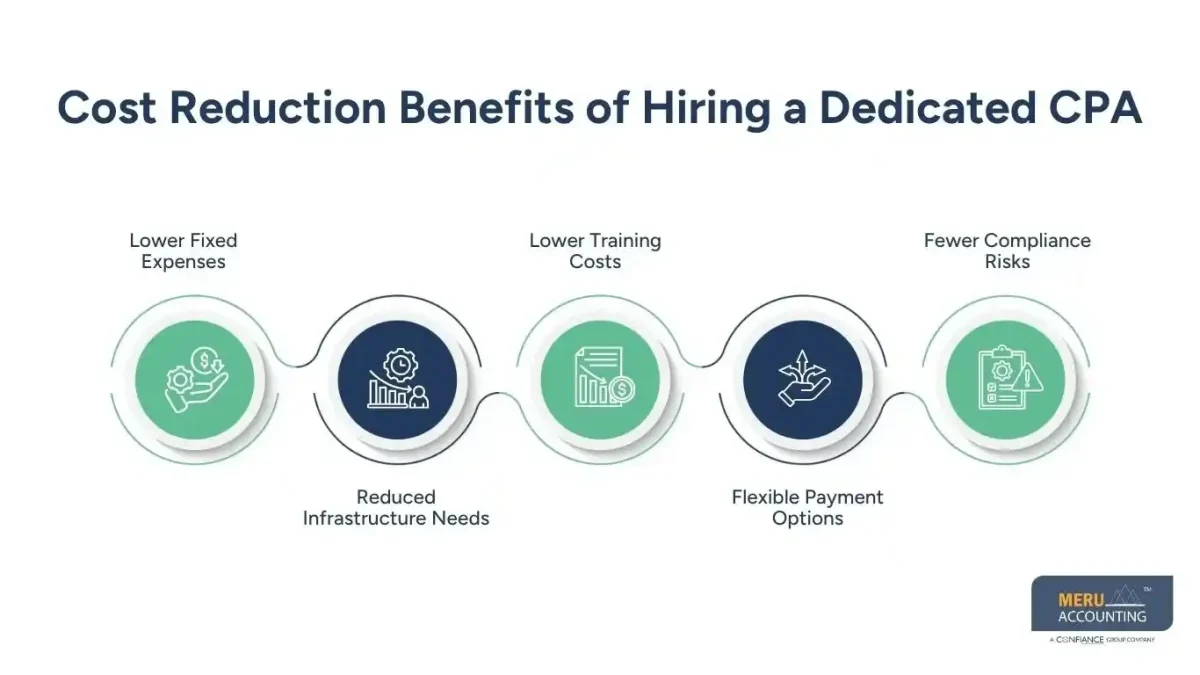
Flexible Payment Options
Businesses can choose monthly or task-based billing based on needs. This allows better control over cash flow and makes budgeting more predictable.
Fewer Compliance Risks
An outsourced accounting setup reduces accounting errors that could lead to penalties or reporting issues. Regular monitoring also ensures timely filings and fewer last-minute corrections.
Role of Dedicated Staff in CPA Outsourcing Services
Focused Task Handling
Dedicated staff handles specific client accounts, which improves consistency in accounting work. Reduced task overlap leads to clearer ownership of responsibilities across accounting activities.
Timely Financial Updates
A CPA ensures reports are prepared on schedule. Faster reporting cycles allow businesses to review financial positions without delays.
Improved Accuracy
Repetition of structured tasks reduces errors in bookkeeping and reporting. Consistent workflow strengthens record quality across all accounting periods.
Clear Communication Flow
Clients interact directly with assigned accounting professionals for updates and clarifications. Direct coordination reduces response delays and improves clarity in financial discussions.
Continuous Monitoring
Financial transactions are tracked regularly instead of being reviewed only at month-end. Early detection of discrepancies helps maintain cleaner and more reliable financial records.
Scalability Benefits of Dedicated CPA and Dedicated Staff Models
Easy Capacity Expansion
A dedicated CPA model allows quick addition of team members during workload increases.
Accounting capacity can be adjusted without delays in hiring or onboarding processes.
Seasonal Work Handling
Tax and audit seasons can be managed without stress through temporary scaling.
Extra accounting support can be added during peak filing periods to manage workload spikes.
Cost-Controlled Growth
Businesses can expand operations without increasing fixed payroll costs.
Financial planning remains stable even when accounting demand increases.
Task Redistribution
Workload can be adjusted among dedicated staff based on priority. Balanced task allocation helps maintain steady progress across all accounting activities. Critical tasks receive attention first, reducing delays in financial reporting.
Business Adaptability
The outsourcing structure adjusts easily as financial needs change over time. Flexibility in operations supports smoother handling of growth, restructuring, or seasonal fluctuations.
How Dedicated CPA Outsourcing Supports Business Growth Strategy
Financial Clarity For Decision Making
A dedicated CPA provides accurate reports that help management understand cash flow, expenses, and profit trends clearly.
These financial insights allow business owners to make informed decisions, identify risks early, and plan future investments with confidence.
Better Resource Allocation
With structured reporting from dedicated staff, businesses can allocate funds to growth areas instead of fixing accounting errors.
Accurate financial records help companies control unnecessary spending and use available resources more effectively.
Faster Expansion Planning
Financial data is always kept updated, which helps leadership plan expansion without delay.
Timely reports give businesses a clear view of their financial position before entering new markets or launching new services.
Reduced Operational Burden
By shifting accounting work to external professionals, internal teams can focus more on sales, clients, and core operations.
This reduces daily administrative pressure and allows employees to spend more time on activities that support business growth.
Support For Scalable Systems
This model adjusts easily as business size grows, supporting long-term strategy execution.
The flexible structure allows companies to increase accounting support when needed without creating high internal costs.
Workflow Structure in Dedicated CPA Outsourcing Services
Task Allocation System
A dedicated CPA assigns specific accounting tasks to dedicated staff based on skill and priority.
This helps ensure each task is handled by the right person, improving the speed and accuracy of work completion.
Daily Accounting Updates
Transactions are recorded daily to maintain updated financial data. The practice reduces the risk of missing entries and keeps financial records aligned with real-time activity.
Weekly Review Cycles
A CPA reviews reports weekly to ensure accuracy. Regular reviews help identify errors early and maintain consistency in financial reporting.
Monthly Reporting Structure
Financial statements are prepared on a monthly basis for decision-making. These reports provide a clear summary of performance trends and financial position.
Client Communication Flow
Clients receive regular updates from assigned team members for transparency. This ensures smooth communication and quick resolution of accounting-related queries.
Industries That Benefit Most From Dedicated CPA Services
E-Commerce Sector
High transaction volumes require structured accounting handled by a CPA. Accurate tracking of sales, refunds, and platform fees becomes easier with organized financial processes.
Real Estate Industry
Project-based accounting and rent tracking are easier with external support. Complex property transactions can be recorded with better clarity and reduced manual effort.
Healthcare Sector
Billing and insurance processes require accurate financial management. Strict compliance requirements make consistent accounting support essential for smooth operations.
IT and SaaS Companies
Recurring revenue models benefit from structured reporting systems. Subscription-based income tracking becomes more reliable with consistent financial monitoring.
Hospitality Industry
Daily expense and income tracking becomes easier with dedicated accounting support. High transaction frequency in hotels and restaurants requires continuous financial record updates.
How Meru Accounting Delivers Dedicated CPA Support For Global Clients
Meru Accounting provides structured financial support through a skilled CPA model designed for international clients. Each engagement is assigned based on business size and accounting complexity.
Our dedicated staff works on bookkeeping, payroll, tax preparation, and reporting tasks in a structured manner. This reduces dependency on internal hiring while maintaining consistent financial records.
The system is designed to ensure accuracy, timely reporting, and smooth communication between clients and accounting professionals. A clear workflow is followed for every engagement to ensure that financial tasks move in a planned sequence without delays.
Each stage of accounting work is monitored to maintain consistency and reduce reporting gaps. Clients also receive consistent updates through structured communication channels. Financial data is organized in a way that makes review and decision-making easier across different reporting periods.
Our Expert Perspective
Our experience shows that a dedicated CPA model works best when businesses need consistent financial output without maintaining a large internal accounting team. Organizations that work with dedicated staff within a structured accounting setup often experience fewer reporting delays and clearer financial records.
Strong results are achieved when responsibilities are clearly defined and reviewed on a regular basis. A well-structured workflow with continuous monitoring improves accuracy and keeps financial records consistent across reporting cycles.
Key Takeaways
- A dedicated CPA reduces fixed accounting costs
- Dedicated staff improve task consistency
- In-house accounting teams require higher long-term investment
- Flexible scaling is possible with outsourced models
- Reporting consistency improves with structured workflows
- Meru Accounting provides organized CPA support services
FAQs
A dedicated CPA is a trained accounting professional who works on assigned client tasks with full focus. Clear responsibility for specific financial work ensures better accuracy and consistency in reporting.
A professional CPA reduces salary, training, and infrastructure costs by replacing full-time hiring needs. Lower fixed expenses allow businesses to manage accounting within a flexible cost structure.
Dedicated staff handles routine accounting tasks such as bookkeeping and reporting. Assigned responsibilities support smoother workflow and improve consistency in financial records.
Yes, strict data handling processes are followed to ensure financial information remains secure and confidential.
A CPA model allows easy scaling by adjusting team size based on workload. Flexible resource allocation supports business expansion without operational delays.