An ecommerce sale doesn’t end when a customer clicks “Place Order.” There are payment fees to record, inventory costs to account for, sales tax to track, and refunds or returns that may change the final numbers. NetSuite ecommerce integration brings these moving parts into a connected system, helping businesses keep sales, inventory, and financial records aligned.
But syncing data is only part of the equation. The real value comes from knowing what was sold, what it cost, how much money the business actually received, and what stock remains. Let’s look at how NetSuite integration for ecommerce businesses supports more reliable financial reports and inventory records.
What You Will Learn From This Blog
- Why disconnected systems cause errors in ecommerce records.
- How NetSuite connects sales, payments, and inventory data.
- Ways to improve revenue reports and payment reconciliation.
- How integration helps track stock, returns, and inventory costs.
- Which reports and metrics can help ecommerce owners make better decisions.
Why Ecommerce Businesses Need Connected Financial and Inventory Systems
Many ecommerce businesses use separate tools for online sales, payment processing, stock control, shipping, and accounting. Each tool may work well on its own, but problems can arise when the data does not match.
For example, an order may be placed on an online store, but the inventory count may not update at once. The finance team may also need to enter the sale by hand. If the same order is entered twice or left out, the sales and stock records may no longer match.
Some common problems include:
- Duplicate sales records: The same order may be entered more than once in the books.
- Wrong stock counts: A product may still show as available after it has been sold.
- Late financial reports: Finance teams may need to collect data from several systems before closing the books.
- Payment gaps: Store sales, payment gateway fees, and bank deposits may not match.
- Poor cost tracking: Stock costs, returns, and write-offs may not be fully recorded.
These gaps make it harder to know how much the business has earned, what stock it has, and which products are making money.
NetSuite ecommerce integration helps address these issues by setting up a clear flow of data between sales and back-office systems. This gives teams a more reliable base for daily checks and month-end reports.
What Is NetSuite Ecommerce Integration?
NetSuite ecommerce integration is the process of linking an online store or sales channel with NetSuite so that key business data can move between systems.
Depending on the setup, the data may include:
- Customer details and order records.
- Product names, SKUs, and prices.
- Stock levels and item details.
- Shipping and fulfillment status.
- Refunds, returns, and canceled orders.
- Payment and settlement details.
NetSuite Connector offers links for ecommerce platforms and marketplaces, including Shopify, BigCommerce, WooCommerce, Amazon, eBay, and Walmart. The available data flows and sync options depend on the connector and platform setup.
For some businesses, a prebuilt connector may meet their needs. Others may need middleware or custom API links because of their sales channels, order rules, or reporting needs.
The key goal of NetSuite integration for ecommerce businesses is to create a reliable flow of data without the need for repeat data entry. A sound setup also defines which system controls each type of data and how errors are found and fixed.
optional anymore
on running the business
How NetSuite Ecommerce Integration Improves Financial Reporting
Financial reports are only as good as the data behind them. When sales, fees, refunds, and costs sit in separate systems, finance teams may spend too much time pulling data and fixing gaps.
NetSuite ecommerce integration can improve this process in several ways.
Centralizes Sales Data Across Channels
Businesses that sell through their own website and online marketplaces may have many sales records to track. An integrated setup can bring order and sales data into NetSuite, making it easier to review results across channels.
Finance teams can compare sales by store, product, or sales channel without relying on several separate reports. This also makes it easier to spot changes in order volume and sales trends.
Improves Revenue Tracking
An order total does not always equal the revenue that should appear in the books. Discounts, refunds, sales tax, shipping charges, and order changes all affect the final entries.
A good NetSuite ecommerce integration maps these items to the right accounts. It also helps teams apply their revenue rules in a steady way.
Businesses should not treat every order as earned revenue at the time of checkout. Revenue must be recorded based on the business’s accounting policy and when the goods or services have been provided.
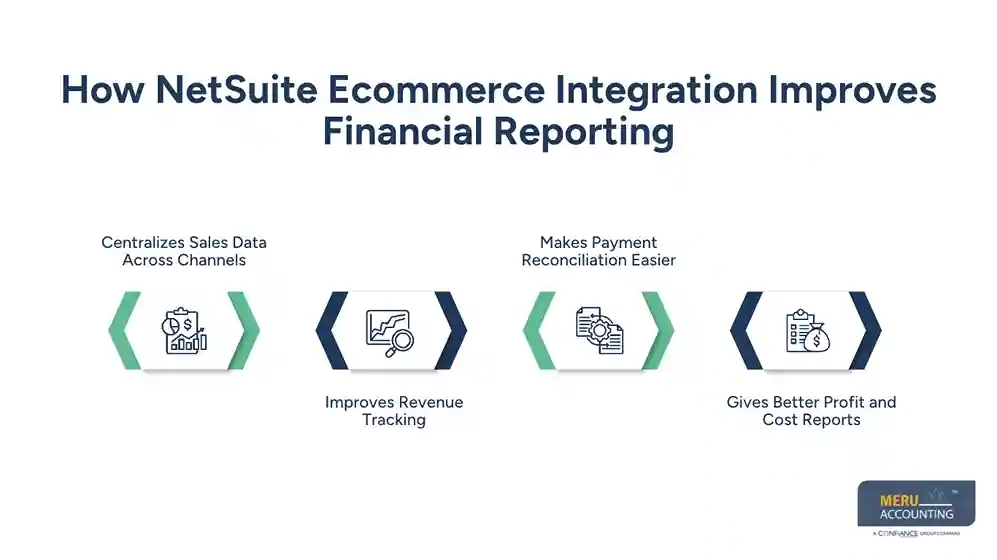
Makes Payment Reconciliation Easier
The amount a customer pays may differ from the amount that reaches the business bank account. Payment gateways and marketplaces may take fees, hold funds, or group many orders into one payout.
An integrated process can bring order and settlement details together. The finance team can then match sales, fees, refunds, and deposits to find gaps.
For example, consider this order:
Item | Amount |
Product sales | $1,000 |
Discount | -$100 |
Net sales | $900 |
Sales tax collected | $72 |
Shipping charged | $15 |
Customer payment | $987 |
Payment processing fee | -$30 |
Bank payout | $957 |
The $30 fee is a business expense, not a reduction in product revenue. The $72 tax is a liability, not sales income. The team must record each item in the right place.
This kind of breakdown helps keep the books clear and makes it easier to match the order with the bank payout.
Gives Better Profit and Cost Reports
When sales data links with product costs, shipping costs, and other expenses, owners can get a better view of profit.
They can review gross profit by product or sales channel and see which items bring in strong sales but weak margins. These reports can help guide price changes, ad spend, and stock buys.
Key NetSuite Reports and Metrics Ecommerce Businesses Should Monitor
A well-planned NetSuite setup can give ecommerce teams access to reports that help them track sales, stock, and profit. The most useful reports depend on the business model, product range, and sales channels.
Report or Metric | What It Helps Track |
Sales by channel | Revenue from each store or marketplace |
Gross profit margin | Profit after product costs |
COGS report | Cost of products sold during a period |
Inventory turnover | How often stock is sold and replaced |
Days inventory outstanding | How long stock stays on hand |
Inventory aging | Items that have remained in stock for too long |
Stock on hand | Current recorded stock by item or location |
Refund and return reports | Returned orders and their effect on sales |
Payment reconciliation | Differences between sales, fees, and deposits |
For example, high sales do not always mean strong profit. A product may sell well but have high shipping costs, return rates, or marketplace fees. Reviewing sales and cost reports together gives owners a fuller view of their value.
Businesses should also compare system records with bank statements and physical stock counts. These checks help find missing entries, wrong quantities, and other gaps before they affect month-end reports.
NetSuite Accounting Services for Ecommerce Businesses by Meru Accounting
An integrated NetSuite system can bring orders, payments, and inventory records into one place, but someone still needs to make sure the numbers tell the right story. A marketplace payout may include fees and refunds, a returned item may need a stock adjustment, and a change in product cost can affect reported margins. These details need proper accounting treatment, not just data synchronization.
At Meru Accounting, we provide NetSuite accounting services for ecommerce businesses that need more than transaction entry. Our team works across the financial records that connect sales activity with inventory costs, cash flow, and business performance.
Our services include:
- NetSuite bookkeeping and transaction review: Record and review sales, expenses, refunds, fees, and other transactions to keep the books organized.
- Marketplace and payment reconciliation: Match Shopify, Amazon, and payment processor settlements with NetSuite records and bank deposits. Identify fee differences, missing payments, and unmatched transactions.
- Inventory and COGS accounting: Review inventory values, purchase costs, stock adjustments, returns, and cost of goods sold to support accurate gross profit reporting.
- Sales and financial reporting: Prepare and review income statements, balance sheets, cash flow reports, and sales reports to help owners understand business performance.
- Accounts payable and receivable: Manage supplier bills, customer balances, payment records, and outstanding amounts.
- NetSuite month-end close support: Reconcile accounts, review balance sheet items, check inventory-related entries, and resolve discrepancies before closing the books.
Our accounting team pays attention to how individual transactions affect the bigger financial picture. For example, we look beyond the marketplace payout amount to account for gross sales, selling fees, refunds, and other deductions separately. We also review stock adjustments and product costs so inventory changes do not go unnoticed in financial reports.
With Meru Accounting, ecommerce businesses get a dedicated accounting team, multi-industry experience, and a structured review process to support their ongoing NetSuite accounting needs. We help turn synced business data into organized financial records that owners can use to track margins, manage stock costs, and make better decisions.
Our Expert Insight
One decision that can prevent a lot of trouble with NetSuite ecommerce integration is deciding which system owns each piece of business data. For example, product prices may be managed in the ecommerce platform, while inventory records and item costs are maintained in NetSuite.
When both systems are allowed to update the same fields without clear rules, one platform can overwrite changes made in the other. This can lead to outdated prices, incorrect product details, or conflicting records.
We recommend defining data ownership before setting up sync rules. Decide where product details, pricing, inventory, and customer records should be maintained, then set permissions and sync directions around those decisions. This gives each system a clear role and makes future changes easier to manage.
Key Takeaways
- NetSuite ecommerce integration connects sales, stock, and accounting data.
- Linked systems can reduce repeat data entry and help limit errors.
- Payment fees, refunds, tax, and bank payouts must be recorded in the right accounts.
- Accurate item costs and stock checks help improve inventory valuation and COGS reports.
- Regular account and stock reviews are still needed, even with automated data sync.
- An experienced accounting team can help keep NetSuite records ready for clear reports and sound business decisions.
FAQs
It connects orders, sales, payments, and inventory data in one system. This reduces manual work and helps improve financial reporting and stock control.
NetSuite tracks inventory across connected stores and warehouse locations, helping businesses maintain accurate stock counts and avoid overselling.
Yes. NetSuite can connect with Shopify and Amazon through NetSuite Connector or other integration solutions, depending on business needs.
Inventory updates depend on the connector and sync settings. Some integrations support frequent updates, while others use scheduled syncing.
Yes. With the right accounting setup, businesses can compare revenue, expenses, and gross profit across channels such as Shopify and Amazon.
optional anymore
on running the business