
Managing investment portfolios requires more than just tracking performance because it demands precise compliance with financial regulations. A portfolio accountant ensures that every transaction, allocation, and report aligns with regulatory standards, helping investors and institutions maintain transparency and accuracy.
For complex investment portfolios, this role becomes even more important because of the diversity of assets and the detailed reporting requirements involved.
What You Will Learn From This Blog
- How portfolio accountants handle compliance in complex investment structures.
- The major duties involve regulatory monitoring and financial reporting.
- Common compliance issues faced in diversified investment portfolios.
- Best practices that reduce reporting errors and financial risks.
- The role of automation and modern tools in compliance management.
- How professional portfolio accounting services maintain accuracy and reliability.
The Role of a Portfolio Accountant in Modern Investment Management
Tracking Investment Transactions
A portfolio accountant records all trades, purchases, and sales accurately. Every investment is properly documented for both reporting and compliance purposes.
Valuation of Assets
Accurate valuation is essential for financial statements. Portfolio accountants calculate the fair market value of equities, bonds, and alternative investments to provide a clear view of portfolio performance.
Monitoring Cash Flows
Cash inflows and outflows are tracked to maintain liquidity and prevent discrepancies in fund reporting. Dividends, interest payments, and capital gains are included in this process.
Preparing Reports
Comprehensive reports are generated for investors, regulators, and internal teams. These reports demonstrate portfolio performance and adherence to financial standards.
Risk Assessment
Portfolio risks are evaluated to ensure investment strategies comply with legal and internal requirements. Proper risk analysis helps avoid non-compliance and financial penalties.
Communication with Stakeholders
Coordination with auditors, investment managers, and compliance officers ensures clear communication of financial information and maintains transparency. Regular updates strengthen relationships and improve decision-making across teams.
How a Portfolio Accountant Ensures Regulatory Compliance
Understanding Regulatory Requirements
Portfolio accountants monitor financial regulations closely to ensure accurate reporting and avoid legal issues. For US-based portfolios, this includes SEC rules and US GAAP standards, while international portfolios may follow IFRS requirements.
Staying aware of regulatory updates allows accountants to adjust processes and maintain compliance consistently across jurisdictions.
Transaction Verification
Every trade is reviewed to ensure it meets both regulatory and internal compliance standards, preventing errors, discrepancies, and potential financial penalties. Careful verification reduces errors and prevents fraudulent activities.
Tax Compliance in Portfolio Accounting Services
Portfolio accountants calculate taxes on dividends, interest, and capital gains accurately, ensuring timely filing and adherence to tax requirements. Proper handling of tax obligations safeguards investors from penalties and supports overall portfolio compliance.
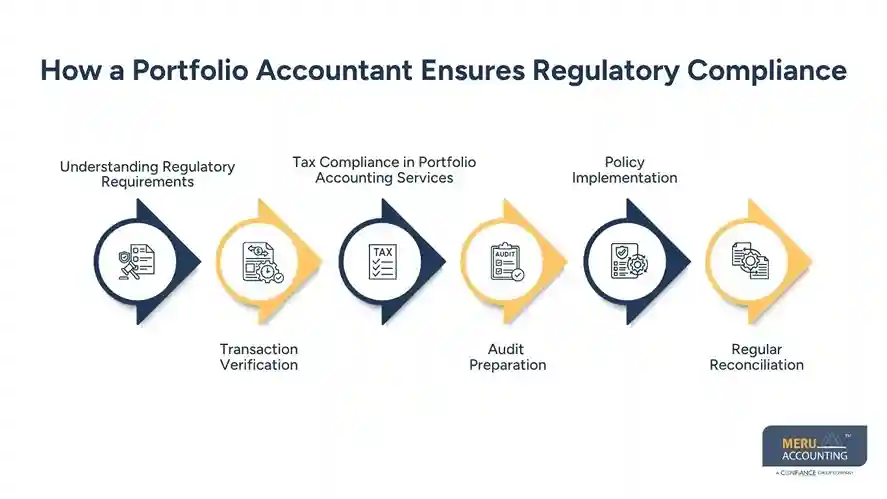
Audit Preparation
Accurate records are maintained for both internal and external audits. Organized documentation simplifies the audit process and strengthens financial credibility.
Policy Implementation
Internal compliance policies are implemented to ensure that all investment activities follow legal and ethical standards. Regular updates to policies keep operations aligned with current regulations.
Regular Reconciliation
Accounts are reconciled frequently to ensure that portfolio data matches bank statements, broker statements, and internal ledgers. Consistent reconciliation prevents discrepancies and maintains financial accuracy.
Challenges in Maintaining Compliance in Complex Portfolios
Multiple Asset Classes
Complex portfolios include equities, bonds, derivatives, and alternative assets. Each asset class has unique reporting and compliance requirements, which is why professional portfolio accounting services can provide the specialized oversight needed to manage these diverse investments.
Regulatory Changes
Regulations can change frequently, requiring accountants to adapt quickly and update reporting methods. Staying informed about updates is essential to prevent compliance gaps.
Data Accuracy
Large portfolios generate massive amounts of data. Ensuring accuracy in such volumes can be difficult without structured processes. Even small errors can affect reporting and decision-making.
Time Constraints
Investment managers require timely reporting. Accountants must balance thorough compliance checks with tight deadlines. Efficient processes are necessary to meet reporting timelines without sacrificing accuracy.
Cross-Border Investments
International investments bring challenges related to tax laws, foreign regulations, and currency management. Portfolio accounting services help navigate these complexities, ensuring compliance across jurisdictions and reducing cross-border risks.
Coordination with Multiple Teams
Accountants often coordinate with auditors, risk managers, and fund managers, requiring strong collaboration skills. Clear communication across teams is critical to maintain consistent compliance.
Best Practices Followed by an Expert Portfolio Accountant
Maintaining Updated Knowledge
Continuous learning about regulations, market trends, and accounting standards is essential for compliance. Regular training also helps accountants stay prepared for industry changes.
Systematic Documentation
Keeping clear and organized records helps track investments and supports regulatory audits efficiently. Proper documentation also reduces the risk of missing important financial details.
Regular Reconciliation
Frequent reconciliation of accounts ensures errors are identified and corrected promptly, reducing risk. Consistent reviews also maintain the accuracy of financial statements.
Clear Communication
Regular updates to management and stakeholders ensure transparency and build trust. Clear communication also supports faster decision-making during financial reviews.
Technology Utilization
Using accounting software and portfolio management tools increases accuracy, reduces manual errors, and provides audit-ready records. Advanced tools also allow faster access to financial data when needed.
Conducting Internal Reviews
Periodic internal checks help identify gaps in compliance and prevent regulatory issues before they arise. Early reviews also strengthen overall financial control within the portfolio.
Why Businesses Rely on Professional Portfolio Accounting Services
Expertise in Compliance
Professional services provide specialized knowledge in complex regulations, ensuring portfolios remain compliant. Industry expertise also reduces the risk of missing important regulatory updates.
Reduced Risk of Errors
Experienced portfolio accountants minimize mistakes that could lead to penalties or financial loss. Accurate financial handling also strengthens investor confidence and reporting reliability.
Cost Efficiency
Outsourcing portfolio accounting can be more cost-effective than hiring full-time internal teams for small to mid-sized firms. Businesses can also reduce expenses related to training and software management.
Time Savings
Delegating portfolio accounting frees investment managers to focus on strategy rather than administrative tasks. Faster reporting processes also support timely business decisions.
Tailored Services
Portfolio accounting services can be customized to suit the size, complexity, and structure of an investment portfolio. Flexible solutions allow businesses to scale services as investment activities grow.
Reliable Reporting
Professional services ensure timely, accurate, and comprehensive reporting for internal and external stakeholders. Consistent reporting also supports better transparency and financial planning.
How Automation Improves Compliance Efficiency in Portfolio Management
Automated Transaction Recording
Accounting software logs every trade automatically, reducing manual entry errors. Automated recording also saves time during reconciliation and reporting processes.
Real-Time Monitoring
Automated tools provide instant insights into portfolio performance, ensuring immediate detection of discrepancies. Quick access to data allows faster response to compliance issues.
Consistent Reporting Standards
Automation ensures reports follow uniform formats aligned with regulatory requirements. Standardized reporting also reduces confusion during audits and reviews.
Tax Calculations
Automated systems can calculate tax obligations accurately, reducing errors and delays. Faster tax processing also supports timely filing and compliance management.
Alert Systems
Software can flag unusual activities, helping portfolio accountants address potential compliance breaches promptly. Early alerts reduce the risk of larger financial or regulatory issues.
Integration Across Platforms
Automation tools can synchronize data across accounting, portfolio management, and banking platforms, reducing reconciliation issues. Connected systems also provide better visibility into overall financial activities.
Meru Accounting’s Portfolio Accounting Services
Specialized Expertise
At Meru Accounting, our team of certified portfolio accountants handles complex investment portfolios across industries and regions. Our experts bring years of experience in managing diverse asset types and regulatory requirements.
Tailored Compliance Solutions
We customize our services according to portfolio size, asset classes, and regulatory frameworks, ensuring full compliance. Personalized solutions allow us to meet the unique needs of each client effectively.
Technology-Driven Accuracy
We use advanced accounting and portfolio management tools to maintain accurate records and provide timely reports. Automation and software integration also minimize errors and streamline data management.
Transparent Reporting
Our clients receive detailed, audit-ready reports that demonstrate compliance and performance metrics clearly. Clear reporting builds trust and supports informed investment decisions.
Ongoing Support
Meru Accounting provides continuous support, from daily transaction monitoring to annual audit preparation, ensuring stress-free portfolio management. Our team is always available to address client queries and provide guidance.
Global Reach
We serve clients across the US and other international markets, managing compliance with local and international regulations efficiently. Our global expertise ensures seamless handling of cross-border investments and multi-jurisdictional compliance.
Our Expert Perspective
At Meru Accounting, our experience in managing complex investment portfolios has shown that strong compliance practices are essential for financial accuracy and long-term stability. By combining industry expertise with advanced technology, our team ensures accurate reporting, transparent records, and proper regulatory compliance, allowing businesses to manage investments with greater confidence and reduced financial risk.
Key Takeaways
- Portfolio accountants ensure compliance with financial regulations for every investment.
- They manage transactions, valuations, tax calculations, and audits accurately.
- Complex portfolios pose challenges like multiple asset classes and cross-border investments.
- Best practices include regular reconciliation, clear communication, and systematic documentation.
- Automation and professional services reduce errors, save time, and maintain regulatory standards.
- Meru Accounting offers specialized, technology-driven, and globally compliant portfolio accounting services.
FAQs
A portfolio accountant manages and records all investment transactions, calculates asset values, and ensures compliance with regulations.
Compliance ensures that investments follow legal standards, preventing fines, penalties, or financial loss.
Automation reduces manual errors, speeds up reporting, and provides real-time monitoring of transactions and compliance.
Yes, professional services are tailored to portfolios of any size, ensuring accurate management and regulatory compliance.
Portfolio accountants face challenges like managing multiple asset classes, handling large data sets, and keeping up with changing regulations.