
Many businesses face delays in maintaining proper books, which raises a key question: what is backlog in accounting and why does it happen so often in daily operations? In simple terms, it refers to a situation where financial records are not updated on time, leaving several months of missing entries that must be corrected later. When this issue grows, companies often rely on structured clean-up methods like catch up bookkeeping to restore accuracy.
In practice, this is not only about missing entries but also about lost financial clarity, delayed reports, and weak decision-making. Businesses across the USA and other regions face this issue when transactions pile up faster than they are recorded. This is where a structured cleanup process becomes important to rebuild accurate financial data.
What You Will Learn From This Blog
- Meaning of what is backlog in accounting in simple terms
- The main reasons financial records fall behind
- Impact of delayed accounting on business health
- Difference between ongoing bookkeeping and catch up bookkeeping
- Step-by-step method used to clear accounting delays
- How experts like Meru Accounting manage cases related to backlog in accounting
- Real benefits of fixing accounting delays on time
What is Backlog in Accounting?
To understand what is backlog in accounting, it refers to a situation where financial transactions are not recorded for an extended period, resulting in missing, delayed, or incomplete financial data. Instead of viewing it as just unrecorded entries, it is better understood as a breakdown in the accounting flow that creates gaps between actual business activity and recorded books.
When this happens, businesses lose real-time financial visibility, which affects cash flow tracking, reporting accuracy, and decision-making. Over time, even small delays accumulate and turn into a significant accounting backlog that requires structured correction.
For example, a retail business may continue operating normally, but if invoices and expenses are not recorded for several months, the financial reports will not reflect actual performance. This can lead to incorrect profit estimation, tax filing issues, and difficulty in understanding business health. Such situations highlight why structured cleanup methods like catch up bookkeeping are used to restore financial accuracy and operational clarity.
Common Causes of Accounting Backlogs
High Transaction Volume
When daily transactions increase, record-keeping often falls behind. This is one of the most common reasons in growing firms, where entries accumulate faster than they are recorded.
Lack Of Skilled Staff
Small teams often struggle with accounting workload, which leads to delays in updating books. Over time, this creates gaps in financial records and later requires structured cleanup to correct and organize the missing data.
Manual Accounting Systems
Businesses using spreadsheets instead of accounting software face frequent delays in recording and tracking transactions. These limitations often lead to incomplete or outdated financial data.
Poor Internal Processes
Without a clear workflow for approvals and documentation, invoices and expenses remain unrecorded for long periods. This lack of structure slowly builds up accounting delays that affect overall financial accuracy.
Business Expansion
Rapid growth increases financial complexity, and without proper systems, structured cleanup becomes necessary. As transaction volume rises quickly, existing accounting processes often fail to keep pace with operational needs.
Impact of Accounting Backlogs on Business Operations
Cash Flow Confusion
- Cash inflow and outflow become unclear when records are not updated on time
- Financial decisions are made without a proper view of available funds
- Bank reconciliation also becomes difficult due to missing entries
- This creates uncertainty in day-to-day business planning
Tax Filing Issues
- Missing or delayed records often lead to incorrect tax calculations
- Businesses may face penalties or need to revise filed returns
- Compliance becomes stressful during tax season
- Understanding what is backlog in accounting helps identify why catch up bookkeeping is needed in such cases
Poor Financial Decisions
- Business planning is based on incomplete or outdated data
- Budgeting and forecasting become less reliable
- Owners may misjudge profits or expenses
- This increases the risk of financial instability
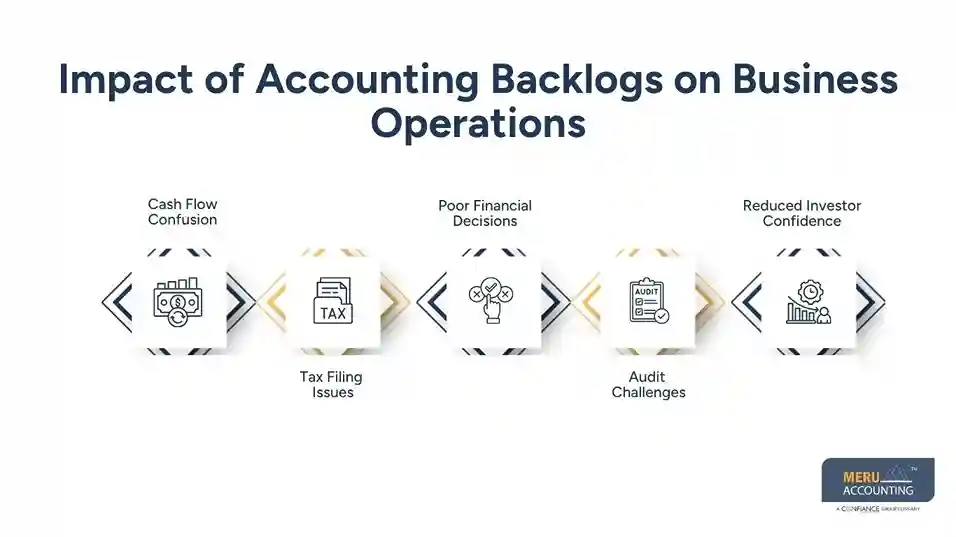
Audit Challenges
- Auditors need complete and organized financial records
- Backlogs increase time and effort during audit preparation
- Missing data can lead to audit queries and delays
- It also raises compliance pressure on the business
Reduced Investor Confidence
- Investors prefer businesses with clear and updated financial records
- Delayed accounting reduces trust in reported performance
- It becomes harder to attract funding or partnerships
- Transparency in financial data is negatively affected
Difference Between Ongoing Bookkeeping and Catch Up Bookkeeping
Aspect | Ongoing Bookkeeping | Catch Up Bookkeeping |
Process | Records financial transactions daily or weekly as business activity happens. | Rebuilds and updates missed financial records for past weeks or months. |
Purpose | Keeps books continuously updated and prevents delays. | Restores accuracy in accounts where records were not maintained on time. |
Timing | Continuous and ongoing throughout the year. | Used after delays or gaps have already occurred. |
Cost | Generally lower due to regular maintenance of records. | Higher due to the correction of the accumulated backlog work. |
Risk Level | Maintains low risk by ensuring timely updates. | Used in higher-risk situations where records are incomplete or missing. |
Step-By-Step Process To Clear Accounting Backlogs
Data Collection Phase
All bank statements, invoices, and receipts are collected to understand what is backlog in accounting size. Complete data gathering ensures no financial document is missed during the cleanup process.
Sorting Transactions
Transactions are categorized into income, expense, and adjustments. Proper classification ensures every financial entry is placed under the correct head before further processing.
Reconciliation Process
Bank accounts are matched with records using catch up bookkeeping methods. Matching transactions confirms that financial data aligns with actual bank activity.
Error Correction
Missing or duplicate entries are corrected carefully. Accurate correction removes inconsistencies and improves the overall reliability of financial records.
Final Review
Financial reports are reviewed to ensure accuracy and compliance. Final verification confirms the readiness of books for reporting, taxation, and business analysis.
Supporting Document Verification
Supporting documents such as invoices, bills, and receipts are checked against recorded entries. Verification ensures every transaction carries valid proof and aligns with accounting records.
Historical Data Reconstruction
Missing months of financial data are rebuilt using available bank statements and source documents. Reconstruction restores clarity in records affected by backlog situations.
Adjustment Entries Posting
Required adjustment entries are recorded to correct timing differences and accounting mismatches. Adjustment entries ensure financial statements reflect accurate business activity.
Management Reporting Preparation
Cleaned financial data is organized into structured reports for management review. Structured reporting helps stakeholders understand true financial performance after backlog clearance.
Benefits of Resolving Accounting Backlogs
Better Financial Clarity
Clearing accounting delays gives a true view of business performance. To understand what is backlog in accounting, clear financial records play an important role in showing accurate profit, expenses, and cash flow.
Timely Tax Filing
Clean books make tax filing faster and more accurate. Properly updated records reduce errors and lower the risk of penalties or revisions.
Strong Decision Making
Updated data allows better planning and budgeting. Management can rely on correct figures instead of estimates for financial decisions.
Improved Compliance
Regulatory requirements are easier to meet with proper bookkeeping cleanup. Well-maintained records support smooth audits and compliance checks.
Reduced Financial Stress
Business owners gain confidence when books are up to date. Clear financial records reduce uncertainty and improve control over business operations.
How Professional Services Help Manage Accounting Backlogs
Expert Handling of Data
To understand what is backlog in accounting, professionals carefully review financial records to locate missing or delayed entries. This structured review helps ensure all financial gaps are identified and corrected with accuracy.
Use of Accounting Software
Advanced tools make catch up bookkeeping faster and more accurate. Automation features reduce manual work and improve consistency in financial reporting.
Error Detection Skills
Experts identify mistakes that are often missed internally. Careful analysis helps uncover duplicate entries, missing transactions, and posting errors.
Time-Saving Process
Outsourcing reduces internal workload significantly. Businesses can focus on core operations while experts manage financial clean-up work.
Compliance Assurance
Professional teams ensure financial records meet legal standards. Proper documentation and reporting support smooth tax filing and audit readiness.
How Meru Accounting Helps Businesses Fix Backlogs
Meru Accounting provides structured support for businesses facing accounting backlog challenges and helps in understanding what is backlog in accounting through practical cleanup of financial records. Our team specializes in restoring delayed financial data using reliable catch up bookkeeping systems designed for US and global clients.
We work with tools like QuickBooks, Xero, and Odoo to clean and update books with accuracy. Businesses facing months of delay often rely on our bookkeeping cleanup services to bring their accounts back on track. Our team ensures that delayed record situations are handled with clear steps, proper reconciliation, and audit-ready outputs.
With over years of experience, Meru Accounting has supported companies in retail, IT, real estate, and service sectors to resolve backlog cases efficiently.
Key Takeaways
- Accounting backlog refers to missing or delayed financial records in business books
- Backlogs create tax, cash flow, and reporting issues for business operations
- Structured cleanup methods are used to fix missing financial data gaps
- Regular bookkeeping prevents backlog formation in accounting systems
- Professional help ensures accurate financial recovery and reporting quality
- Timely action reduces long-term financial risk in business management
FAQs
Financial records remain unupdated for a certain period, leading to missing or incomplete data in the books.
Workload pressure, shortage of staff, and weak accounting systems are the main reasons behind delays in bookkeeping.
No, software helps organize data but cannot fully fix missing or incorrect records without review.
Yes, incorrect or delayed records can lead to filing errors, penalties, and compliance issues during tax season.
Accounting software like QuickBooks, Xero, and Odoo helps organize data, reduce manual errors, and speed up financial cleanup processes.