
Catchup bookkeeping is the process of updating old or delayed financial records so that all accounts reflect accurate and current information. It involves organizing invoices, bank entries, and expense data that were not recorded on time, ensuring financial records are complete and reliable.
For CPA firms, catchup bookkeeping plays a critical role in restoring order in client accounts when records are left incomplete for extended periods. It helps teams regain visibility over financial data and prepare accurate reports without disruptions in workflow.
The process typically begins with collecting and organizing financial documents, followed by systematic review and classification of entries. Each transaction is then validated for accuracy and aligned with supporting records before final reporting.
This structured approach ensures CPA firms work with complete financial data, improving consistency in reporting and enabling smoother operational planning.
What You Will Learn From This Blog
- What catchup bookkeeping means in simple terms
- Why CPA firms often face client backlog issues
- How clean-up work reduces pressure on accounting teams
- Ways firms can improve client handling speed
- Impact of delayed records on firm output
- Methods to manage high-risk clients better
- How firms can scale service delivery using structured accounting work
- How expert support can reduce workload pressure
Introduction To Catchup Bookkeeping
Catchup bookkeeping is the process of updating old or delayed financial records so that all accounts reflect accurate and current information. It involves organizing invoices, bank entries, and expense data that were not recorded on time, ensuring nothing is missing or misplaced in the books.
For CPA firms, the core purpose of catchup work, or catch up accounting, is to reduce pending tasks that block normal accounting operations. It is commonly used when clients fall behind in maintaining records for months or even years, helping restore clarity in financial systems and reducing confusion in reporting cycles.
The process usually begins with collecting and sorting financial data, followed by classification and correction of entries.
Each record is verified for accuracy and reconciled with bank statements before final reporting. This structured approach ensures firms always work with complete data, which strengthens financial planning and builds long-term trust between CPA firms and their clients.
Why CPA Firms Face Client Backlogs
Irregular Client Submissions
Many clients often fail to submit financial records on time. Gaps appear in monthly and yearly accounting cycles frequently. CPA teams face pressure to complete work within shorter timelines.
High Volume During Tax Seasons
Tax season brings a sharp increase in workload for CPA firms. Firms receive bulk documents at once, creating sudden backlog situations. Teams struggle while processing everything within strict filing deadlines.
Limited Internal Capacity
Some CPA firms operate with very small accounting teams. Rising workload often exceeds what internal staff can handle together. Delayed processing of important financial records becomes a common outcome.
Poor Record Keeping By Clients
Clients often maintain incomplete or poorly organized financial records, increasing reliance on catch up accounting support. Missing invoices and unclear expenses slow accounting processes significantly. Extra time goes into corrections and detailed data verification work.
Frequent Changes In Compliance Rules
Accounting rules and reporting standards change frequently across regions. Firms must update old records to match new compliance requirements. Additional backlog pressure builds up and slows routine operations.
How Catchup Bookkeeping Helps CPA Firms Clear Client Backlogs
Structured Data Collection
Financial catchup bookkeeping begins with gathering all missing documents from clients to ensure records are complete before processing. Bank statements, invoices, and expense records are collected in one place. A clear structure reduces confusion during later accounting stages.
Organized Record Sorting
Collected financial data is sorted by time period and account type. Proper sorting makes it easier to identify missing or delayed entries. Duplicate entries are reduced through systematic classification methods.
Error Identification And Fixing
Old records are reviewed carefully to find incorrect or missing entries. Errors are corrected to maintain accuracy in financial statements. Clean data reduces mismatch issues during reporting and audits.
Bank Reconciliation Process
Transactions are matched with corresponding bank records step by step in a catch up accounting reconciliation process. Unmatched entries are adjusted after careful review and verification. Accurate reconciliation ensures strong financial record consistency.
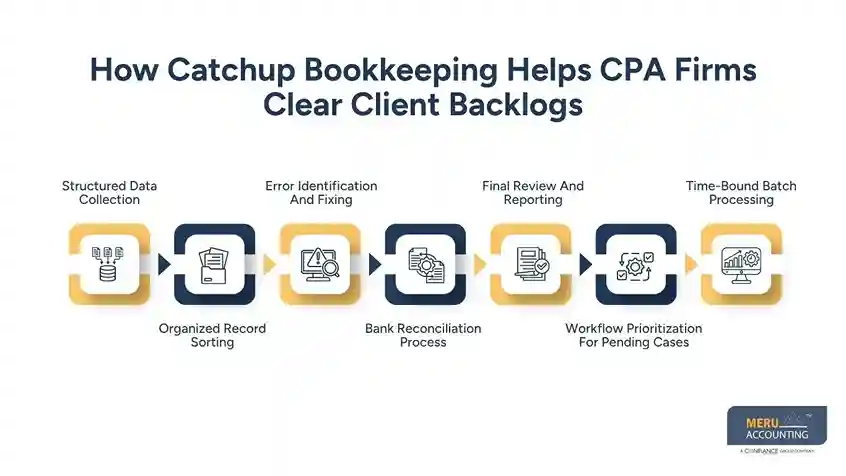
Final Review And Reporting
Updated records are reviewed thoroughly before final financial reporting. CPA firms use corrected reports for tax filing and advisory work. Reliable outputs ensure smoother delivery to clients without delays.
Workflow Prioritization For Pending Cases
Pending client files are prioritized based on urgency and complexity level. High-risk or deadline-driven cases are addressed before routine work. Structured prioritization reduces overall backlog pressure across teams.
Time-Bound Batch Processing
Large volumes of records are handled in controlled processing batches. Each batch is completed within defined time frames for consistency. Batch processing ensures steady progress without overwhelming accounting teams.
How CPA Firms Scale Using Catchup Bookkeeping Services
Handling More Clients Efficiently
Structured financial clean-up work and catch up accounting processes allow CPA firms to manage a larger client base without increasing confusion in operations. Teams are no longer blocked by long-pending files and can move steadily through active assignments.
Reducing Internal Workload Pressure
Organized catchup bookkeeping processes reduce pressure on internal accounting teams by separating old records from current tasks. Staff members can focus more on ongoing client work instead of constantly resolving past issues.
Improving Turnaround Time
Clean and updated financial records from catch up accounting reduce the time needed for corrections and adjustments. Reports can be prepared faster since most inconsistencies are already resolved during the catch-up process.
Better Resource Allocation
CPA firms can assign skilled professionals to complex financial analysis while dedicated teams handle catch-up tasks separately. This ensures better use of internal talent and improves overall output quality.
Stronger Client Retention
Clients prefer firms that maintain accuracy and deliver reports on time without repeated delays. Structured catch-up work reduces missed deadlines and builds stronger long-term client relationships.
How Backlogged Financial Records Impact CPA Firm Productivity
Delayed Reporting Cycles
Financial records remaining unupdated slow down reporting cycles significantly, especially when catch up accounting processes are not implemented on time.
Tax filing and advisory tasks get pushed forward, creating pressure on both firms and clients. Compliance risks also increase due to late submissions and incomplete data.
Increased Staff Pressure
Accounting teams often handle both current work and pending backlogs together. Dual workload increases pressure and reduces focus on daily tasks. The chances of errors in financial processing rise under such conditions.
Reduced Work Quality
Overloaded teams may overlook small but important details in financial reports. Accuracy gets affected, leading to possible client dissatisfaction. Maintaining consistent quality becomes difficult under heavy workload conditions.
Missed Deadlines
Backlogs frequently cause delays in meeting important submission timelines, which increases dependency on catch up accounting work. Missed deadlines can result in penalties and loss of client confidence. A firm’s reputation may suffer over time due to repeated delays.
Lower Growth Potential
Teams spending most of their time clearing old records experience slower new client onboarding. Growth opportunities are reduced due to limited operational capacity. Expansion becomes harder when backlog work dominates daily operations.
How To Prioritize High-Risk Clients In Catchup Bookkeeping Projects
Identifying Risk Levels
Clients with large gaps in financial records or missing data fall under high-risk categories in catch up accounting workflows. These cases require immediate attention to avoid compliance issues and reporting delays. Proper risk assessment helps CPA firms set clear priorities.
Sorting By Deadline Pressure
Clients with urgent filing deadlines need faster processing compared to routine cases. Work allocation based on time sensitivity ensures critical submissions are completed on schedule. Structured sorting improves control over workload distribution.
Segmenting Workload By Complexity
Simple cases can be completed quickly, while complex records require deeper review and more time. Dividing tasks based on difficulty helps maintain steady progress across all files. Balanced segmentation also prevents operational bottlenecks.
Assigning Skilled Staff First
In catchup bookkeeping projects, experienced accounting professionals should handle complex or high-risk cases first for better accuracy.
Skilled handling reduces the chances of errors and improves accuracy in financial reporting. Less complex tasks can be managed by junior staff members.
Monitoring Progress Regularly
Regular tracking of ongoing files ensures no client work remains delayed for long periods. Continuous monitoring supports steady workflow movement across all categories. Strong oversight improves overall control and delivery consistency.
How Meru Accounting Supports CPA Firms in Catchup Bookkeeping Work
Meru Accounting supports CPA firms in catchup work by providing structured financial clean-up and bookkeeping assistance designed to handle large client backlogs.
Our dedicated clean-up teams work through old and delayed records using a step-by-step process, which reduces pressure on in-house CPA staff while improving overall speed and efficiency.
We also work across multiple accounting systems such as Xero, QuickBooks, and others, ensuring smooth handling of different client environments without data disruption.
In addition, we manage high volumes of pending records through structured batch processing, helping CPA firms clear backlogs more quickly during peak periods.
Every transaction is carefully reviewed by our team during catch up accounting to maintain accuracy and compliance, reducing risks during audits and tax filings.
With our support designed for CPA firms across the US, UK, and other global regions, we make cross-border accounting and backlog management significantly easier and more reliable.
Our Expert Perspective
We see catchup bookkeeping as a critical operational layer that helps CPA firms regain control over fragmented and delayed financial data. In our experience, firms that adopt structured clean-up workflows consistently reduce turnaround time and improve reporting accuracy across client portfolios. A disciplined approach to backlog management not only stabilizes day-to-day operations but also strengthens overall client trust and service consistency.
Key Takeaways
- Catchup work brings delayed financial records back to order
- CPA firms face a backlog due to client delays and high workload
- Structured clean-up in catch up accounting improves speed and accuracy
- Proper prioritization reduces compliance risk
- External support can improve a firm’s capacity and growth
- Clear financial records improve client trust and reporting quality
FAQs
Catchup bookkeeping refers to the process of updating old or missing financial records so accounts become accurate and current.
CPA firms rely on catchup bookkeeping to manage delayed client records and reduce backlog pressure during busy seasons.
Yes, updated financial records reduce correction time and help produce reports faster with higher accuracy.
Yes, small CPA firms use catchup bookkeeping to manage workload better and handle more clients without operational stress.
The time depends on how large and complex the records are. Small cases may take a few days, while larger multi-year records can take several weeks.