



Understanding how taxes work is key to smart financial planning. A consumption tax is charged when you buy goods or services, while an income tax applies to the money you earn. These taxes help fund things like schools and roads. Some countries rely more on one than the other. When comparing Consumption Tax vs Income Tax, it’s important to understand how each affects your daily expenses and earnings. It also gives you more control over how you save, spend, and plan during tax season.
Introduction to Consumption Tax and Income Tax
Governments use many tools to collect money, and taxes are the main one. Consumption Tax and Income Tax are the two most commonly used tax types. Each plays a role in funding public services, like schools, roads, and hospitals. Though they seem similar, their impact and design differ a lot.
What Is a Consumption Tax?
A consumption tax is charged when you buy goods or services. It gets added when you pay for the item. You pay it without much effort, and it’s already part of your bill.
Types of Consumption Tax
- Sales Tax: Added on top of the price in most parts of the U.S. It is added at checkout and varies by location.
- GST (Goods and Services Tax): Used in countries like Australia and Canada. It applies to most goods and services sold domestically.
- VAT (Value-Added Tax): Common in Europe, it taxes value added at each stage of the supply chain. It helps ensure tax is collected at multiple stages.
These taxes are easy to track. They grow with more spending and shrink when people spend less.
What Is Income Tax?
Income tax is paid on what you earn. It can come from jobs, businesses, or savings. It is often taken from your paycheck or filed yearly.
Who Pays Income Tax?
- Workers with regular jobs: They pay tax directly from wages through payroll.
- Business owners: They pay income tax on the profit left after business costs.
- Freelancers and self-employed: They file their income tax returns based on earnings, which may change monthly.
Governments use this money for long-term needs like health care, defense, and welfare.
Difference Between Income Tax and Consumption Tax
Comparing consumption tax vs income tax reveals several key differences that affect how we earn, spend, and report.
Tax Base
Feature | Income Tax | Consumption Tax |
Basis | Charged with the money earned | Charged when you buy goods or use services |
Source | Taken from salary, business profits, or investments | Added at the point of sale or purchase |
Who Pays | Earners: salaried, business, or self-employed | All consumers who buy goods or services |
Control Level | Based on personal income levels | The same rate often applies regardless of income level |
Example | Monthly payroll tax or annual return | GST or sales tax at stores and online shops |
Timing
Feature | Income Tax | Consumption Tax |
Payment Period | Yearly or monthly through salary deductions | Paid instantly during each purchase |
Collection Time | After income is earned | At the time of the transaction |
Method | Via employer or self-reporting | Automatically charged at checkout |
Frequency | Periodic, based on earnings | Ongoing, every taxable purchase |
Adjustment | Based on income changes and tax brackets | Flat and rarely adjusted by personal income |
Effect on Behavior
Feature | Income Tax | Consumption Tax |
Work Motivation | High tax rates may reduce the drive to earn more | Spending may fall if taxes on goods and services increase |
Saving Habit | Can impact disposable income | Encourages saving by taxing spending, not earnings |
Business Impact | May lower profits and reduce reinvestment | Paying less income tax leaves more money to build the business |
Lifestyle Choices | May influence job decisions and income declaration | Affects what and when people buy |
Policy Influence | More progressive and tied to income levels | Flat rate, seen as fairer in structure |
Advantages of Consumption Tax Over Income Tax
There are times when consumption tax and income tax show clear pros and cons. Let’s see why some experts prefer a consumption-based system.
Easy to Track
The tax is included at the sales point. Businesses record it in systems. This makes it easy for authorities to track and match tax collections and returns.
Less Avoidance
It is collected at the time of purchase. Shoppers cannot skip paying for it. This reduces the chances of fraud and increases the reliability of revenue collection.
Promotes Saving
Tax is only paid when someone spends money. This setup helps people save more by delaying non-essential spending and thinking more before buying.Helps Business Flow
When income taxes are lower, businesses can reinvest more. This leads to hiring, expansion, and higher overall growth across markets.
For these reasons, some favor boosting the consumption tax vs the income tax in the long run.
Limitations of Consumption Tax Compared to Income Tax
While simple, consumption tax and income tax don’t affect everyone equally, so governments often use a mix of both.
Hits Low Earners More
People with lower incomes spend most of what they earn. A flat consumption tax takes a bigger share of their money than from wealthier people.
Basic Needs Still Taxed
Unless exempt, food, clothes, and medicine also have taxes. These add cost to daily needs and strain people with lower earnings.
Fewer Brackets
Income tax has many levels based on earnings. Consumption tax is often flat, so it doesn’t adjust for income differences across groups.
Needs Safety Nets
Governments may offer credits or refunds. These help low earners manage rising costs. Such policies try to balance fairness in tax systems.
When Is Consumption Tax More Effective Than Income Tax?
The effectiveness of consumption tax vs income tax often depends on a country’s goals and economic situation.
During Slow Growth
When job income drops, income tax falls too. Sales taxes bring in money even when the economy slows and incomes are weak.
In Tourism
Tourist-heavy places collect from visitors. Sales taxes on hotels, food, and shopping raise funds from people who use local services.
In Small Economies
In places with fewer formal jobs, tracking income is hard. Sales taxes work better. They’re simple and collected from a broader group.
Each type has its place. It’s about balance and timing.
Global Trends in Consumption Tax and Income Tax
Different nations use consumption tax and income tax in many ways. Some go heavy on one, while others mix both.
Europe
Countries in Europe lean more on VAT. The tax is collected in stages and brings stable revenue. VAT rates are usually around 20% or more.
US
The U.S. relies heavily on income tax. While there are sales taxes, they vary by state and are lower compared to many VAT systems.
Australia and Canada
Both use a mix. GST is standard, and income tax brackets vary. This helps maintain both fairness and stable tax collection.
Asia
Countries like Japan rely more on consumption taxes to support aging populations and reduce national debt. This trend is growing in Asia.
Choosing Between Consumption Tax and Income Tax: Policy Considerations
When governments weigh consumption tax vs income tax, they look at:
Revenue Needs
Sales taxes give a fast and stable income. Income taxes take longer to collect. Choosing depends on how soon the funds are needed.
Fairness
Income taxes rise with income, making them fairer. Sales taxes hit everyone equally, so additional policies are needed to help lower earners.
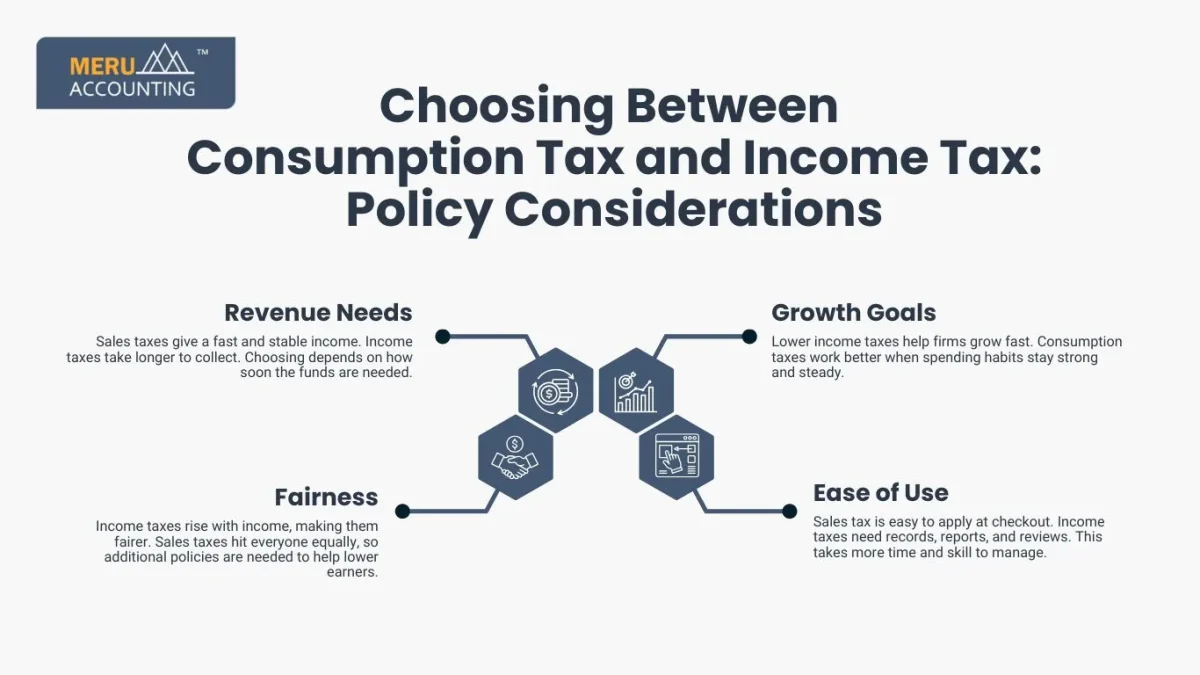
Ease of Use
Sales tax is easy to apply at checkout. Income taxes need records, reports, and reviews. This takes more time and skill to manage.
Growth Goals
Lower income taxes help firms grow fast. Consumption taxes work better when spending habits stay strong and steady.
At Meru Accounting, we provide comprehensive tax services that cover both personal and business needs. Our team delivers tailored solutions for planning, filing, and compliance, ensuring accuracy while optimizing savings. By managing your tax requirements, we help you focus on running your business or managing your finances with confidence.
FAQs
- What is the main difference between income tax and consumption tax?
Income tax is based on how much a person or business earns. Consumption tax is paid when buying goods or services. One is tied to income, the other to spending.
- Are consumption taxes fair to low-income earners?
Not always. Low earners spend most of their money. So, they often pay a bigger share of their income as consumption tax.
- Can a country rely only on a consumption tax?
It’s possible, but not ideal. Most countries use both taxes. A mix provides a steady income and spreads the tax burden more fairly.
- Why do some countries prefer income tax?
Income tax allows higher earners to pay more. It supports fairness in wealth distribution and helps fund services without burdening low earners too much.
- How do tax policies affect savings?
Consumption taxes promote saving. You pay tax only when you spend. Income tax, on the other hand, reduces what you can save from your earnings.
- Which tax is easier for the government to collect?
Consumption tax is often easier. It is charged at the point of sale. Income tax takes more effort due to reports and audits.


