
If you’re starting your business or studying business subjects, you may have come across the terms financial and managerial accounting. At first glance, they might seem tough. But with the right understanding, both can become easier to manage. This blog will break them down into simple steps so you can know what to expect and how to tackle each one.
What Is Financial Accounting?
Financial accounting is the part of accounting that keeps track of the money a business makes and spends. It helps record the company’s history in terms of numbers. Every sale, every expense, and every tax payment is recorded in a way that others can understand. This includes reports like profit and loss statements, cash flow statements, and balance sheets.
The main goal is to create reports that go outside the company. These reports are used by investors, banks, tax offices, and other outside parties. Because so many people rely on these reports, they must follow set rules. These rules are often called GAAP or IFRS, and they make sure the reports are fair and honest.
So, in simple terms, It records past actions and reports them in a format that others can trust. It’s all about being correct, clear, and honest.
What Is Managerial Accounting?
Managerial accounting, on the other hand, is more about the future than the past. It helps business owners and managers make better choices by giving them the right numbers at the right time. This type of accounting stays inside the company and helps with day-to-day tasks and long-term planning.
For example, managers use this accounting to make budgets and check if the company is meeting its goals. They also use it to compare the cost of products, control spending, and set prices. Each business can build its report formats based on what the managers need.
If a company wants to know which product brings in more money or which project is over budget, they use managerial accounting. The goal here is to guide smart choices and improve performance. While it may sound complex, it’s more about getting useful facts from your business data.
Key Differences: Financial vs. Managerial Accounting
Point of Difference | Financial Accounting | Managerial Accounting |
Purpose | Tracks past business activity | Helps plan and guide future actions |
Users of Reports | Used by people outside the business (investors, banks, etc.) | Used by managers and internal staff |
Rules and Standards | Follows strict rules like GAAP or IFRS | No set rules; reports are flexible |
Report Timing | Done monthly, quarterly, or yearly | Created daily, weekly, or as needed |
Report Format | Formal and standard | Custom and based on internal needs |
Focus | Focuses on the entire business | Focuses on parts of the business (like products or projects) |
Data Type | Uses historical (past) data | Uses both current and estimated data |
Accuracy Requirement | Must be very accurate and audit-ready | Good enough for internal use; speed is often more vital |
Decision Support | Supports investment and legal decisions | Supports operations and quick planning |
Nature of Information | More general and high-level | More detailed and specific |
Common Challenges in Financial Accounting and Managerial Accounting
Both accounting have their own sets of issues. Let’s look at what can make them hard.
Financial Accounting Challenges:
Staying Accurate
Even a small mistake in data entry can create large problems. Reports must be exact because they are shared with outsiders.
Rule Compliance
Following all the rules and formats (like GAAP or IFRS) can be tough, especially when the rules change often.
Audit Pressure
Financial reports often face audits. Any error can lead to big fines or legal issues.
Managerial Accounting Challenges:
Real-Time Data
Managers need up-to-date info. If the data is late, it loses value. Getting real-time numbers can be a big challenge.
Decision-Making Pressure
Managers must make smart choices using this data. If the reports are wrong or unclear, poor choices may be made.
Custom Reports
Since there are no set rules, every report must be built for a goal. Creating these tailored reports can take time and effort.
Why Some People Find Financial and Managerial Accounting Hard
Too Many Numbers
Both types of accounting involve a lot of numbers and formulas. This can be scary if you’re not a math person.
Complex Terms
Words like “depreciation,” “amortization,” or “variance analysis” can sound difficult at first. It’s not the math, but the terms that confuse people.
Lack of Practice
Many people do not get hands-on practice with accounting software. Reading is one thing, but doing it is what builds real skill.
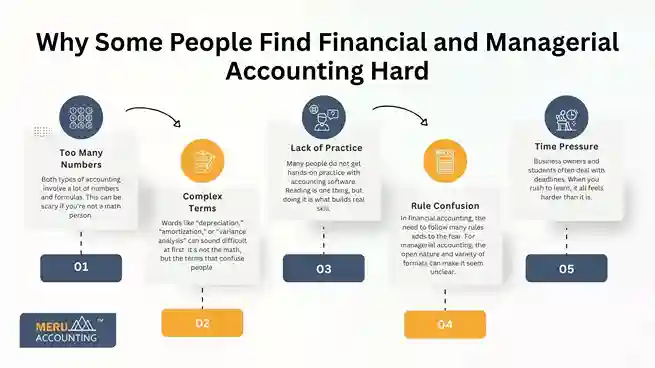
Rule Confusion
In financial accounting, the need to follow many rules adds to the fear. For managerial accounting, the open nature and variety of formats can make it seem unclear.
Time Pressure
Business owners and students often deal with deadlines. When you rush to learn, it all feels harder than it is.
Tips to Overcome Difficulties in Financial and Managerial Accounting
You don’t have to struggle forever. There are ways to make both types of accounting easier.
Start With the Basics
Build a strong base. Learn simple terms and what they mean. Once you know the basics, the rest becomes easier.
Use Good Software
Accounting tools like QuickBooks, Zoho Books, or Xero can help. They do the work for you and stop errors.
Take Short Courses
Many online platforms offer short, free, or paid courses for both financial accounting and managerial accounting. A few hours a week can build your skills.
Hire Expert Help
If you run a business and don’t enjoy accounting, get help. Bookkeepers or firms can handle your reports while you focus on your work.
Practice Often
The more you practice, the better you get. Try solving small case studies or building sample reports.
Stay Updated
Rules in financial accounting may change. New tools for managerial accounting come out often. Keep learning to stay ahead.
At Meru Accounting, we make accounting easy for small businesses. We handle both financial and managerial tasks with care and speed. Our experts give clear reports, smart insights, and full support. You save time, avoid stress, and focus more on growth.
FAQ
Is financial and managerial accounting the same?
No, they are not the same. Financial accounting tracks past business activity for outsiders. Managerial accounting helps firms plan ahead and make smart calls.- Why do people find accounting hard?
People find it hard because of rules, numbers, and terms. With the right help and steps, it feels much easier. - Can software help with accounting work?
Yes, many tools make accounting simple. You can track spending, check profits, and plan better with them. - How is managerial accounting used in daily business tasks?
It helps you plan spending, check goals, and control costs. You use it daily to guide smart business moves. - What if I make a mistake in financial accounting?
Mistakes can happen. It’s best to fix them fast and stay organized. A good accountant or tool can help you stay right.