
Managing payroll across several business locations is very difficult and also sometimes complicated to handle payroll for a single office. Different work schedules, state tax rules, and local labor regulations can create inconsistencies. Payroll outsourcing helps businesses standardize various demanding operations by using unified processes with reliable payroll systems. It helps with payroll accuracy and compliance with better client satisfaction.
As businesses expand, payroll becomes more complex. Understanding the pros and cons of outsourcing payroll helps decision-makers identify the good solutions and strategies needed. This blog explains how payroll outsourcing supports consistency and also reduces compliance risks with improved payroll management for growing firms.
What You Will Learn From This Blog
- About payroll outsourcing and how it improves payroll consistency.
- How businesses face payroll challenges.
- Explore the pros and cons of outsourcing payroll.
- Related to standardized payroll processes and how it improves compliance.
- Learn how payroll technology supports business growth.
- The benefits of working with payroll specialists.
What Is Payroll Outsourcing?
Understanding Payroll Outsourcing
Payroll outsourcing is the process of assigning payroll responsibilities to a specialized and specific service provider. Rather than processing it internally, businesses rely on experienced payroll professionals to calculate wages, manage tax deductions, process direct deposits, and many more. It helps businesses reduce administrative work with enhanced accuracy.
Why Businesses Choose Payroll Outsourcing
Many organizations operate across multiple offices, warehouses, retail outlets, or project sites. Each location may have different payroll requirements, employee classifications, complex overtime rules that are complex,or various other obligations. Helping businesses to standardize payroll processes instead of maintaining different payroll practices is needed. Understanding the pros and cons of outsourcing payroll also helps businesses evaluate whether outsourcing meets up to the present goals.
Common Payroll Challenges for Multi-Location Businesses
Businesses with multiple locations often experience delays in the processes, inconsistent calculations with payroll, along with reporting differences. Manual payroll processing also increases compliance risks. It also enhances administration risks. Payroll outsourcing provides standardized workflows that improve consistency. It supports finance and HR teams to focus on strategic business responsibilities.
Pros and Cons of Outsourcing Payroll
Outsourcing payroll helps businesses simplify payroll administration while improving accuracy that is required. However, like any business decision, it comes with both advantages and considerations that have their effects.
Pros
- Saves time by eliminating manual payroll calculations and supports administrative tasks
- Improves payroll accuracy and reduces the risk of errors and such issues
- Helps maintain compliance with changing tax laws.
- Reduces the need for in-house payroll resources.
- Ensures employees receive accurate and timely salary payments.
- Delivers secure payroll record management and confidential employee data handling.
- Gives management more time to focus on business growth that is needed
Cons
- Businesses have less direct control over day-to-day payroll processing.
- Service costs may increase as workforce size and complexity grow.
- Payroll providers require timely and accurate employee information to avoid delays.
Why Payroll Outsourcing Improves Standardized Payroll Operations
Standardized Payroll Processes Across Every Location
One of the biggest advantages of outsourcing is standardization. Every employee follows the same payroll workflow without any location concerns. Payroll calculations, tax deductions, and payment schedules remain consistent. This reduces payroll confusion while improving internal controls.
Better Compliance With Payroll Regulations
Payroll laws frequently change across different states and regions. Multi-location businesses must comply with varying tax requirements, wage regulations, and employee benefit obligations. While reviewing the pros and cons of outsourcing payroll, many organizations find regulatory compliance highly advantageous.
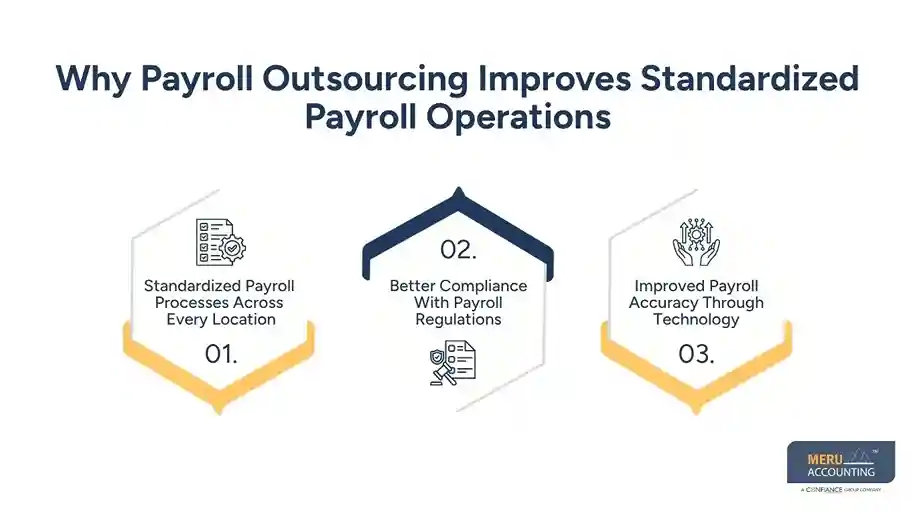
Improved Payroll Accuracy Through Technology
Modern payroll platforms automate many repetitive payroll tasks that are demanding. Automated calculations reduce errors along with improved payroll accuracy. Outsourcing providers also perform quality checks before payroll is finalized. This helps businesses avoid costly payroll corrections that are productive.
A centralized payroll approach also provides better visibility into labor costs across all locations. Finance and HR teams can access consolidated payroll reports, monitor workforce expenses, and make informed decisions using consistent data. As the business expands into new regions or opens additional offices, standardized payroll processes make onboarding new employees and managing payroll significantly more efficient.
By outsourcing payroll to an experienced provider, multi-location businesses can simplify complex payroll operations, strengthen compliance, reduce administrative burden, and create a consistent payroll experience for employees across every branch. This allows leadership teams to focus on business growth while ensuring payroll remains accurate, efficient, and fully aligned with organizational policies.
Why Standardized Payroll Operations Matter
Managing payroll across multiple locations gets complex as businesses grow. Different branches have varied schedules, employee types, taxes, and deadlines. Without standard processes, there is an increase in errors and other issues. Payroll outsourcing centralizes all payroll tasks into one system. This creates better policies, approvals, and reports across various locations. It improves accuracy and ensures employees are paid correctly and on time everywhere.
How Payroll Outsourcing Supports Business Growth
Supports Business Expansion Without Increasing Payroll Complexity
Business growth often brings more employees, new offices, and additional payroll responsibilities. Payroll management becomes difficult as operations expand. Outsourcing allows businesses to handle higher payroll volumes without increasing internal workload. Standardized payroll systems support new locations with quality. When evaluating the pros and cons of outsourcing payroll, scalability is often one of the strongest advantages for the fastest growth of the business.
Provides Better Payroll Reporting and Financial Visibility
Payroll information supports budgeting, workforce planning, and financial reporting. Multi-location businesses require consistent payroll reports from every office. Outsourcing providers generate standardized reports that give management a complete view of payroll expenses, taxes, overtime, and employee costs. Reliable payroll data helps business leaders make informed financial decisions while improving operational planning.
Improves Employee Experience Across All Locations
Employees expect timely and accurate salary payments regardless of where they work. Payroll errors reduce employee confidence and increase HR queries. Outsourcing improves payment accuracy, maintains consistent payroll schedules, and gives employees reliable access to payroll records. Businesses reviewing the pros and cons of outsourcing payroll often recognize employee satisfaction as an important long-term benefit.
Choosing The Right Payroll Outsourcing Partner
Evaluate Industry Experience And Compliance Knowledge
Not every payroll provider has experience supporting multi-location firms. Organizations should select a provider with proven knowledge of payroll regulations along with tax compliance and employee classifications. Outsourcing works best when the provider understands industry-specific payroll challenges with changing scenarios.
Look For Secure Payroll Technology
Payroll data contains sensitive employee information. Businesses should verify that payroll providers maintain secure systems, better encryptions with data and regular security monitoring. Reliable outsourcing providers also maintain backup systems and disaster recovery plans to protect payroll information. While reviewing the pros and cons of outsourcing payroll, businesses should carefully evaluate security standards that help at various levels.
Choose Flexible Services That Grow With Your Business
Payroll requirements change as businesses expand into new locations. A payroll provider should offer flexible services that support business growth without requiring major process changes. Payroll outsourcing becomes more valuable when providers can handle additional changing workforce structures through one standardized system.
Why Choose Meru Accounting For Payroll Outsourcing?
Managing payroll across many locations can be tough. It needs clear processes and good payroll systems. At Meru Accounting, we make payroll simple and accurate. Our experts use modern technology to handle payroll tasks. We manage calculations, taxes, deductions, reports, and employee records carefully.
We know payroll rules change often. Our team stays updated to keep you compliant. We also give advice to make payroll easier and faster. Whether you have two offices or many, we support your business growth. We work closely with your finance and HR teams. Together, we keep your payroll smooth and consistent.
Our Expert Perspective
Many businesses think payroll software causes most payroll problems. But often, inconsistent payroll processes are the real issue. We often find companies using different methods at various locations. This leads to reporting errors and compliance risks.
Standard payroll processes with skilled professionals boost payroll accuracy. Businesses should weigh outsourcing benefits beyond just cost savings. A well-run payroll system ensures compliance, builds employee trust, and aids financial planning for the future.
Key Takeaways
- Payroll outsourcing makes payroll the same across all locations.
- Consistent processes help payroll stay accurate and clear.
- Centralized payroll is good for businesses in many places.
- Payroll technology cuts down on manual mistakes.
- Experienced payroll pros make compliance easier.
- Knowing outsourcing pros and cons helps you decide well.
- Standard payroll reports help with financial planning.
- Secure systems keep employee information safe.
- Flexible payroll services grow with your business.
FAQs
Payroll outsourcing means hiring experts outside your company to handle payroll. It improves accuracy and compliance and saves time.
Outsourcing makes payroll the same at all locations. It reduces errors and helps follow different rules easily.
Outsourcing improves payroll accuracy and cuts admin work. But businesses must check provider trust, security, and costs first.
Yes, outsourcing works well for small and growing businesses. It keeps payroll simple as the business grows.
Choose a provider with experience, good technology, and strong security. Also, look for flexible services and helpful support.
optional anymore
on running the business