
Corporate real estate is one of the biggest cost areas for large companies. It includes offices, warehouses, retail locations, and other spaces used for daily business work. Managing these assets is not only about building care. It is also about planning, cost control, and long-term business support in a clear and steady way. In large enterprises, real estate choices affect cash flow, team output, and overall growth. This is why leaders often ask – What is corporate real estate management, and how can it improve business results in a real and practical way.
Today, many companies are moving away from fully in-house setups. They are using flexible models like corporate real estate outsourcing to reduce cost pressure and improve focus on core work. This shift is growing fast across global firms. It also helps teams work with more clarity and less stress. Understanding what is corporate real estate management is becoming more important because companies now operate across more locations and need tighter cost control than before.
This blog explains what corporate real estate management is, why it matters in large firms, key challenges, and why outsourcing is becoming more important over time through corporate real estate outsourcing models.
What You Will Learn From This Blog
In this blog, you will learn:
- What does corporate real estate management mean in large firms
- How knowing “what is corporate real estate management” helps in real business operations
- Key parts of real estate work and planning
- Why it matters for growth and cost control
- Common issues companies face in this area
- Why corporate real estate outsourcing is growing fast
- How Meru Accounting supports real estate needs
You will also get a clearer view of how real estate connects to daily business work and how corporate real estate management supports better financial control over time.
What is Corporate Real Estate Management?
To understand what is corporate real estate management, it is the process of planning, managing, and improving all property assets that a company uses for work. In simple terms, corporate real estate management helps companies control how they use space and how much they spend on it.
These assets include offices, warehouses, retail stores, factories, and other work sites. The goal is to make sure each space fits business needs while keeping costs under control in a steady and planned way. In large companies, corporate real estate management is not basic facility work. It is a core business function that connects finance, HR, operations, and leadership planning. It also supports long-term company goals in a direct way.
When companies clearly understand what is corporate real estate management, they can make better choices about space use, cost planning, and expansion.
Corporate real estate management helps companies:
- Reduce unused space
- Lower rent and upkeep costs
- Improve employee work conditions
- Follow local property rules
- Plan future space needs based on growth
It also helps turn real estate into a managed business asset instead of just a fixed cost that keeps growing without control.
When done well, it improves efficiency, cost balance, and planning. When done poorly, it leads to waste, confusion, and higher long-term costs that build up over time.
Key Components of Corporate Real Estate Management
Corporate real estate management has several connected parts that work together in a simple but important system.
Portfolio Management
This is tracking all company properties in one system. Large firms often operate in many regions, so clear visibility is very important for control and planning. It is a key part of understanding what is corporate real estate management in reality.
Lease Administration
This includes managing lease contracts, rent payments, renewal dates, and terms. Small misses here can lead to large cost issues over time.
Space Planning and Allocation
Companies must plan how much space each team needs. Poor planning can lead to empty space or crowded work areas. Both situations increase cost or reduce comfort.
Facilities Management
This includes cleaning, repairs, safety checks, and daily building operations. It keeps work sites safe and ready for daily use.
Cost Management
Real estate costs include rent, taxes, utilities, and upkeep. Managing these costs is a key part of corporate real estate management and overall financial control.
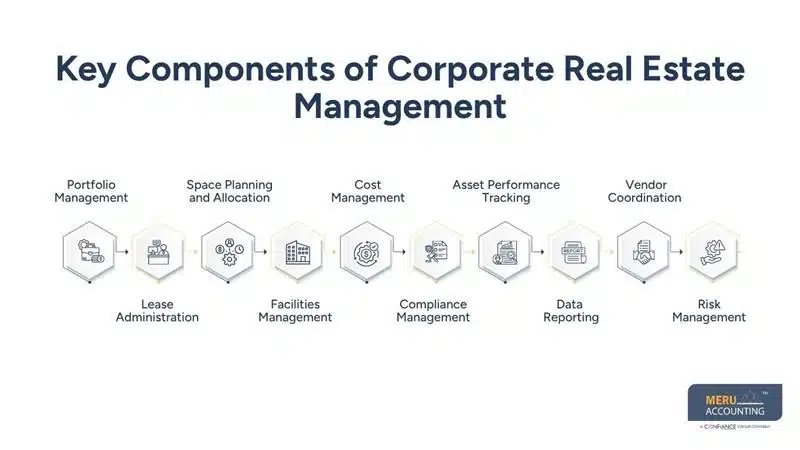
Compliance Management
Each region has different rules. Companies must follow them to avoid legal and financial risk.
Asset Performance Tracking
This shows how each property performs in cost, use, and value. It helps leaders decide if a site should stay, grow, or be reduced.
Data Reporting
Reports and dashboards help leaders see cost and usage clearly. This is often improved through real estate outsourcing systems.
Vendor Coordination
Many sites use outside vendors for cleaning, repair, and security. Managing these vendors well helps keep quality stable across locations.
Risk Management
This helps identify lease risks, cost risks, or unused space early. It supports better planning and reduces surprises.
All these parts work together to support better control and clear decision-making in corporate real estate management.
The Importance of Corporate Real Estate Management in Large Enterprises
Large companies depend heavily on real estate for daily work. If corporate real estate management is not handled well, costs can rise fast and performance can drop over time.
One key reason firms study what is corporate real estate management is cost control. Real estate is often one of the highest fixed costs in large firms.
Strong corporate real estate management helps companies:
- Cut unused property costs
- Improve space use across teams
- Support hybrid and remote work models
- Avoid lease and legal risks
- Improve planning with clear data
It also helps companies stay flexible. As needs change, space needs also change. A strong system makes it easier to adjust without waste or delay.
Without proper corporate real estate management, companies may keep paying for unused space or enter long leases that no longer fit business needs.
This is also where real estate outsourcing becomes useful, as it helps improve control and reduce long-term cost pressure.
Common Challenges Faced by Large Enterprises in Managing Corporate Real Estate
Even large firms face many real estate challenges in daily operations when corporate real estate management is not structured well.
- No Central Visibility: Many companies work in many locations. Without one system, tracking becomes hard and slow.
- Rising Costs: Rent, taxes, and upkeep costs keep increasing each year. Without strong corporate real estate management, this becomes a heavy burden.
- Low Space Use: Many offices are not fully used due to hybrid work models. This leads to wasted cost and poor efficiency.
- Complex Leases: Different contracts across regions make tracking difficult. This increases the need for better systems or corporate real estate outsourcing.
- Compliance Risk: Each region has different rules. This increases legal and financial risk if not managed well.
- Lack of Experts: Many companies do not have dedicated corporate real estate management teams.
- Data Gaps: Without real-time data, planning becomes weak and slow.
- Slow Decisions: Poor data leads to slow and unclear decisions.
- No Standard Process: Different regions follow different methods, which creates inconsistency.
- Limited Forecasting: Companies often struggle to plan future space needs with accuracy.
These issues grow as companies expand and make corporate real estate outsourcing more important.
Why Corporate Real Estate Outsourcing is Becoming Essential
Many companies are now turning to outsourcing to handle these growing challenges. The demand for corporate real estate outsourcing is rising due to global growth, cost pressure, and complex property setups.
Outsourcing helps companies improve control without increasing internal workload.
- Lower Costs: Experts help reduce waste and unused space, improving cost control.
- Skilled Support: Outsourcing teams bring strong knowledge in leases, markets, and compliance.
- Better Tools: Many providers use modern systems for tracking and reporting corporate real estate data.
- Focus on Core Work: Internal teams can focus on finance and growth instead of managing real estate operations.
- Flexible Setup: Real estate outsourcing can scale with company needs.
- Lower Risk: Experts help reduce legal and compliance issues.
- Faster Reports: Leaders get quick access to updated data.
- Better Planning: Accurate data improves forecasting and space planning.
- Standard Process: One system across regions improves control.
- Better Efficiency: Workflows become smoother and more consistent.
Because of these benefits, real estate outsourcing is now a key part of modern enterprise strategy.
Meru Accounting’s Corporate Real Estate Outsourcing Services
At Meru Accounting, we help large companies manage corporate real estate in a simple, clear, and cost-effective way through structured corporate real estate outsourcing support.
Our services reduce workload, improve visibility, and support better control across all property assets.
We provide:
- Lease tracking and management support
- Real estate cost monitoring and reporting
- Property data cleanup and structuring
- Compliance and document support
- Space utilization tracking and insights
- Leadership dashboards and reporting
- Multi-location portfolio support
- Regular updates and performance reports
Our goal is to make corporate real estate management simple, clear, and easy to control.
With our support, companies reduce manual work, avoid costly mistakes, and gain full visibility across their real estate portfolio. This helps leaders make faster, clearer, and more confident decisions.
Key Takeaways
- Corporate real estate management helps companies manage property assets, control costs, and support business goals.
- Key areas include lease management, space planning, cost tracking, compliance, and property performance monitoring.
- Strong real estate management improves efficiency, reduces waste, and supports better decision-making.
- Large enterprises often face challenges such as rising costs, low space utilization, complex leases, and compliance risks.
- Corporate real estate outsourcing provides expert support, better technology, and standardized processes.
- Outsourcing helps companies reduce workload, improve reporting, lower risks, and focus on core operations.
FAQs
It is the process of managing company property in a way that supports work and controls cost.
It helps reduce costs, improve space use, and support long-term business planning and growth.
It brings expert support, reduces cost, improves speed, and simplifies property management.
It includes lease work, space planning, cost control, compliance, reporting, and asset tracking.
Yes, especially for companies with many locations or high property costs.